5 SaaS Financial Statement Red Flags, Updated for 2026




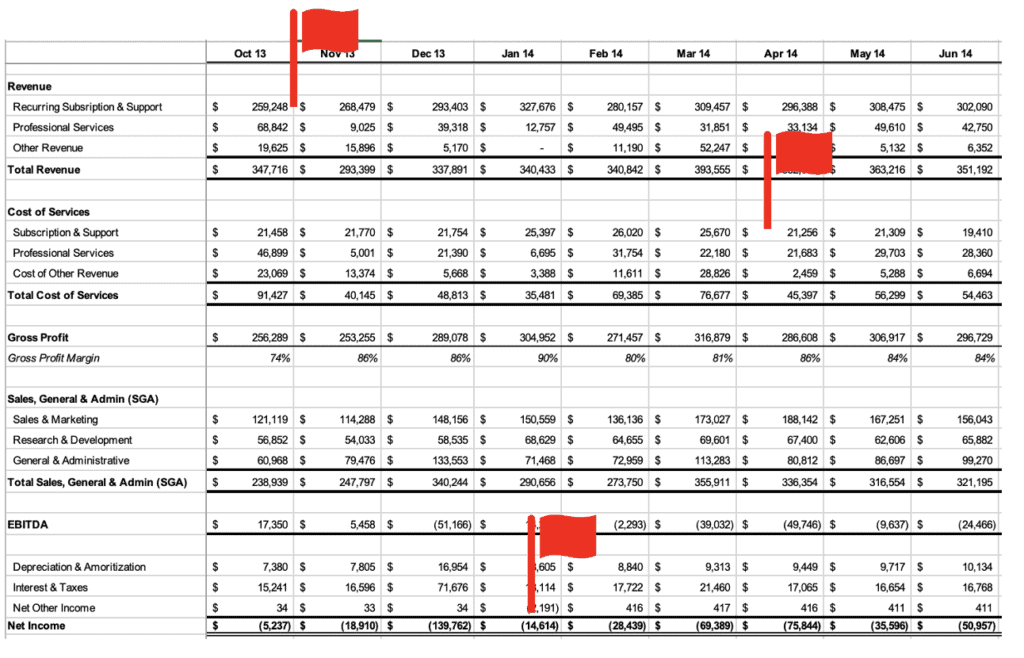
I have reviewed the financial statements of over a thousand SaaS companies, and here are my red flags (updated in May 2026).
- Poor gross margin definition and calculation
- A mix of cash and accrual accounting
- No/slow bank reconciliations
- Disconnected income statement, balance sheet, and cash flow
- Disconnected MRR report
Poor SaaS Gross Margin Definition and Cloud Cost Allocation
With the rise of AI, boards and investors are scrutinizing gross margins much more closely. Simply dumping your AWS bill into COGS no longer cuts it.
If you are delivering an AI product or module, finance needs to sit with engineering and truly understand which cloud costs are directly supporting the production environment and which belong in R&D.
Most often, the cloud bill can be directly mapped to one category or another, but sometimes allocations are required.
Investors care where expenses are categorized. COGS are considered part of the core business model, while operating expenses are considered more discretionary. If you overstate COGS, you will directly reduce your company’s valuation and lower your odds for raising capital.
Mixing Cash and Accrual Accounting in SaaS Financials
Cash accounting in SaaS makes revenue data noisy and calculating metrics difficult, but it’s manageable and “clean”. Accrual accounting smooths revenue and is better for metrics, but it is subject to revenue recognition errors and can hide cash flow issues.
Surprisingly often, I find companies using a mix of cash and accrual accounting. It’s a bad idea. I recently had a client who deferred revenue on large contracts but not others. They received three term sheets for a capital raise, but all the deals eventually fell away as diligence stalled amid efforts to decipher the P&L.
Slow or Missing Bank Reconciliations That Undermine Financial Accuracy
Bank reconciliations are a cornerstone of validating the integrity of the financial statements. All debits and credits must eventually be tied to the cash in your bank account. That is the beauty of double-entry accounting. Ignore this process at your peril.
I had TWO portfolio companies fall behind on reconciling cash, and the results were disastrous. The financials had to be restated, the CFO’s fired, and each company failed, in part, due to a lack of faith in the accounting. This is not a “nice to have.”
Disconnected Income Statement, Balance Sheet, and Cash Flow Statement
Income statements, balance sheets, and cash flow statements all fit together to tell a complete story. Companies that use ad hoc accounting methods often can’t generate all three reports, and that is a big red flag.
The cash flow statement is the most underused financial report in SaaS. For companies with pay-in-advance contracts, seasonality, or debt, cash flow statements often tell a different story from the P&L.
Check out Todd Gardner’s on demand webinar with Maxio
Learn more about financial reporting red flags and how to avoid them.

MRR Reports That Do Not Reconcile to the Financial Statements
An MRR report that is not integrated with the accounting system is also a red flag. Revenue on the income statement is tied to cash and validated. A disconnected MRR report that can’t be reconciled to the P&L lacks a natural cross-check and is more often than not, incorrect.
A separate MRR report is fine, but it must be reconciled to the financial statements..
Tools and Talent: The Backbone of Financial Hygiene
Tools and systems help support accurate and timely financial statements, but also require experienced people. Some of the worst financial reporting I have ever seen came from NetSuite systems because the finance people did not know how to use them.
My hope for AI in finance is that many of the problem areas I outlined above will be automated and streamlined, so finance can focus more on analyzing the numbers rather than producing them.
That said, the priority for a finance team should always be: good numbers first, analysis second.
My worst experiences in SaaS finance have stemmed from “high-level” CFOs who focused on M&A and strategy but failed to deliver accurate, timely financial statements.