Metering for AI Agents: How to Turn Agent Usage into Predictable Revenue




When you buy Microsoft Office, you pay per seat. One person, one license, one monthly charge. That logic works because the software is used by humans, one at a time, and value maps reasonably well to access.
Now picture an AI agent that processes thousands of support tickets overnight. No human triggered those interactions. Nobody logged in. The agent worked autonomously, at a scale that has nothing to do with how many seats the account holds.
Seat-based pricing was built for the first scenario. A growing share of AI products look like the second one. The companies moving fastest are the ones that have updated their monetization model to match.
How AI Agents Create Value
AI agents execute tasks across systems without requiring users to drive each interaction. They ingest data, make decisions, take action, and produce outputs on a schedule or in response to triggers, not in response to someone clicking a button.
The value they deliver scales with the work they perform. A customer with a small team might run an agent that automates thousands of tasks per month. Another with twice as many seats might use agentic features lightly. Under seat-based pricing, those two customers pay similar rates. Under consumption-based pricing, the first pays in proportion to what they’re getting, and the second gets a price point that reflects their actual usage.
That second dynamic is also good for acquisition. Consumption-based entry points lower the barrier for customers who are not yet sure how heavily they’ll rely on the product. They start small, see value, and grow into higher spend naturally.
The Real Cost of Seat-Based Pricing
Seat pricing measures access rather than output. For agentic AI, those two things have a weakening relationship.
A customer running hundreds of automated workflows pays the same as one who logs in occasionally. From a billing perspective, they look identical. From a value delivery and infrastructure cost perspective, they are not. That gap grows over time as customers deepen their use of agents, and by the time a vendor tries to close it, customers have built budget expectations around the original model.
That mismatch is worst on the accounts you’d most want to protect. Customers with smaller teams but high automation intensity are often getting the most value, but seat pricing has no way to see that. Because their bill is driven by headcount, not usage, they can look unremarkable on paper next to a larger account that barely touches the agent. That’s a visibility problem as much as a pricing one: without a usage-based signal, it’s hard to know who your best customers actually are, let alone build a retention or expansion strategy around them.
There is an internal cost, too. When revenue does not grow as agent usage grows, the incentive to invest in agent reliability, capability, and performance weakens. Consumption-based pricing ties revenue to product performance and aligns the whole organization around making the product more valuable.
What to Meter
The right metering approach for agentic AI focuses on the work the system performs rather than the people who have access to it. What that looks like in practice depends on the product.
Tasks automated and agent executions. For platforms where agents complete discrete tasks, such as responding to tickets, processing documents, or triggering workflows, task or execution count is a natural value metric. It scales directly with adoption and is straightforward for customers to verify.
Workflow runs and model inference requests. For orchestration platforms where a single customer interaction involves many underlying steps, metering at the workflow or inference level captures a meaningful unit of value while keeping billing comprehensible.
Output volume. For generative AI features where the product produces content, decisions, or analysis, output volume works well when customers have a clear sense of what that output is worth.
Across all of these, a reliable value metric is easy for customers to understand, grows naturally as they get more from the product, and can be measured consistently. When those three things are true, pricing feels fair. When they’re not, customers either look for ways to game the metric or lose confidence in their bills.
The Hybrid Path
Moving from seat-based to consumption-based pricing does not have to be a hard cutover. Many companies land on hybrid models that combine a base subscription or minimum commitment with usage-based components.
Pure pay-as-you-go introduces revenue variability that complicates forecasting, especially early in a transition. A subscription floor creates predictable revenue while still letting consumption-based revenue grow with usage. In enterprise contexts, minimum commitments also give procurement teams the committed spend figure they need to get budgets approved.
The key is letting the consumption metric carry the weight. An AI agent platform that adds a per-execution overage on top of a seat-based structure is an improvement, but it still anchors the primary pricing signal to the wrong thing. The better model uses the subscription component as a floor, not as the core pricing logic.
Customer communication is part of getting this right. Transitions work best when customers understand exactly how usage will be measured, what their bill would look like based on current consumption, and how they can monitor usage going forward. Treat it as a transparency exercise. The companies that do come out of the transition with stronger customer relationships.
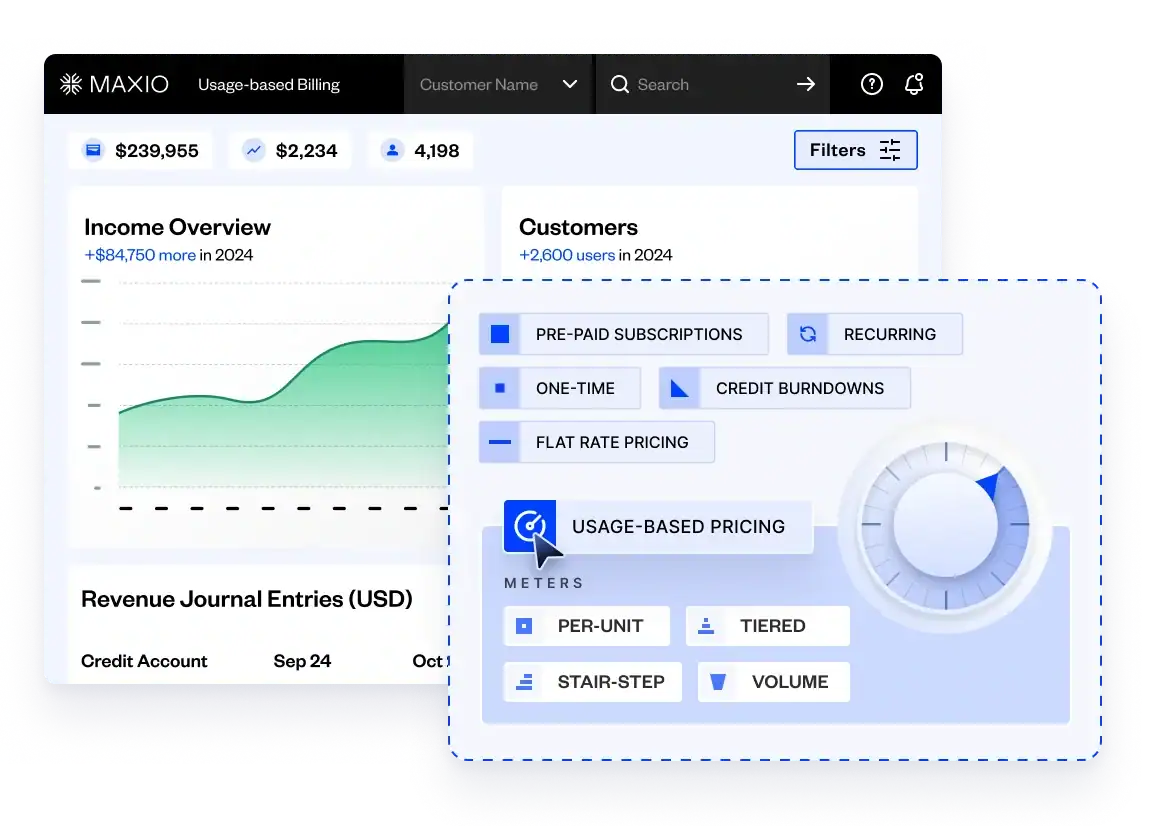
Ready to meter AI agent usage and turn it into predictable revenue? See how Maxio supports consumption-based pricing for AI-native and AI-enabled SaaS.