Orb Billing vs. Maxio: The Finance Buyer’s Guide to Scalable Usage Billing

Every SaaS company eventually outgrows flat-rate pricing. What starts as simple, predictable billing evolves into usage-based everything—a more dynamic, data-driven way to capture value as customers grow.
Orb Billing makes usage-based pricing look easy. Spin up a new metric, launch a plan, push it to production, and you’re live in minutes. But those minutes quickly multiply into millions of usage events—and someone has to turn that data into revenue.
Product says, “We just want flexibility.” Finance says, “We just want numbers that match.” Somewhere between those two sentences lies a mountain of CSVs.
That’s the moment when usage billing stops being a pricing problem and becomes a finance problem.
Key takeaway: Orb Billing gives developers freedom. Maxio gives finance teams control.
This isn’t a teardown of Orb—it’s a reality check for finance leaders who’ve inherited developer-driven billing systems. Orb delivers incredible flexibility, but flexibility without structure eventually collapses under its own data.
Let’s look at where Orb shines, where it breaks for Finance, and how Maxio turns that data chaos into clarity.
Why Orb Works (Until It Doesn’t)
Orb is an elegant, developer-first usage billing system.
If you’re on the Product or Engineering side, it feels like freedom. You can meter anything—API calls, minutes streamed, seats used, bytes stored—through simple APIs and clear documentation. You can test, iterate, and launch new pricing fast.
But while that flexibility is a dream for Product, it’s a nightmare for Finance.
Because Orb was never built for Finance—it’s a metering layer, not a financial system. When your billing logic lives inside code instead of contracts, accuracy becomes optional.
Where Orb Shines
- Flexible usage metering: APIs for any imaginable metric—from calls and transactions to seats or storage.
- Rapid iteration: Launch, test, and refine pricing without engineering bottlenecks.
- Developer-first design: Clean documentation, logical data models, and speed.
Orb is everything developers want. But for Finance? It’s everything they dread.
Where Orb Breaks for Finance
- No native revenue recognition: Finance is left translating usage logs into journal entries with spreadsheets.
- Data fragmentation: Billing logic lives in code, not your CRM or ERP. There’s no unified source of truth.
- Limited auditability: No policy evidence, no change tracking, no clear handoff to Finance.
- Metrics without context: ARR, NRR, churn—they exist, but not in a contract-driven framework.
- Usage ≠ revenue: Metering precision doesn’t equal financial accuracy. The more data you collect, the more Finance has to clean up.
Orb gives developers freedom, but it leaves Finance with the fallout.
That’s where Maxio steps in. Maxio keeps the flexibility that Product loves—but brings the structure, visibility, and compliance Finance demands.
The Usage Maturity Curve: From Experiment to Audit
No one plans to overcomplicate billing—it just happens.
It starts with one usage-based plan. It works. Then Sales wants custom deals, Product wants hybrid pricing, and suddenly there are 14 pricing models, 9 “special” contracts, and a reconciliation spreadsheet only one person understands.
Congratulations—you’ve built a growth engine and a reconciliation nightmare.
Usage billing doesn’t fail all at once. It fails in stages.
| Stage | Experience | What It Looks Like | Fix |
| 1. The Experiment | Stripe + Orb + Sheets | Product-led pricing freedom, Finance drowning in exports. | Automate usage → revenue flow. |
| 2. The Reconciliation Loop | Orb + BI tools + manual RevRec | Endless back-and-forth between Product and Finance. | Centralize contracts + data. |
| 3. The Unified Model | Maxio | Metering, rating, invoicing, and RevRec in one system. | Finance-led clarity. |
Stage 1 feels fast. Stage 2 feels painful. Stage 3 finally feels scalable.
Key takeaway: You don’t need to give up speed to gain accuracy—you just need systems designed for Finance.
Orb captures what happened. Maxio tells you what it means—financially, contractually, and auditably.
What Maxio Actually Changes
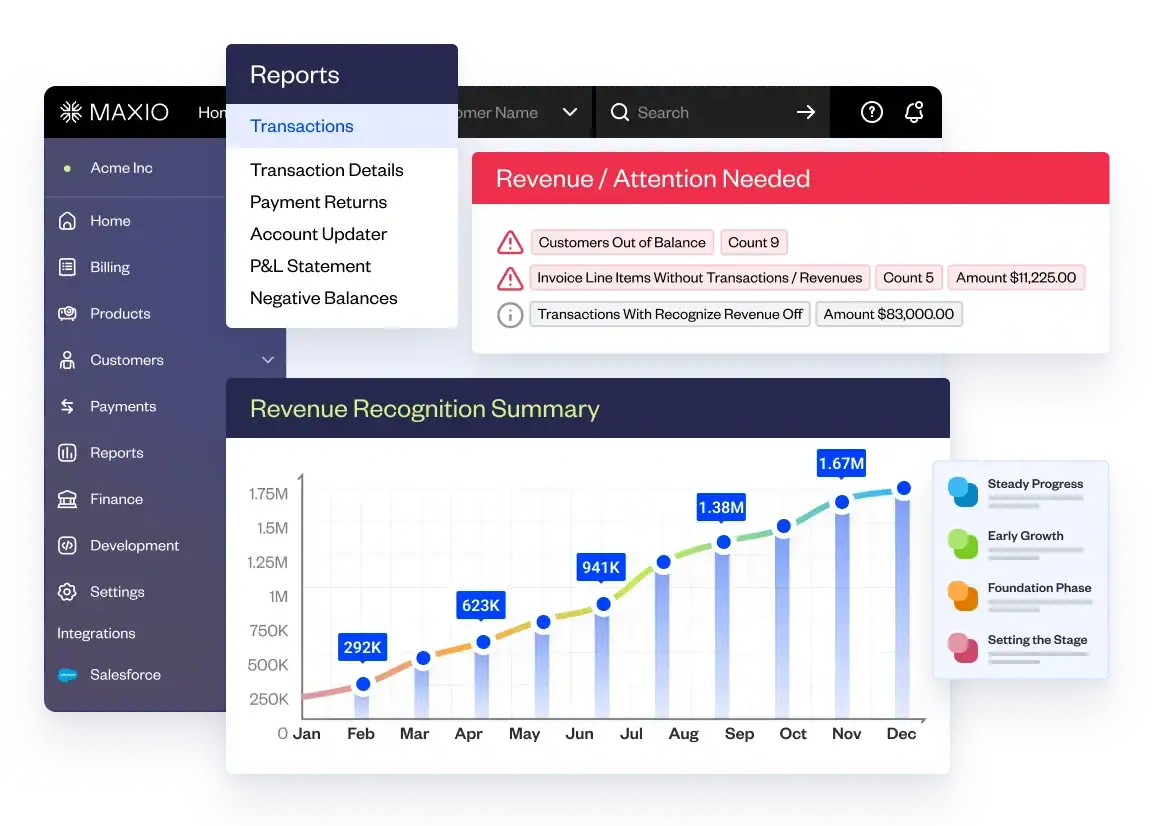
Maxio connects your usage data to your financial truth. No more reconciling exports or guessing what last month’s invoices should have been.
Every usage event can be traced from meter → invoice → revenue → report.
What That Looks Like in Practice
- Unified billing + RevRec: Usage events flow directly into ASC 606-compliant revenue schedules.
- Finance-grade rating and invoicing: Pricing logic lives where it belongs—in Finance’s hands, not code.
- Built-in auditability: Every event, credit, or adjustment is timestamped and traceable.
- Quote-to-cash alignment: Sales, Product, and Finance all see the same contract truth.
- Real-time SaaS metrics: ARR, NRR, churn, and expansion pulled directly from billing truth.
- Continuous experimentation: Product keeps iterating. Finance keeps closing on time.
Maxio doesn’t limit innovation—it makes it sustainable.
Orb vs. Maxio: Two Approaches to Usage Billing
Orb isn’t bad—it’s just built for a different audience. It’s a developer tool. Maxio is a finance system.
| Capability | Orb | Maxio |
| Metering and Usage Tracking | Event-level precision built for developers. | Integrates directly; keeps Orb as a data source if needed. |
| Rating and Invoicing | Developer-defined logic via APIs. | Finance-grade rules tied to contracts and compliance. |
| Revenue Recognition | Manual or external. | Native ASC 606 automation. |
| Data Ownership | Product and Engineering. | Finance-led, cross-functional visibility. |
| Audit Trail and Controls | Minimal. | Full event lineage from meter → ledger. |
| Change Agility | Fast but risky. | Fast and compliant. |
| Reporting and Metrics | Requires BI stitching. | 150+ SaaS metrics driven by billing truth. |
Orb gives you speed. Maxio gives you scale. One was built for experimentation. The other was built for accountability.
FAQs Finance Leaders Actually Ask
Do we have to replace Orb to use Maxio?
No. Maxio integrates with Orb to take usage data all the way to revenue recognition and reporting.
Think of it this way: Orb meters. Maxio monetizes.
Can Maxio handle complex usage logic?
Yes. Maxio supports per-seat, per-event, tiered, committed, or prepaid pricing—plus hybrids. Finance controls logic without custom code.
How difficult is integration?
Orb exposes clean usage data via API. Maxio ingests it and ties every event to contracts, invoices, and revenue schedules. Most teams see results in weeks.
What about audits?
Maxio was built for them. Every event, adjustment, and recognition entry is traceable and policy-backed.
Will Product lose flexibility?
Not at all. Maxio doesn’t constrain innovation—it ensures it scales without breaking Finance.
What’s the ROI?
Time saved, cleaner closes, and greater trust in your data. Finance stops chasing Product. Product stops waiting on Finance. Alignment becomes the default.
Should You Switch from Orb to Maxio?
If Orb got you here, it did its job. It helped you experiment fast. But there’s a point where flexibility turns into fragility—where data chaos stalls Finance and every close feels like a rescue mission.
That’s the moment to level up.
Maxio gives Finance the same control and precision that Orb gives developers. Together, they don’t just track usage—they turn it into revenue clarity.
See how Maxio transforms usage billing into revenue confidence. Schedule a demo.