
Zuora vs. Maxio: The Finance Buyer’s Guide to Smarter Scale



Enter yIf you’ve ever spent a quarter waiting for your billing system to finish implementing, this one’s for you.
Zuora is powerful. Maybe too powerful. What starts as enterprise-grade automation can quietly morph into a slow-moving maze of integrations, custom logic, and weekly stand-ups just to push an invoice out the door.
Somewhere along the way, the dream of no manual work turned into three new logins, a 200-page implementation doc, and a dedicated Slack channel.
The irony? Finance teams adopt systems like Zuora to gain control—but often end up with less of it.
You know the feeling:
- Reports that don’t quite match what’s in the ERP
- Billing rules buried behind configuration layers only IT understands
- Auditors asking questions you thought the system was supposed to answer
It’s not that Zuora doesn’t work. It’s that it works like an enterprise ERP—even when you’re not one.
Most SaaS finance teams don’t need a 12-month implementation plan. They need clean data, clear policies, and confidence that their billing system won’t require a project manager to adjust a contract term.
That’s where Maxio steps in.
This is a reality check for finance leaders who want control without needing a systems integrator. Let’s look at where Zuora shines, why it breaks for finance, and how Maxio gives you the same control—without the complexity tax.our blog content here.
Why Zuora Works (Until It Doesn’t)
Zuora is the backbone of some of the world’s largest subscription businesses: massive, multi-entity operations with global customers, custom pricing models, and teams of administrators to keep it all running smoothly.
If you’ve ever envied those teams, here’s the truth: they’re not smarter than you. They just have people—lots of them—dedicated to managing Zuora full-time.
For smaller, leaner SaaS finance teams, that same power starts to feel less like leverage and more like lift.
Where Zuora Shines
- Enterprise flexibility: Handles complex billing logic, global entities, and every imaginable contract variation.
- Automation depth: Manages renewals, usage charges, and proration—even edge cases that break most systems.
- Integration ecosystem: Connects Salesforce, NetSuite, and SAP into one enterprise-grade workflow.
When your company is operating across continents with thousands of customers, Zuora delivers exactly what it promises: scale, structure, and standardization.
But for everyone else? That enterprise-grade stack starts to show cracks.
Where Zuora Breaks for Growing SaaS Companies
- Implementation drag: Rollouts that take quarters, not weeks. By the time you go live, your pricing model has already changed.
- Engineering dependence: Every tweak—a new billing cadence, discount rule, or contract term—becomes a Jira ticket.
- Too heavy for mid-market SaaS: Without a full-time admin (or three), you’re operating in survival mode.
- Hidden costs: Professional services, custom scripts, and never-ending change requests.
- Fragmented data: Billing, RevPro, and analytics live in separate silos, leaving finance to reconcile across systems that don’t speak the same language.
Zuora isn’t broken—it’s just optimized for a world most SaaS finance teams don’t live in.
It’s the ERP of billing: industrial strength, endlessly configurable, and just as likely to need consultants as credentials.
Most SaaS businesses don’t need a system that can model 27 currencies and 300 revenue rules. They just need one that closes cleanly, reports accurately, and scales with their actual headcount. Maxio was built for finance teams that want the same control—without the overhead.
The Complexity Curve: When Automation Becomes Overhead
Every finance leader wants control. That’s why you bought automation in the first place.
But somewhere between the kickoff call and the third implementation sprint, the project stopped feeling like empowerment and started feeling like dependency.
You didn’t lose control—you just handed it to the system.
What used to be a clean policy document is now a maze of configuration objects. Your billing cadence lives in one module, your revenue rules in another, and your metrics—well, wherever your analyst managed to stitch them together last quarter.
And the irony? Every layer of enterprise-grade logic feels like a step closer to precision—until you realize you can’t change any of it without opening a ticket.
That’s the enterprise trap: complexity that masquerades as control.
The Complexity Curve
Here’s the uncomfortable truth: the more complex your billing system becomes, the less agile your finance team gets.
At first, automation is liberating—until you need a developer to adjust a rule. Then it’s just a prettier form of dependency.
Most SaaS companies fall somewhere along what we call The Complexity Curve. It starts simple, scales fast, then collapses under its own weight.
| Stage | Experience | What It Looks Like | Fix |
| 1. Manual Chaos | Stripe + Sheets | Disconnected billing, manual RevRec | Automate the basics |
| 2. Enterprise Overload | Zuora + consultants + custom code | Overbuilt, under-adopted, and expensive | Simplify architecture |
| 3. Finance-Led Clarity | Maxio | Unified billing + RevRec + metrics in one system | Finance owns automation |
In Stage 1, chaos looks obvious. In Stage 2, it’s dressed up in dashboards and acronyms, but it’s still chaos.
You’re running a sophisticated system, but you’re still reconciling reports by hand, still waiting for IT to deploy fixes, still hoping this month’s close doesn’t require a war room. That’s when automation becomes overhead.
Maxio exists to flatten that curve—to give finance the power of enterprise automation without the weight of enterprise processes.
What Maxio Actually Changes (Beyond ‘Automation’)
Every vendor promises automation. But automation isn’t the goal—it’s the byproduct of good design.
What finance really wants is clarity: a single system where billing, revenue, and reporting all agree on what happened. No duplicate logic. No missing data. No mysterious numbers appearing three days before the board meeting.
That’s what Maxio delivers.
Here’s What That Looks Like in Practice
- Finance-first design: No developer dependencies. Finance defines rules, policies, and workflows—and the system follows.
- Time to value: Implementation measured in weeks, not quarters.
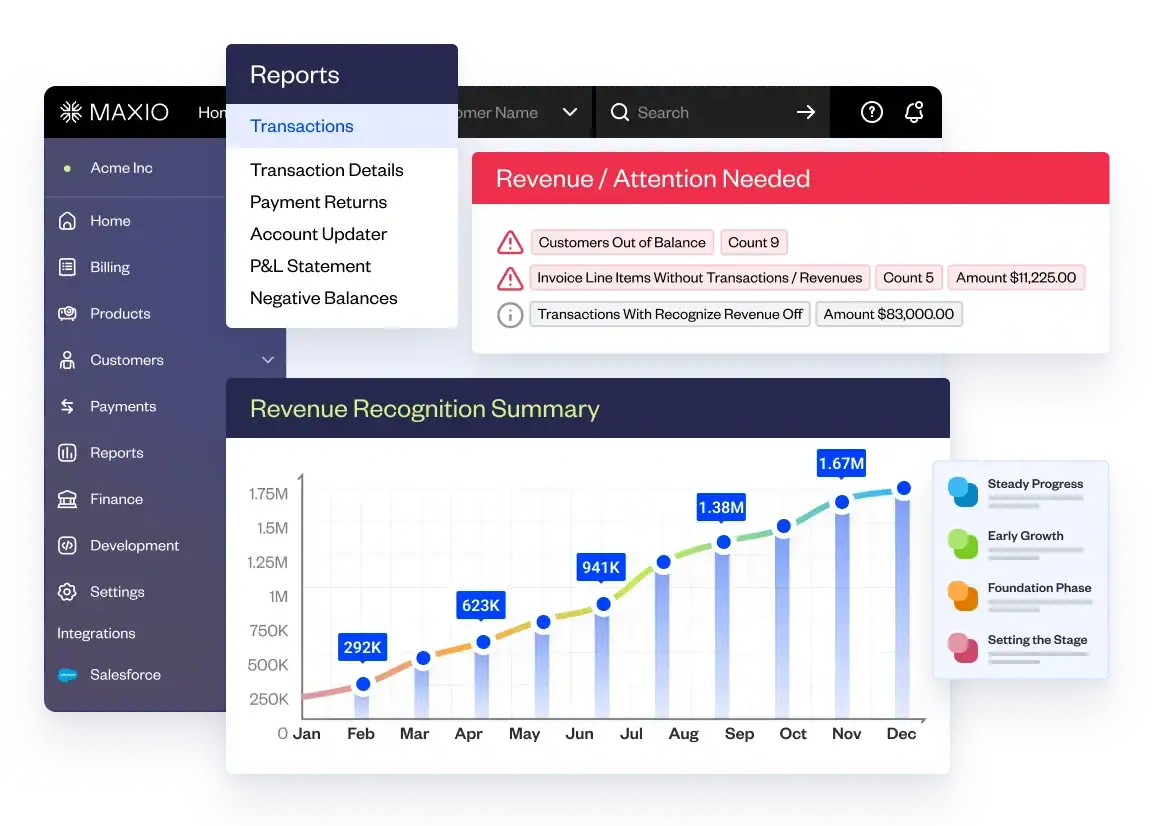
- Native revenue recognition: ASC 606 schedules tied directly to contract events—no exports, no guesswork.
- Quote-to-cash alignment: Sales, RevOps, and Finance operate on the same contract truth—no shadow billing.
- Usage and hybrid pricing: Metering, rating, and invoicing built for finance, not code.
- Multi-entity, multi-currency made simple: Local compliance, clean consolidations, accurate roll-ups—all in one system.
- SaaS metrics that tell the truth: ARR, NRR, churn, expansion, cohorts—140+ metrics calculated from contract-grade data.
Maxio doesn’t just automate—it unifies. It collapses the distance between how you sell and how you recognize. It turns billing from a back-office function into a financial system of record—one that closes cleanly, reports confidently, and scales without consultants.
Zuora vs. Maxio: A Side-by-Side Comparison
Zuora isn’t the villain. It’s doing exactly what it was built to do: automate revenue for enterprises with global complexity and deep budgets.
The problem is that most SaaS companies don’t need an enterprise ERP for billing. They need a finance system that scales as fast as their business. If Zuora is the mainframe, Maxio is the modern OS—faster to deploy, easier to adapt, and built for finance to run, not just maintain.
| Capability | Zuora | Maxio |
| Implementation | 6–12 months, consultant-led | Weeks, finance-led |
| Revenue recognition | Add-on (RevPro) | Native ASC 606 compliance |
| Multi-entity / multi-currency | Supported, complex setup | Built-in consolidation & roll-ups |
| Quote-to-cash | Multi-tool (Zuora + CPQ + CRM) | Unified workflow |
| Engineering involvement | High | Minimal |
| Cost of ownership | High (services + integration) | Transparent SaaS pricing |
| Time to value | Long | Fast |
| Data visibility | Fragmented across modules | Single source of truth |
| SaaS metrics | Limited / add-on | 150+ finance-grade metrics |
| Admin overhead | Requires ops or IT | Managed by finance |
Zuora will get you automation—eventually. But every layer of customization adds time, cost, and risk.
Maxio delivers the same level of financial precision with less overhead, less friction, and far less dependency. You still get automation—you just get to own it.
The table below compares Maxio and Zuora across key capability areas, drawn from Maxio’s comparison page.
| Billing & Subscription Management | ||
| Feature | Maxio | Zuora |
| Subscription billing | ✓ | ✓ |
| Contract billing | ✓ | Limited |
| Self-service portals | ✓ | ✓ |
| Multi-attribute rating | ✓ | Limited |
| Advanced prepaid subscriptions | ✓ | Limited |
| Prepaid usage | ✓ | Limited |
| A/R Management | ✓ | Limited |
| Multiple payment gateways | ✓ | ✓ |
| SaaS Metrics & Reporting | ||
| End of period reporting | ✓ | ✓ |
| ARR/MRR snowball | ✓ | Requires config |
| Drill-down reports | ✓ | ✗ |
| FX Gain/Loss by currency | ✓ | ✗ |
| Deferred revenue | ✓ | ✓ |
| Revenue Recognition | ||
| Revenue recognition | ✓ | ✓ |
| End of period reporting | ✓ | ✓ |
| Carve-outs / Reallocations | ✓ | Limited |
| Expense recognition | ✓ | Limited |
| Integrations | ||
| Salesforce (two-way) | ✓ | Limited |
| HubSpot (two-way) | ✓ | Limited |
| Xero (two-way) | ✓ | Limited |
| QuickBooks (two-way) | ✓ | Limited |
| NetSuite (two-way) | ✓ | Limited |
| QuotaPath | ✓ | ✗ |
| Clearbit | ✓ | ✗ |
Who is This Ideal For?
Maxio is ideal for:
- SaaS and AI companies scaling beyond simple subscription management
- Finance teams that need revenue recognition tied to contract events, not just invoice dates
- Companies managing contract complexity — upgrades, credits, co-terms, and usage overlays
- Organizations where billing, CRM, and ERP need to share a single source of truth
- Teams preparing for audits, board reporting, or investor due diligence
- Businesses with multi-entity or multi-currency reporting requirements
- Finance leaders who want to run the system, not the other way around
Maxio Pros:
- Purpose-built for SaaS and AI companies with complex revenue models
- Native ASC 606 / IFRS revenue recognition tied to real contract events
- 150+ out-of-the-box SaaS metrics (ARR, NRR, churn, cohorts, CLV:CAC)
- Two-way native integrations: Salesforce, HubSpot, NetSuite, QuickBooks, Xero
- Supports both product-led and sales-led growth motions
- Dedicated onboarding specialists for all customers
- Multi-entity and multi-currency support built in
- Volume-based pricing discounts as you scale
- End-to-end quote-to-cash automation, finance-led
Drillable reporting trusted by investors and auditors
Maxio Considerations:
- Designed for companies ready to invest in a purpose-built finance platform — not a transactional payment tool
- Migration from Stripe is a structured process, ensuring your billing logic and revenue data are set up correctly from day one
- Built for finance and RevOps teams, not just developers — teams that want deeper control will find it worth the onboarding investment
- Best suited for companies that have outgrown simple pricing models and are ready to scale with confidence
Zuora is ideal for:
- Large enterprises with global operations, thousands of customers, and dedicated billing ops teams
- Organizations with extremely complex, custom billing logic requiring enterprise-grade configurability
- Companies already deeply integrated into the Salesforce/NetSuite/SAP enterprise stack
- Businesses with the budget for professional services, ongoing consulting, and long implementation timelines
- High-volume B2B and B2C operations where standardization at scale is the primary requirement
Zuora Pros:
- Enterprise-grade billing that handles global complexity, thousands of customers, and custom contract logic
- Deep automation for renewals, usage charges, and proration including edge cases
- Established integration ecosystem with Salesforce, NetSuite, and SAP
- Designed for multi-entity, multi-currency operations at significant scale
- Strong track record with large enterprises in B2B and B2C industries
Zuora Considerations:
- Implementation typically takes 6–12 months and requires external consultants
- Every billing change — new cadence, discount rule, or contract term — generally requires engineering or IT involvement
- Revenue recognition (RevPro) is a separate add-on product, not natively unified with billing
- Cost of ownership is high: licensing, professional services, custom scripting, and ongoing administration
- Data is fragmented across modules (billing, RevPro, analytics), requiring manual reconciliation
- Optimized for enterprises with dedicated billing ops teams — leaner finance teams face significant overhead
FAQs Finance Leaders Actually Ask
“Are we too small for Zuora?”
Probably. Zuora was built for enterprises with thousands of customers and a full-time billing ops team. If your finance team can still fit around a conference table, Zuora’s complexity will slow you down before it helps you scale. Maxio gives you the same billing precision—without needing a six-figure admin headcount.
“What happens to our custom billing logic?”
Nothing breaks. Maxio models complex contracts natively—co-terms, upgrades, credits, ramp deals, usage overlays—all without custom code. Finance owns configuration directly in the UI.
“Can Maxio handle our multi-entity, multi-currency structure?”
Yes. Maxio was designed for businesses operating across subsidiaries, currencies, and regulatory frameworks. Each entity can follow local rules while rolling up cleanly into consolidated reporting.
“We’ve already implemented Zuora—do we really need to switch?”
Maybe not today. But you’ll know when it’s time. Many Maxio customers started with Zuora and reached a tipping point where maintenance, admin cost, and implementation lag outweighed the benefits. Maxio’s migration process takes weeks, not fiscal quarters, with full continuity of contracts, schedules, and metrics.
“Can Maxio scale beyond $100M ARR?”
Absolutely. That’s where Maxio shines. It’s built for the moment finance needs to lead—not follow. You can manage multiple entities, complex billing models, and audit-level reporting without reimplementing your system every time you grow.
“How long until we see value?”
Typically weeks to first close. Because you shouldn’t have to wait a year to find out if your billing system works.
Should You Switch from Zuora to Maxio?
If Zuora got you where you are, give it credit—it served its purpose. It helped you operationalize billing, standardize revenue, and survive the messy middle of scale.
But there’s a point where enterprise-grade stops being an advantage and starts becoming inertia.
When every small change requires a Jira ticket, every new pricing model needs a sprint, and your billing admin starts sounding like a DevOps engineer—that’s not automation. That’s overhead.
Maxio gives you the same control—without the drag.
- Run billing without bottlenecks.
- Flex pricing without friction.
- Recognize revenue automatically, not manually.
- Scale globally, consolidate locally, and close confidently.
Maxio gives finance leaders the control they’ve been promised—without the complexity tax.
See how finance-led automation feels different. Schedule a demo.