Stripe Billing vs Maxio: When Payments Aren’t Enough for Scalable Revenue



Lost in billing complexity? You’re not alone. Stripe Billing is the obvious first pick for early SaaS—fast, dev-friendly, and global. But at some point, the board stops asking about button colors and starts asking about deferred revenue schedules. That’s when billing stops being a developer project and becomes a finance problem.
This guide is for that moment.
We’ll keep it simple: what Stripe does brilliantly, where it breaks for finance, and how Maxio steps in when the job isn’t “collect a payment” but “tell a defensible revenue story.”
When Billing Stops Scaling
Stripe Billing is perfect for getting money from Point A to your bank account. Launch a PLG motion, test a price, collect card details in 135+ currencies—done.
Then growth happens.
- Contracts get weird: mid-term upgrades, credits, usage overlays, and discounts that only legal understands.
- Your CFO wants ASC 606 compliance without 47 spreadsheets.
- Your ERP needs a clean sub-ledger, not CSV duct tape.
- Your metrics need to match what you told investors—every single month.
You don’t need another API. You need a financial system.
Key takeaway: Stripe Billing simplifies payments for early SaaS companies. Maxio unifies billing, revenue recognition, and metrics for finance teams scaling beyond Stripe.
Why Stripe Works (Until It Doesn’t)
Let’s give Stripe credit where it’s due: it’s a great developer experience.
If you’re launching a new SaaS product, there’s no faster way to start collecting revenue. It’s clean, it’s global, and it gets the job done with minimal friction. Stripe feels like magic—until that magic meets the demands of finance.
For early-stage SaaS, the tradeoffs are invisible. You just want to ship. But as ARR climbs and contracts get complicated, those invisible tradeoffs start showing up in your close process, your audit prep, and your CFO’s blood pressure.
Where Stripe Shines
- Time-to-value: Spin it up and start collecting revenue—great for MVPs and PLG.
- Developer experience: Clean APIs and fast iteration.
- Global payments: Cards, wallets, and 100+ currencies—a payments powerhouse.
Stripe’s brilliance is speed. It’s built for developers who don’t want to think about billing ever again. But when your business model evolves, abstraction becomes the enemy of accuracy.
Where Stripe Breaks (for Finance)
- Revenue recognition lives elsewhere: Exports, spreadsheets, and side logic auditors side-eye.
- No single source of truth: CRM says one thing, billing another, ERP something else entirely.
- Multi-entity/multi-currency headaches: Subsidiaries, consolidations, and local rules turn into manual exports.
- Metrics that aren’t audit-ready: ARR, NRR, and churn lack contract-grade integrity.
Stripe doesn’t break because it’s bad software. It breaks because it was never built for finance.
In short, Stripe makes billing easy for developers. Maxio makes revenue predictable for finance.
The Finance Bottleneck: When Growth Outpaces Your Stack
Every SaaS company hits this point.
Revenue’s growing, deals are flowing, the business looks great on paper—until finance week rolls around. Then suddenly, it’s late nights, scattered exports, and six different versions of Final_RevRec_v2_REAL_THIS_TIME.xlsx.
Stripe still runs payments beautifully. But finance? Finance is duct-taping data together and hoping the numbers reconcile before the board meeting.
The more your GTM teams win, the harder finance’s job becomes. Every new pricing model, discount, or contract amendment adds reconciliation chaos.
You’re not behind—you’re just using tools built for product velocity, not financial precision.
If this sounds familiar, you’ve likely experienced:
- Board prep: “Can you reconcile ARR, bookings, and cash?”
- Audit emails: “Please provide deferred revenue schedules and policy evidence for recognition timing.”
- Pricing brainstorms: “We’re adding usage tiers and ramp deals—starting next month.”
When finance is running on Stripe exports and spreadsheets, your systems are running you. Billing becomes a tax, not a tool.
Maxio changes that dynamic. It gives finance back control—turning every close from chaos into clarity, every forecast into confidence, and every audit into a non-event.
The Billing Maturity Curve
Every SaaS company thinks their billing setup is fine. Until one day it’s not.
It starts small—an extra spreadsheet here, a deferred revenue tab there. Then someone creates a new pricing model. Then your AE closes a deal with a custom term. Then someone in Europe asks, “Wait, can we bill in euros?”
And suddenly your billing system looks less like infrastructure and more like archaeology.
Most SaaS companies follow the same path, or what we call The Billing Maturity Curve.
| Stage | Typical Stack | What Works | What Starts Breaking | What You Need Next |
| 1. Launch | Stripe Billing + Sheets | Speed, simplicity, and just-ship-it energy. | Manual RevRec, inconsistent metrics, late-night exports. | Automation + basic controls. |
| 2. Scale | Stripe + add-ons + ERP exports | Scrappy fixes, MVP finance ops. | Revenue leakage, slow close, painful audits. | Maxio (unified billing + RevRec + metrics). |
| 3. Strategic | Maxio as the finance engine | One source of truth, predictable reporting, clean audits. | N/A | Continuous optimization + finance leadership. |
If you’re in Stage 1, keep Stripe humming. But bookmark this page—growth creates gravity.
If you’re in Stage 2, you already feel the drag. Stripe still handles payments, but finance is buried under reconciliations.
And if you’re in Stage 3, you’re leading finance with control, precision, and visibility—and likely already using Maxio.
What Maxio Actually Changes (Beyond Buzzwords)
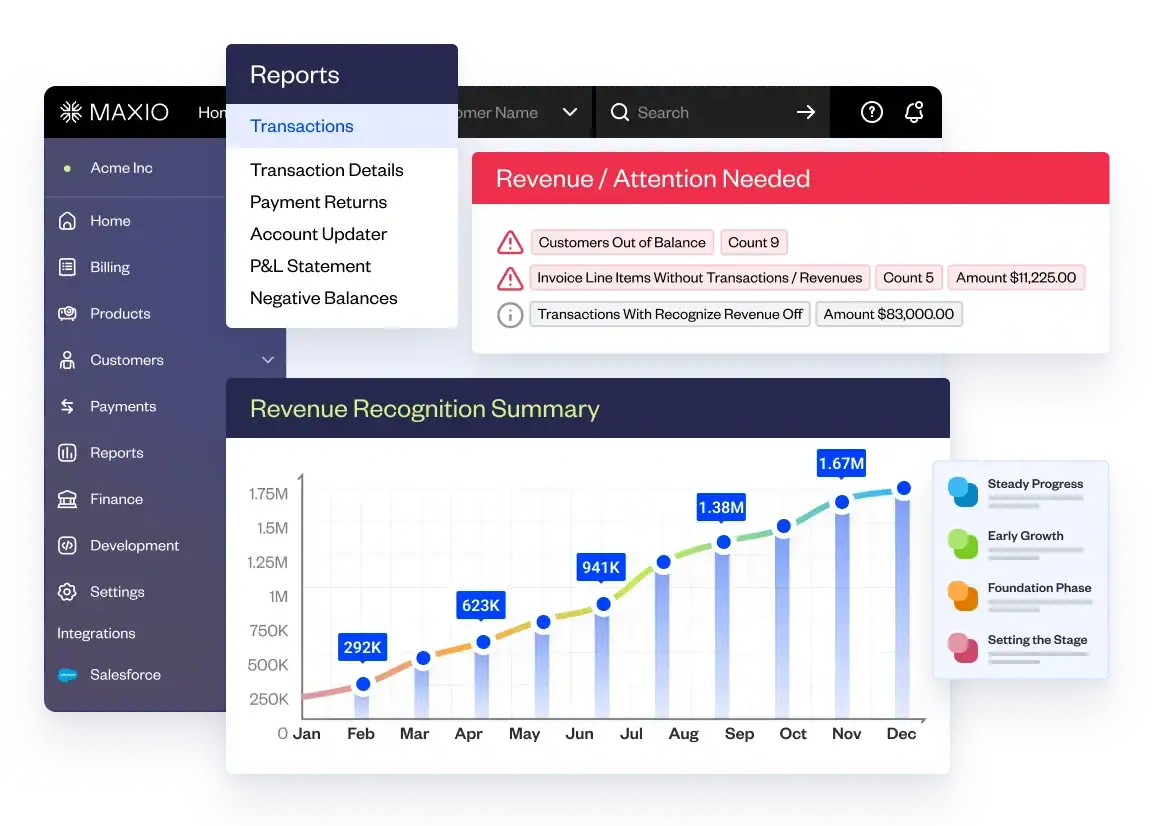
Let’s be clear. Maxio is a platform that unifies contracts, invoicing, usage, revenue recognition, and SaaS metrics—then syncs the right sub-ledgers into your ERP. That’s the job.
- Revenue recognition, native: ASC 606 schedules tied to real contract events. Auditors get line-of-sight, not lore.
- Quote-to-cash without bottlenecks: Sales, RevOps, and Finance operate on the same contract truth.
- Multi-entity, multi-currency made simple: Local rules, consolidated reporting, clean interco.
- ERP + CRM that actually sync: NetSuite, Intacct, QBO, Salesforce—structured for finance, not patchwork.
- Usage + hybrid pricing: Metering, rating, and invoicing finance can explain—no dev babysitting.
- 150+ SaaS metrics from the source: ARR, NRR, churn, expansion, cohorts—all from contract-grade data.
Keep Stripe for payments. Put Maxio in charge of the financial story.
Stripe vs. Maxio: Side by Side
Stripe Billing isn’t bad—it’s just built for a different job. Stripe is the Swiss Army knife of payments. But finance doesn’t need a Swiss Army knife. It needs a scalpel—a clean, precise, audit-ready tool.
| Capability | Stripe Billing | Maxio |
| Collect payments | World-class | Integrates (keep Stripe if you want) |
| Usage-based pricing | Strong dev primitives | Finance-grade rating & invoicing |
| Revenue recognition (ASC 606) | Basic/add-on, manual assists | Native automation tied to contract events |
| Multi-entity / multi-currency | Limited | Built for subsidiaries & consolidation |
| Quote-to-cash automation | Partial, dev-led | End-to-end, finance-led |
| ERP/GL integration | Exports, custom glue | Structured sub-ledgers |
| SaaS metrics & dashboards | Minimal | 150+ metrics from billing truth |
| Audit trail & controls | Light | Full auditability & policy evidence |
| Month-end close | Spreadsheet calisthenics | Days, not weeks |
Maxio delivers the same level of financial precision with less friction and far less dependency. You still get automation—you just get to own it.
Feature Matrix
The table below compares Maxio and Stripe Billing across key capability areas, drawn directly from Maxio’s comparison page.
| Billing & Subscription Management | ||
| Feature | Maxio | Stripe Billing |
| Subscription billing | ✓ | ✓ |
| Contract billing | ✓ | Beta |
| Self-service portals | ✓ | ✓ |
| Multi-attribute rating | ✓ | ✗ |
| Prepaid subscriptions | ✓ | ✓ |
| Prepaid usage | ✓ | Fixed fee & overages only |
| Company Management | ||
| Single product with multiple currencies | ✓ | ✗ |
| Localized customer support | ✓ | ✗ |
| Dedicated onboarding for all customers | ✓ | ✗ |
| Revenue & Expense Reporting | ||
| Basic revenue recognition | ✓ | ✓ |
| End of period reporting | ✓ | ✓ |
| Carve-outs / Reallocations | ✓ | ✗ |
| Expense recognition | ✓ | ✗ |
| Integrations | ||
| Salesforce (two-way) | ✓ | ✗ |
| HubSpot (two-way) | ✓ | ✓ |
| Xero (two-way) | ✓ | ✓ |
| QuickBooks (two-way) | ✓ | ✗ |
| NetSuite (two-way) | ✓ | ✓ |
| QuotaPath | ✓ | ✗ |
| Clearbit | ✓ | ✗ |
Who is this ideal for?
Maxio is ideal for:
- SaaS and AI companies experiencing painful month-end close processes due to billing complexity
- SaaS and AI companies scaling through billing complexity
- Finance teams that need audit-ready ASC 606 / IFRS revenue recognition
- Companies with multi-product catalogs, usage-based, or hybrid pricing models
- Organizations running both product-led and sales-led growth motions
- Teams requiring native two-way ERP and CRM integrations (NetSuite, Salesforce, HubSpot, QuickBooks, Xero)
- Businesses needing 150+ real-time SaaS metrics (ARR, NRR, churn, CLV:CAC, cohorts)
- Companies preparing for investor reporting, board meetings, or audits
Stripe Billing is ideal for:
- Businesses that need enterprise usage billing and are willing to layer in Metronome as a separate product
- Early-stage startups launching quickly with simple subscription pricing
- Developer-led teams that want full API control over billing logic
- B2C, eCommerce, or e-Learning platforms with high-volume, low-complexity transactions
- Companies accepting payments across 135+ currencies with minimal finance overhead
- Product-led growth motions where self-service sign-up is the primary channel
- Teams that prefer to build custom billing logic on top of payment infrastructure
- AI companies with straightforward token-based metering needs (via Stripe’s 2026 AI billing features)
Pros vs Considerations
Maxio Pros:
- Purpose-built for SaaS and AI companies with complex revenue model
- Native ASC 606 / IFRS revenue recognition tied to real contract events
- 150+ out-of-the-box SaaS metrics (ARR, NRR, churn, cohorts, CLV:CAC)
- Two-way native integrations: Salesforce, HubSpot, NetSuite, QuickBooks, Xero
- Supports both product-led and sales-led growth motions
- Dedicated onboarding specialists for all customers
- Multi-entity and multi-currency support built in
- Volume-based pricing discounts as you scale
- End-to-end quote-to-cash automation, finance-led
- Drillable reporting trusted by investors and auditors
Maxio Considerations:
- Best suited for companies that have outgrown simple pricing models and are ready to scale with confidence
- Designed for companies ready to invest in a purpose-built finance platform — not a transactional payment tool
- Migration from Stripe is a structured process, ensuring your billing logic and revenue data are set up correctly from day one
- Built for finance and RevOps teams, not just developers — teams that want deeper control will find it worth the onboarding investment
Stripe Billing Pros:
- Fast time-to-value — ideal for MVPs and early-stage PLG
- World-class developer experience with clean APIs
- Accepts payments in 135+ currencies globally
- Transparent pay-as-you-go pricing — easy to understand upfront
- Extensive self-service documentation and developer community
- Strong for B2C, eCommerce, and simple subscription models
- Named a Leader in Forrester Wave (Q1 2025) and Gartner Magic Quadrant (2025) for Recurring Billing
- Acquired Metronome (January 2026) to add enterprise usage-based billing, commits, and multidimensional pricing; expanded further at Stripe Sessions 2026 with dimensional pricing and streaming payments
- AI-native metering launched (March 2026): LLM token billing, agent workflow metering, and automatic markup on model costs
- Stripe Revenue Recognition product automates accrual accounting and generates automated reports
Stripe Billing Considerations:
- Revenue Recognition is an add-on product, not natively unified with billing data the way Maxio’s is
- No single source of truth across CRM, billing, and ERP without custom integration work
- Advanced analytics still require Stripe Sigma (paid add-on) and SQL expertise
- Multi-entity and multi-currency consolidation requires manual workarounds
- Contract billing remains limited — no mixed billing intervals in a single subscription; contract amendment history lives in spreadsheets
- Usage aggregations limited to sum, count, and last natively (no count-unique, average, max, or weighted sum without Metronome)
- Metronome integration for complex usage billing is a separate product layer, not turnkey out of the box
- Metrics (ARR, NRR, churn) lack contract-grade integrity without additional tooling
- Minimal onboarding and implementation support; largely self-serve
- Growth-prohibitive core pricing — no volume discounts as you scale on standard Billing plans
FAQs You’re Probably Thinking (and Your CFO Definitely Is)
“Can Maxio handle our Frankenstein contracts?”
Yes. Modifications, co-terms, credits, ramps, and usage overlays—the stuff that breaks spreadsheets—is exactly what Maxio models natively.
“Will we still need spreadsheets?”
For analysis, sure. For revenue truth? No. Schedules, ledgers, and metrics live in the system—not on someone’s desktop.
“What about entities and currencies?”
That’s the point. Local rules per entity, consistent roll-ups, and controlled exchange handling—without midnight Excel diplomacy.
“How painful is the switch?”
It takes work—mapping contracts, defining policies, aligning ERP flows—but it’s measured in weeks to value, not fiscal years to payback.
Should You Switch from Stripe to Maxio?
Stripe Billing is a fantastic launchpad. Keep it for payments if you want. But when your job shifts from collecting cash to defending the revenue story, you need a finance-grade platform.
Maxio replaces fire drills with clarity:
- Run billing without bottlenecks.
- Flex as you grow.
- Lead with certainty.
Your investors don’t want another export. They want a number they can trust.
Maxio gives finance leaders the control they’ve been promised—without the complexity tax.
See how finance-led automation feels different. Schedule a demo.