

How to Set Up Usage-Based Billing Without Surprising Your Customers




Usage-based billing is where most companies go when they want to move past flat-rate subscriptions, and the appeal is obvious. Customers pay for what they actually consume. The more value they get, the more they pay, and the more you earn. It lowers the barrier to saying yes, because nobody is committing to capacity they aren’t sure they’ll use.
Then the first invoice arrives, and the customer has no idea where the number came from.
That’s the failure mode hiding inside usage-based billing, and it has almost nothing to do with how you configure the billing. Because usage is billed in arrears, your revenue becomes variable and the customer’s bill becomes a surprise. A surprised customer opens a support ticket. Repeat the surprise a few times and you have churn.
The discipline in usage-based billing is the metering and the transparency, more than the billing setup. Both have to be clean before the model is safe to run: if the meter is wrong or the customer can’t see the charge coming, correct billing logic still produces a bill you can’t stand behind.
Metering: get the usage right
Metering is everything that determines whether the number is correct: what you count, how you configure it, and how you record it.
It starts with the metric. What are you counting? API calls, active users, data volume, compute time. The cleaner that metric, the cleaner everything downstream becomes, because the pricing logic and the invoice both inherit whatever ambiguity lives in it. The trap is letting different teams hold different definitions of the same thing. If sales counts an “API call” one way and the billing system counts it another, the invoice becomes the place that disagreement surfaces, in front of the customer. Settle the definition first, across every team and system that touches it. This is the single highest-leverage thing you can get right, and it happens before you configure anything.
Once the metric is settled, usage-based billing in Maxio Advanced Billing is built as a metered component in your product catalog. The component is the thing you meter; the price point on it decides how the usage is charged. The simplest price point is a flat per-unit rate: every unit or event costs the same amount, no discounts, charged for the usage in each metering period. A common variation is a tiered scheme, with the first band set to zero so a baseline allowance is included for free and everything above it charged per unit. Which you choose depends on whether you’re including an allowance, but the mechanics of metering the usage are identical underneath.

Then the usage has to get in, and there’s more than one way. You can enter it through the UI, send it via the API as events happen or in bulk, or upload it by CSV for a periodic batch. Most teams sending real volume use the API; the UI is there for manual entries and corrections. One habit worth building regardless of method: when you record usage manually, attach a memo. A week or a month later, when someone is reconciling the numbers, that memo tells them where the usage came from and who put it in. It’s a small discipline that saves a long investigation later.

That’s the metering half. Clean metric, configured component, usage recorded with a trail. It gets you the correct number. A correct number nobody saw coming still generates the support ticket, which is what the second half is for.
Transparency: make the bill visible before it’s due
This is the part that prevents the surprise, and it’s the part teams skip.
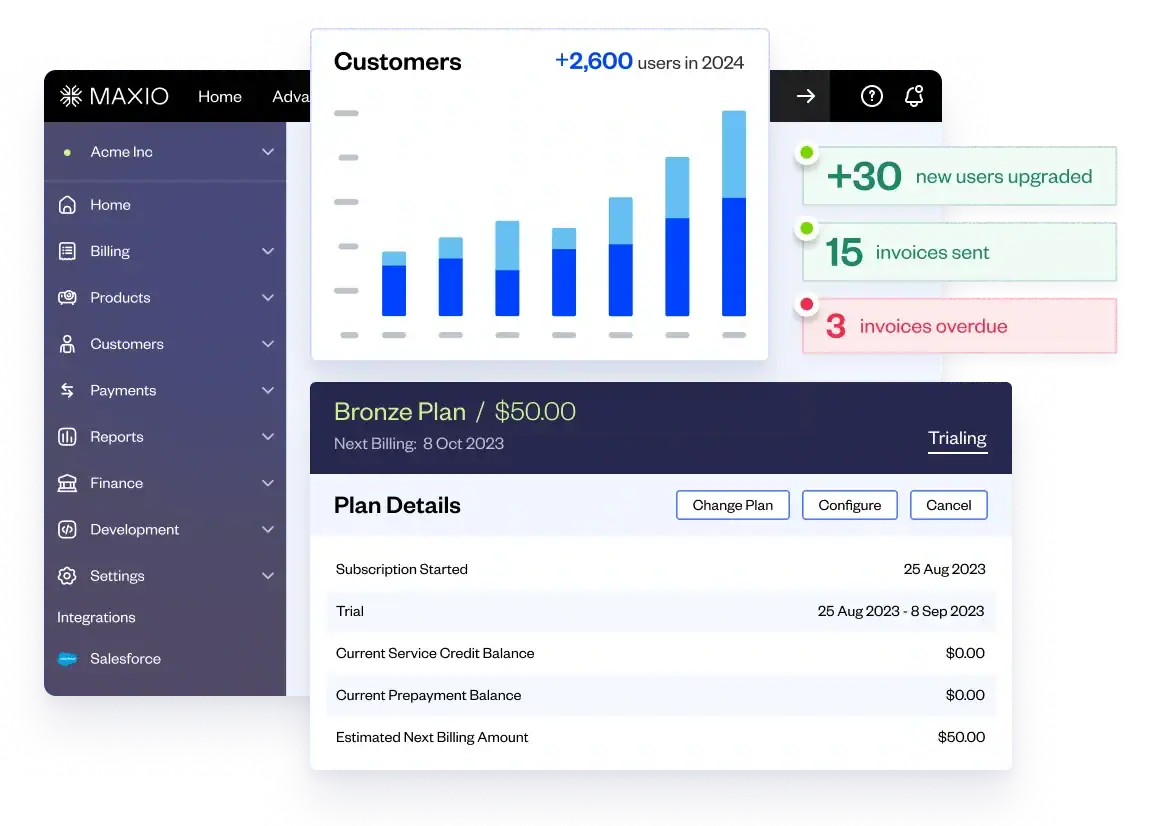
In Advanced Billing you can preview the proforma invoice at any point in the cycle. This will create the upcoming invoice as it stands right now: the base fee plus the usage recorded so far. As more usage comes in, the proforma ticks up, and you can pull it up at any moment to see exactly where the bill sits. Surface that to the customer, through the billing portal or proactively when usage is running high, and the invoice stops being a monthly reveal. It becomes something they watched accumulate.

This is why the discipline has two halves and not one. The metering makes the number correct. The transparency makes it visible. Skip either and you’re back to the surprised customer and the support ticket, no matter how clean the other half was.
Decide the edge cases before they happen
One more thing the metering-and-transparency frame depends on: the edge cases have to be answered before they arrive, not in a support thread after. What happens at zero usage in a period? What happens when usage spikes far beyond the norm? How does the metering period line up with the billing period, so usage lands in the cycle the customer expects? None of these are hard to answer. They’re only hard to answer late, with a customer waiting.
The takeaway
Usage-based billing is easy to turn on and easy to get wrong, and the way it goes wrong is rarely the configuration. It’s a metric that wasn’t pinned down, or an invoice the customer never saw coming. Keep the metering clean and the bill visible, and the model delivers what it promised: a charge that rises with the value delivered, and a customer who already knew it was coming.
Maxio Metering takes the visible half furthest, streaming usage as it happens so the invoice builds in real time rather than arriving as a number at the end. For teams whose usage-based billing depends on that transparency, it’s the next step worth taking.
This post draws on our May Customer Acceleration webinar, “Modeling Complex Pricing in Advanced Billing,” which covers how to model pricing structures in Maxio Advanced Billing. Watch the full session on demand.