
Maxio vs Zuora
Which is Best for B2B?
Get a customized demo
See how you can manage any subscription model—without the financial headaches.
What’s the difference between Maxio and Zuora?
Maxio: Built for B2B SaaS Companies
- Ideal for subscription-based businesses of all sizes.
A platform designed with flexible pricing models like usage-based or metered billing, supporting multi-entity and multi-currency reporting. - Advanced financial analytics.
Gain insights to forecast revenue, manage cash flow, and ensure compliance with ASC 606. - Seamless integrations.
20+ payment gateways, bi-directional synchronization with Salesforce, HubSpot, NetSuite, and more!
Zuora: Tailored for B2C and Enterprise Needs
- Focuses on high-volume, low-complexity subscriptions.
Works best for repetitive, usage-based billing models. - Enterprise-oriented.
Suited for larger companies in B2C industries with simpler pricing structures.
| Features | Maxio | Zuora |
|---|---|---|
Billing & Subscription Management | ||
| Subscription billing | | |
| Contract billing | | |
| Self-service portals | | |
| Multi-attribute rating | | |
| Advanced prepaid subscriptions | | |
| Prepaid usage | | |
| A/R Management | | |
| Multiple payment gateways | | |
SaaS Metrics and Reporting | ||
| End of period reporting | | |
| ARR/MRR snowball | | |
| Drill down reports | | |
| FX Gain/Loss by currency | | |
| Deferred Revenue | | |
Revenue Recognition | ||
| Revenue recognition | | |
| End of period reporting | | |
| Carve-outs / Reallocations | | |
| Expense recognition | | |
Integrations | ||
| Salesforce (two-way) | | |
| HubSpot (two-way) | | |
| Xero (two-way) | | |
| QuickBooks (two-way) | | |
| Netsuite (two-way) | | |
| QuotaPath | | |
| Clearbit | | |
Operational Capabilities
This second matrix compares how each platform performs across the operational and financial dimensions most relevant to finance teams.
| Capability | Zuora | Maxio |
| Implementation | Historically 3–12 months, consultant-led; AI-assisted onboarding being introduced | Weeks, finance-led |
| Revenue recognition | Add-on (RevPro), separate product | Native ASC 606 compliance |
| Multi-entity / multi-currency | Supported but complex setup | Built-in consolidation & roll-ups |
| Quote-to-cash | Multi-tool (Zuora + CPQ + CRM) | Unified workflow |
| Engineering involvement | High — changes require IT or dev | Minimal — finance owns configuration |
| Cost of ownership | High (services + integration + licensing) | Transparent SaaS pricing |
| Time to value | Long | Fast |
| Data visibility | Fragmented across modules | Single source of truth |
| SaaS metrics | Limited / add-on required | 150+ finance-grade metrics |
| Admin overhead | Requires dedicated ops or IT team | Managed directly by finance |
Maxio is ideal for:
- SaaS and AI companies scaling beyond simple subscription management
- Finance teams that need revenue recognition tied to contract events, not just invoice dates
- Companies managing contract complexity — upgrades, credits, co-terms, and usage overlays
- Organizations where billing, CRM, and ERP need to share a single source of truth
- Teams preparing for audits, board reporting, or investor due diligence
- Businesses with multi-entity or multi-currency reporting requirements
- Finance leaders who want to run the system, not the other way around
Maxio Pros:
- Purpose-built for SaaS and AI companies with complex revenue models
- Native ASC 606 / IFRS revenue recognition tied to real contract events
- 150+ out-of-the-box SaaS metrics (ARR, NRR, churn, cohorts, CLV:CAC)
- Two-way native integrations: Salesforce, HubSpot, NetSuite, QuickBooks, Xero
- Supports both product-led and sales-led growth motions
- Dedicated onboarding specialists for all customers
- Multi-entity and multi-currency support built in
- Volume-based pricing discounts as you scale
- End-to-end quote-to-cash automation, finance-led
Drillable reporting trusted by investors and auditors
Maxio Considerations:
- Designed for companies ready to invest in a purpose-built finance platform — not a transactional payment tool
- Migration from Stripe is a structured process, ensuring your billing logic and revenue data are set up correctly from day one
- Built for finance and RevOps teams, not just developers — teams that want deeper control will find it worth the onboarding investment
- Best suited for companies that have outgrown simple pricing models and are ready to scale with confidence
Zuora is ideal for:
- Large enterprises with global operations, thousands of customers, and dedicated billing ops teams
- Organizations with extremely complex, custom billing logic requiring enterprise-grade configurability
- Companies already deeply integrated into the Salesforce/NetSuite/SAP enterprise stack
- Businesses with the budget for professional services, ongoing consulting, and long implementation timelines
- High-volume B2B and B2C operations where standardization at scale is the primary requirement
Zuora Pros:
- Enterprise-grade billing that handles global complexity, thousands of customers, and custom contract logic
- Deep automation for renewals, usage charges, and proration including edge cases
- Established integration ecosystem with Salesforce, NetSuite, and SAP
- Designed for multi-entity, multi-currency operations at significant scale
- Strong track record with large enterprises in B2B and B2C industries
Zuora Considerations:
- Implementation typically takes 6–12 months and requires external consultants
- Every billing change — new cadence, discount rule, or contract term — generally requires engineering or IT involvement
- Revenue recognition (RevPro) is a separate add-on product, not natively unified with billing
- Cost of ownership is high: licensing, professional services, custom scripting, and ongoing administration
- Data is fragmented across modules (billing, RevPro, analytics), requiring manual reconciliation
- Optimized for enterprises with dedicated billing ops teams — leaner finance teams face significant overhead
Why Maxio?
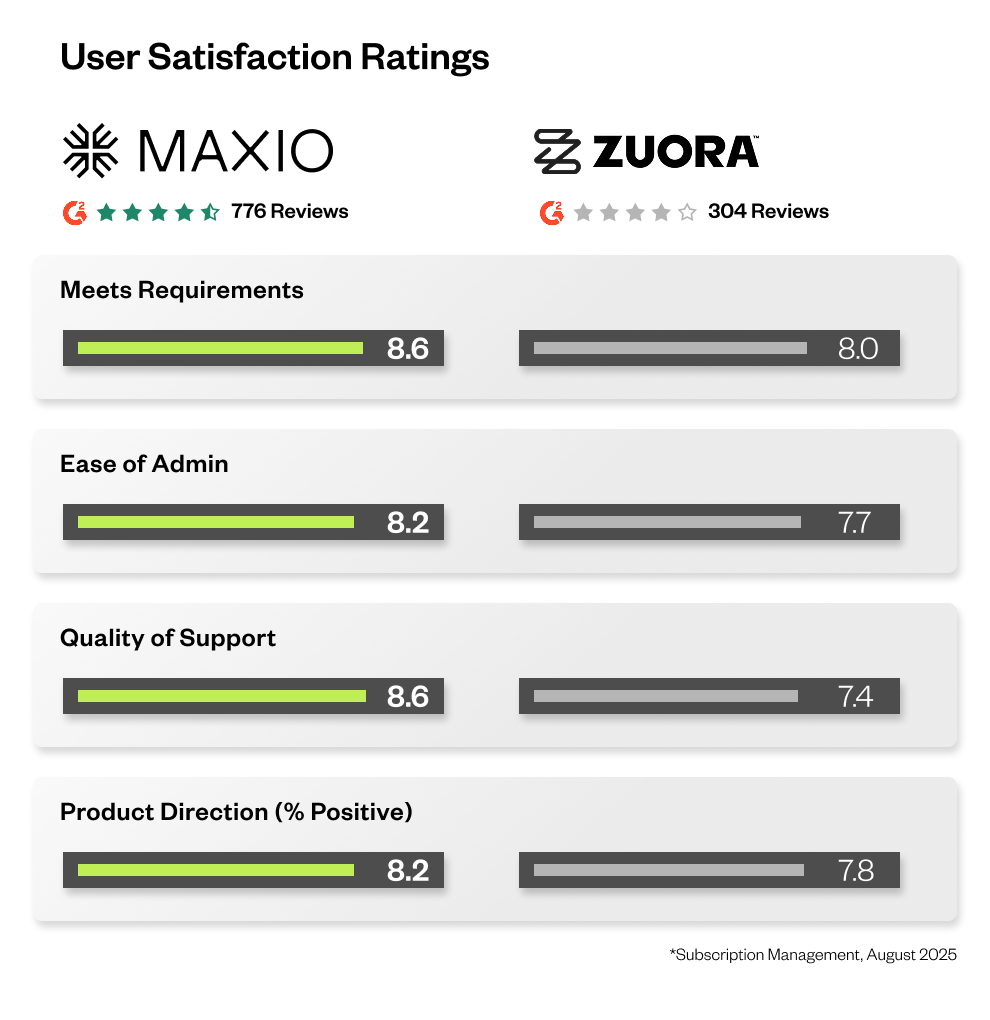
Maxio’s streamlined onboarding process ensures a quick time-to-value while minimizing operational overhead. Its cost-effective implementation is ideal for scaling businesses seeking efficiency without added complexity.
Maxio’s adaptive pricing models grows with your business. Designed for small to medium-sized, and enterprise B2B SaaS companies, it offers accessibility and flexibility to meet evolving needs.
Maxio delivers essential metrics like cohort analysis, cash forecasting, and ASC 606 compliance, providing actionable insights tailored for scaling B2B SaaS companies.
Maxio platform supports diverse billing models, including subscription-based, hybrid, and custom contracts. Its flexible infrastructure handles advanced scenarios like multi-currency transactions and custom contracts with ease.
Maxio’s tailored dashboards provide real-time insights for CFOs, CEOs, and investors, offering visibility into key metrics to drive data-informed decisions.
Maxio simplifies revenue recognition, sales commission calculations, and expense recognition with automated processes, ensuring compliance with accounting standards like ASC 606.
When to use Zuora
Zuora is a suitable option for both B2B and B2C businesses, particularly those handling high-volume subscriptions or usage-based pricing models. However, it is often much more expensive than Maxio and other competitors, making it a better fit for companies with substantial budgets prioritizing scale over cost-efficiency.
High-volume subscription billing
Ideal for businesses managing large-scale, repetitive billing or usage-based models in both B2B and B2C industries.
Simpler business needs
Works best for companies with straightforward pricing structures and fewer customization requirements.
Premium price point
Zuora is significantly more expensive than competitors, making it better suited for enterprises with larger budgets.
-
We bought into a popular subscription management platform that didn’t live up to the hype. When our financial metrics were off, we knew it was time for a change. I wish we had found Maxio from the beginning, although it was definitely worth the wait.
Mindy Drue, Pal USA
Financial Controller
-
Before Maxio, we spent a lot of time checking and reconciling. Now we copy the numbers straight out of Maxio into our revenue recognition journal. It probably takes two minutes instead of a full day.
Craig Humphrey, Arctic Shores (UK)
VP of Finance and Operations



Maxio vs. Zuora FAQs
Maxio implementations typically take weeks. Zuora implementations have historically taken 3–12 months and often require external consultants, though Zuora has been working to shorten this with AI-assisted onboarding. For finance teams that need to go live quickly and iterate on pricing models, Maxio’s timeline remains a material advantage.
No. Finance teams configure billing rules, pricing models, and workflows directly in Maxio without developer dependencies. In Zuora, most changes — new billing cadences, discount rules, contract amendments — require a Jira ticket and engineering involvement.
Maxio includes native ASC 606 and IFRS-compliant revenue recognition tied to contract events, with schedules and journal entries generated within the platform. Zuora’s revenue recognition is handled by a separate product, RevPro, which requires additional setup and integration.
Yes. Maxio supports multiple entities and currencies with built-in consolidation and roll-ups, local rules per entity, and exchange rate management. Zuora supports multi-entity and multi-currency operations as well, but the setup is more complex and typically requires custom configuration.
Maxio uses transparent SaaS pricing. Zuora’s total cost of ownership is significantly higher when accounting for licensing, professional services fees, ongoing custom scripting, and the internal admin headcount required to operate the platform.
Maxio natively supports complex contracts including co-terms, ramp deals, credits, usage overlays, and hybrid pricing — all configurable by finance without custom code. Zuora handles similar complexity but requires significantly more engineering and admin resources to configure and maintain.
Maxio includes 150+ SaaS metrics out of the box — ARR, NRR, churn, expansion, cohort analysis — calculated from contract-grade data. Zuora’s reporting capabilities are more limited and often require additional tools or manual export to get to the same level of detail.
Teams typically reach a tipping point when Zuora’s maintenance cost, engineering dependency, and implementation lag outweigh its benefits. Maxio’s migration process takes weeks, not quarters, and covers full continuity of contracts, schedules, and metrics. Whether it’s worth switching depends on how much time finance is spending on reconciliation, IT support, and manual workarounds.
Maxio models complex contracts natively — co-terms, upgrades, credits, ramp deals, usage overlays — without requiring custom code. Finance configures these directly in the platform. Existing contract structures and billing logic are mapped during the migration process.