The Cash Flow Implications of Metered Billing

Metered billing generates less than a third of the cash that annual subscriptions do in the first year.
Several SaaS companies I work with have been caught off guard by the cash flow dynamics of their new AI products, which are billed on a usage basis.
There are three issues.
First, usage needs to be measured before it can be billed, so most often it’s billed monthly in arrears. For SaaS businesses currently billing annual subscriptions in advance, any switch to monthly in arrears billing has a substantial negative cash impact. (quantified below)
Second, when a new customer is landed, it’s not known how much annual revenue it will generate, or when. Variability in client adoption can significantly reduce or delay cash flow.
Third, customer usage, and thus cash flow, can be erratic. It’s subject to the use cases and business activity of your customer base, which may exhibit seasonal, cyclical, or other types of variability.
All these factors make planning and forecasting cash difficult and delay collections.
The size of the cash impact depends on how much of the business is shifting to usage-based billing, as well as on your company’s growth rate. Counterintuitively, the faster you’re growing, the larger the relative cash drag of metered billing.
Example:
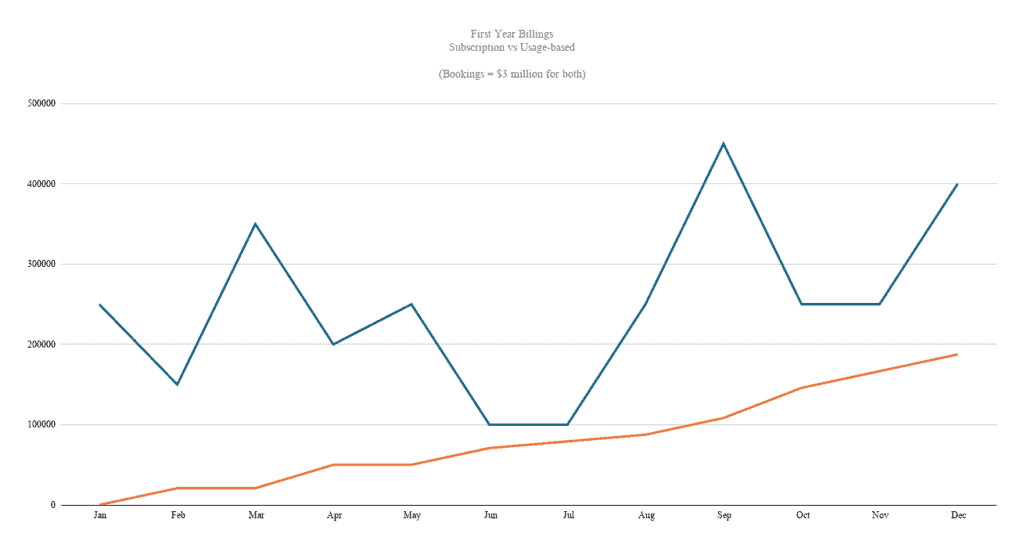
Ignoring the issues of slow adoption and usage variability, the chart below shows the cash-flow implications of switching to monthly billing in arrears for newly closed business.
Both companies close what they estimate to be $3 million in new bookings for the year. Company A closes new annual-in-advance subscription business, and Company B closes new deals with metered pricing billed monthly in arrears.
Revenues and GAAP net income are identical for the two companies, yet by the end of the year, Company A, the all-subscription business, had $2 million more in the bank than Company B, which is billing new business on a usage basis.
New subscriptions generated $3 million in cash from $3 million in bookings. By contrast, new metered billing contracts generated only $1 million in cash on the same $3 million in bookings because they were billed monthly in arrears.
That is 3 times more cash in the first year. Not a small difference.
The cash flow impact would be even greater if there were roll-out, adoption, or ramp-up issues with the usage-based customers.
Mitigation Opportunities
Tiered pricing is one option and enables billing in advance, but it often mitigates the advantages of metered billing.
Selling usage tokens in advance is a better way to mitigate the cash drain. This structure aligns more closely with usage-based benefits while addressing the negative cash implications. The drawback is on the accounting side as revenue recognition is now tied to usage – not billing.
As demonstrated by today’s marketplace, usage-based pricing is the safest and most obvious way to price new AI functionality for existing SaaS businesses, but it’s important to account for the negative cash flow impacts and, if possible, mitigate them.