Stop Starting with Prompts: A Practical AI Implementation Guide for Finance Leaders


Finance leaders are under pressure to figure out how to use AI in finance without compromising accuracy, control, or trust in the numbers.
AI has no shortage of hype in finance right now. Scroll through LinkedIn, and you’ll find plenty of posts promising that the right prompt or workflow can automate FP&A, close the books, build the board deck, and turn messy data into perfect insights.
But for finance leaders, that’s not how AI works in practice.
Finance teams cannot afford outputs that are impressive but unreliable. If an AI-generated report includes dozens of data points, and the finance team has to validate every one, the review process can take longer than creating the report manually. That means the real opportunity is not finding the perfect prompt. It is building the right foundation first.
After working with AI in finance workflows and talking with tech CFOs about how they are actually using AI in the back office, I’ve become convinced that finance leaders need a more practical approach to implementation: stop starting with prompts. Start with the workflow, the data, the definitions, and the deterministic logic. Then layer AI on top to accelerate commentary, QA, analysis, and reporting.
In other words, AI should explain the numbers, not invent them.
Why prompt-first AI implementation fails in finance
Most finance teams start their AI journey with the wrong question: “What prompt should we use?”
That question is tempting because it makes AI feel fast and accessible. But it skips the harder, more important work finance teams need to do before AI can produce anything trustworthy.
The better question is: What finance workflow are we trying to make repeatable?
That shift matters. A prompt may produce a polished answer, but finance leaders still need to know where the data came from, how the metric was calculated, whether the output is tied to the right source system, and whether the same process will produce the same result next month.
That is especially important in finance and accounting, where teams are often working across multiple ERPs, ETLs, mappings, reconciliations, and metric definitions. ARR is a good example. Does ARR come from revenue? An MRR waterfall? Bookings data? Without clear definitions and source-of-truth logic, AI may confidently produce an answer that looks right but is not the official answer.
And if finance has to manually validate every data point in an AI-generated report, the team may not have saved much time at all.
Why AI can’t fix a broken finance foundation
AI can be powerful, but it does not eliminate the need for finance fundamentals. For finance leaders, AI implementation should be treated as a workflow and data strategy before it becomes a prompt strategy.
Before finance teams can use AI to analyze performance, draft commentary, or support executive reporting, they need a foundation that makes those outputs reliable.
That means answering questions like:
- What decision will this output support?
- Which workflow are we improving?
- Which source system owns the data?
- Which metric definition is official?
- What formula should be used?
- Who owns the final number?
These questions are not new. Finance teams have always needed clean data, clear logic, and repeatable processes. What AI changes is the speed and scale at which those processes can be executed once the foundation exists.
Without that foundation, AI does not create trustworthy automation. It creates more review work.
The 4-layer AI implementation stack for finance leaders
Here is a practical implementation stack finance teams can use to think about AI adoption. The core idea is simple: AI belongs at the top of the stack, not the bottom.
Layer 0: Define the finance workflow and system design
Layer 0 is the work that happens before any prompt is written.
This is where finance teams define the question they are trying to answer, the workflow they want to improve, the systems involved, the target output, and the decision that output will support.
For example, if the goal is to calculate net revenue retention, finance needs to know where the source data lives, what time period should be used, what customer cohort logic applies, and who owns the final number. If the goal is to build a board-ready revenue summary, the team needs to define which reports, metrics, and variance explanations should feed that output.
This layer is easy to skip because it feels like documentation. But it is what makes AI useful later.
Layer 1: Structure and label the finance data
Once the workflow is defined, finance teams need to make sure the data is structured in a way AI can interpret consistently.
This means clean, well-labeled data. It means consistent customer naming. It means clear labels for revenue, ARR, MRR, churn, expansion, bookings, headcount, departments, and other core data points.
It also means resolving ambiguity before AI enters the process. If a finance leader asks AI for current ARR, the model needs to know which data source and definition to use. Otherwise, it may pull from the wrong schedule, summarize the wrong report, or blend concepts that finance would normally keep separate.
This layer is not about advanced AI. It is about making the data usable.
Layer 2: Define deterministic formulas and trusted outputs
Finance should own the math.
AI should not be responsible for inventing formulas for CAC payback, net revenue retention, gross margin, ARR, or other core metrics. Those formulas should be defined, documented, and repeatable.
This is where deterministic outputs matter. Finance teams need reusable metric definitions, schedules, reconciliations, and measurement periods. If CAC payback is calculated on a trailing three-month basis, that needs to be defined. If revenue is reported on a specific basis, that needs to be encoded into the process.
Once the formulas are defined and the outputs are trusted, AI can help explain them. But it should not create the official math from scratch.
Layer 3: Add AI for commentary, QA, and acceleration
Only after the workflow, data, and formulas are trusted should AI sit on top.
This is where AI can be genuinely useful for finance teams. It can draft variance commentary, summarize performance, explain metric movement, support forecast explanations, QA outputs, and help prepare board memos.
At this layer, AI is not replacing finance judgment. It is accelerating the work finance teams already do.
The result is a more practical model for AI adoption: finance owns the workflow, the data, and the math. AI helps with the analysis, explanation, and communication.
What data sources do finance teams need before implementing AI?
A finance-first AI strategy also depends on the right data sources. Before implementing AI for finance reporting, forecasting, or analysis, teams need connected data that the model can interpret consistently.
There are four core data sources that are especially important for finance teams operating in recurring revenue businesses:
- Financial data from the general ledger, including revenue streams, COGS, OpEx, departments, and a finance-ready chart of accounts.
- Customer and revenue data, including MRR schedules, contract terms, pricing tiers, segmentation, and retention trends.
- Bookings data, especially for teams that need to forecast revenue and calculate go-to-market efficiency metrics.
- HR and headcount data, including employee costs, contractor costs, department coding, and fully loaded labor costs.
These examples are rooted in SaaS finance, but the broader lesson applies to finance teams more generally: AI is only as useful as the operating data it can access and understand.
If finance data is fragmented, mislabeled, or inconsistently defined, AI will struggle to produce trustworthy analysis. But when finance can connect clean financial, customer, sales, and people data, AI has a much stronger foundation to work from.
Practical AI use cases for finance teams
Once the right foundation is in place, AI can support a wide range of finance workflows. These are the types of AI use cases in finance that become more reliable when the underlying data and calculations are already trusted.
In conversations with CFOs and finance teams, I’m seeing practical AI experimentation across workflows like:
- CFO dashboards
- Month-end reporting
- Variance narratives
- Research briefs
- Forecast support
- Metric QA
- Ad and channel analysis
- Board memo drafts
The common thread across these use cases is that AI is not being asked to magically create trusted finance outputs from messy inputs. Instead, it is being given structured data, calculated metrics, and known definitions so it can help summarize, explain, and package the information.
For example, one use case involved giving AI 12 months of variance explanations, calculated metrics, and brand guidance so it could draft a 10-slide month-end deck with an executive summary, strengths, weaknesses, and charts. Another involved feeding prior QBRs and board materials into AI to identify the questions a board member or investor might ask.
Those are high-value applications because they help finance leaders prepare faster and communicate more clearly. But they only work when the underlying inputs are reliable.
How should finance leaders govern AI usage?
AI implementation is not just a productivity initiative. It also requires governance. Finance leaders need a clear AI governance model before usage scales across FP&A, accounting, reporting, and executive communications.
Finance leaders need to think carefully about which tools are approved, which data can be used, how outputs should be reviewed, and who owns the final result.
That is especially important when teams are using AI to support executive reporting, board materials, customer analysis, or financial commentary. The output may look polished, but someone still needs to confirm that it is accurate, complete, and based on the right sources.
A practical governance model should answer questions like:
- Who owns AI usage and approval?
- Which tools and models are approved for finance data?
- What data can and cannot be uploaded into AI tools?
- How should AI-generated outputs be reviewed before they are shared?
- Who is accountable for the final number or narrative?
One practical technique is using AI itself as part of the quality-control process. For example, one agent can produce an analysis or report, while another can fact-check the output and review the data sources. That does not remove the need for human review, but it can help catch errors earlier in the process.
The key is to avoid treating AI as a black box. Finance teams need clear workflows, clear ownership, and clear review standards.
How structured finance data makes AI more useful
A practical example of this is what becomes possible when AI has access to structured finance data.
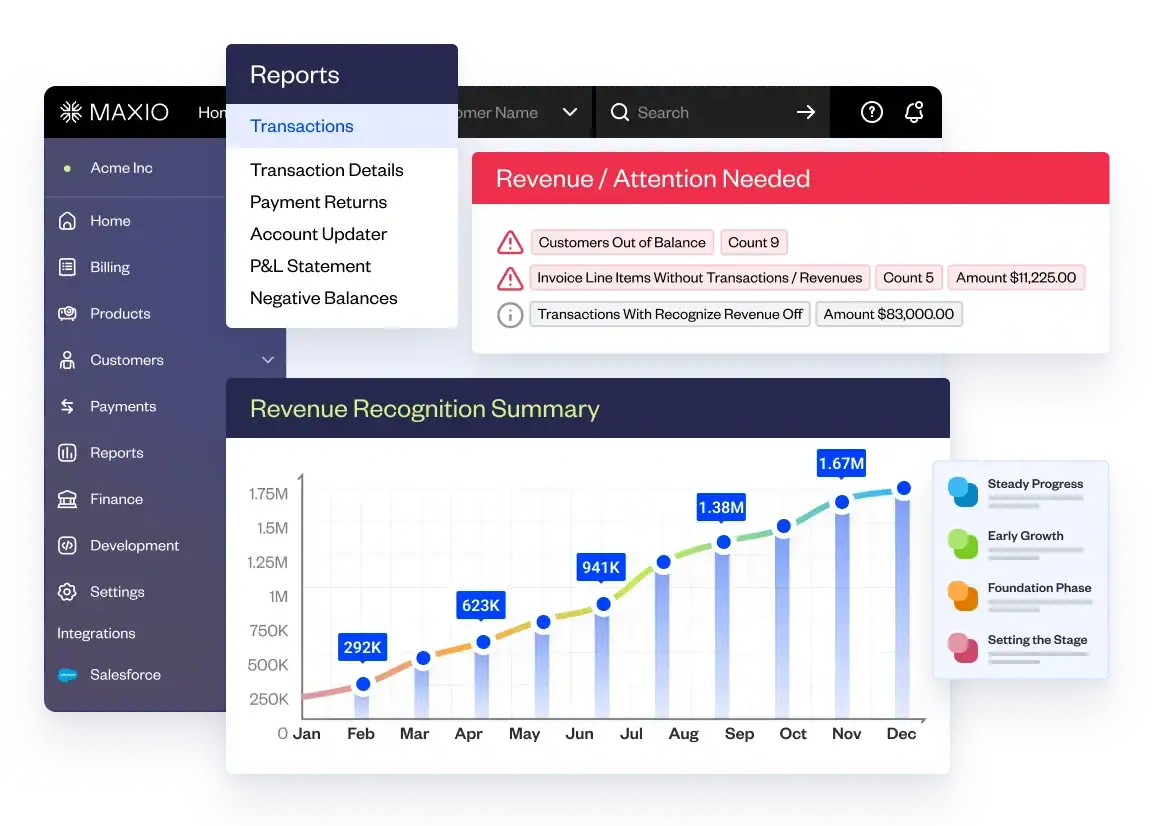
Using Maxio’s MCP connection, AI can access data from Maxio and support finance and customer-facing workflows. For example, AI can create an executive KPI summary using structured revenue data, highlight anomalies, and produce a CSV-ready table for a board deck. It can help prioritize top strategic accounts for customer success. It can also draft board-report-style revenue commentary based on available reports and metrics.
The important distinction is that AI was not being asked to create the MRR waterfall from scratch. It was using existing calculated outputs and structured data to summarize trends, calculate changes and percentages, highlight anomalies, draft commentary, and accelerate analysis.
That is the practical value of AI for finance teams. When the system of record owns the data and calculations, AI can help finance leaders understand and communicate what changed, why it changed, and what to do next.
AI should explain the numbers, not invent them
For finance leaders, the path to AI adoption should not start with a prompt library. It should start with repeatable workflows, clean data, trusted definitions, deterministic formulas, and clear governance.
Once those pieces are in place, AI can help finance teams move faster. It can draft commentary, identify anomalies, summarize performance, prepare board materials, support metric QA, and help leaders ask better questions.
But AI should not be the source of truth for the numbers.
The future of AI in finance will not belong to the teams with the cleverest prompts. It will belong to the teams with the clearest workflows, cleanest data, strongest definitions, and best governance.
To see this framework in action, watch my recent webinar on demand, including practical examples of how finance teams can implement AI without losing trust in the numbers and a demo of the Maxio MCP connection.
Frequently Asked Questions
What is the best way to implement AI in finance?
The best way to implement AI in finance is to start with a repeatable workflow, clean and well-labeled data, clear metric definitions, and deterministic formulas. Once those pieces are trusted, AI can be added to support commentary, QA, variance explanations, forecasting narratives, and reporting.
Why shouldn’t finance teams start with prompts?
Finance teams should not start with prompts because prompts alone cannot solve unclear workflows, inconsistent data, or undefined finance logic. If the underlying data and formulas are not trusted, AI may produce polished outputs that still require extensive manual validation.
What finance workflows can AI support?
AI can support finance workflows such as CFO dashboards, month-end reporting, variance narratives, research briefs, forecast support, metric QA, ad and channel analysis, board memo drafts, and executive KPI summaries.
What data does AI need for finance reporting?
AI needs structured, well-labeled data from core finance and operating systems. For recurring revenue businesses, that often includes financial data from the GL, customer and revenue data, bookings data, and HR or headcount data.
How can finance leaders use AI without losing trust in the numbers?
Finance leaders can use AI without losing trust by keeping finance teams in control of the workflow, data sources, metric definitions, formulas, and final review. AI should help explain, summarize, and analyze trusted outputs rather than invent the official numbers.