
Your Billing Stack Is the Real AI Monetization Bottleneck



Why SaaS Finance Teams Get Stuck Before Launch
Your product team has a consumption-based pricing model on the whiteboard. Your go-to-market team has a launch date. Your finance team has signed off on the revenue targets. Then someone asks: “Can our billing system actually meter this?”
That question stops more AI revenue initiatives than competitive pressure or customer resistance combined. The bottleneck is not strategy. It is the metered pricing stack that most growth-stage SaaS companies built for seat-based or flat-rate subscription models — infrastructure that has little to do with how AI products are consumed and priced.
Most framing of AI monetization treats it as a deployment-era challenge, focused on product packaging and go-to-market motion. That framing is incomplete. Before pricing strategy matters, finance leaders need to answer a harder question: can your consumption billing infrastructure meter, rate, and recognize revenue for AI consumption models without requiring an engineering sprint every time a pricing parameter changes? For most companies right now, the honest answer is no.
What AI Consumption Models Actually Require from Billing Infrastructure
AI products are priced on outputs — tokens processed, API calls made, inference minutes consumed, documents analyzed. These are not seats. They are not flat monthly fees. They are high-frequency, variable events that must be captured at the source, aggregated accurately, and rated against a pricing schedule that may vary by customer tier or contract.
That rated amount then needs to convert into a billable figure that satisfies both the customer invoice and ASC 606 revenue recognition rules. That chain has at least five distinct technical requirements. Most usage-based revenue systems handle two or three of them adequately. Handling all five, at the volume AI workloads generate, is where the gap opens.
- Event ingestion at volume. AI workloads generate usage events at rates that overwhelm polling-based billing integrations. You need a metering layer that can ingest millions of events per day without data loss or latency that distorts the billing period boundary. This is a data pipeline problem as much as a billing problem.
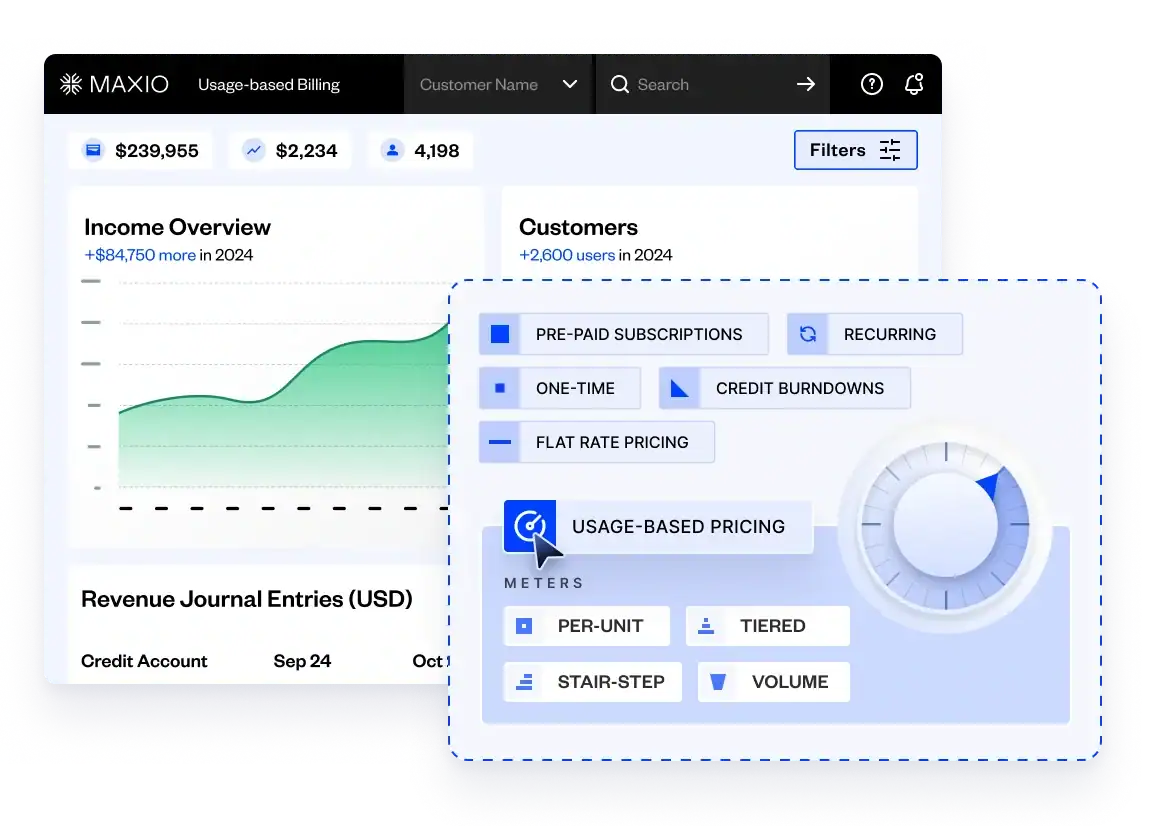
- Flexible rating logic. A customer on a committed-use contract with overage pricing at a different rate than a pay-as-you-go customer cannot be handled by a single flat rate card. Rating engines must support tiered, volume, and hybrid pricing simultaneously across your customer base — without custom code for each variation.
- Contract-aware entitlements. Many AI deals include prepaid credit bundles, draw-down balances, or minimum commitments. Billing infrastructure must track entitlement consumption in real time. Finance and customer success need to see when a customer is approaching a threshold before the invoice surprises anyone.
- Revenue recognition that follows consumption. Under ASC 606, revenue from usage-based contracts is recognized as the performance obligation is satisfied — meaning as consumption occurs, not when the invoice is issued. If your billing system cannot pass consumption data to your revenue recognition layer in a structured, auditable format, your close cycle gets longer and your audit exposure goes up.
- Self-serve pricing changes without engineering. AI pricing is still evolving. If every pricing adjustment requires a developer to modify billing logic, your finance team cannot respond to competitive pressure or customer negotiation without a ticket queue.
Why This Is a CFO Problem, Not an Engineering Problem
Engineering teams will build whatever finance needs given enough time. The issue is that AI revenue timelines do not accommodate multi-quarter billing infrastructure projects. When a competitor ships a consumption-based tier and your sales team starts losing deals because you cannot match the pricing model, the CFO is the one explaining the revenue miss to the board.
There is also a revenue leakage dimension that does not get enough attention. Imprecise metering — events dropped, aggregation errors, rating logic that does not account for contract-specific terms — means you are either under-billing customers (direct revenue loss) or over-billing them (churn risk and dispute cost).
Finance leaders discussing usage-based revenue have described metering discrepancies when consumption tracking is bolted onto billing systems not designed for it. These accounts are informal and not independently audited, so treat any specific error-rate figure as directional rather than definitive. The structural risk is real regardless of the precise percentage: billing inaccuracy at meaningful scale compounds as AI revenue grows as a share of total ARR, and the engineering hours spent reconciling it are not free.
To illustrate, consider a company with $10M ARR where 40% of revenue comes from AI consumption tiers. A metering discrepancy in even a modest range translates to hundreds of thousands of dollars per year in billing variance before reconciliation costs. The actual figure depends entirely on contract structure, metering architecture, and error type. The point is that the math gets uncomfortable quickly, and it gets worse as AI revenue scales.
What Infrastructure Changes Finance Leaders Should Prioritize
If your current billing stack cannot support AI consumption models without significant engineering intervention, the sequencing of infrastructure investment matters.
First, audit your metering layer. Before changing anything in your billing system, confirm that usage events from your AI product are being captured completely and accurately. Dropped events at the metering layer cannot be corrected downstream. This requires coordination between engineering and finance ops. It is not a unilateral finance decision.
Second, evaluate your rating engine’s flexibility. Can your billing platform support tiered pricing, volume discounts, and hybrid models — seat plus consumption — on the same customer account, without custom code? If the answer requires a developer, that is a constraint on how fast you can iterate on pricing. Usage-based billing platforms purpose-built for this model handle rating configuration through finance-owned interfaces, not engineering tickets.
Third, map your revenue recognition data flow. Identify exactly how consumption data moves from your metering layer to your revenue recognition process. If that path involves manual exports, spreadsheet transformations, or undocumented assumptions, you have audit exposure. Fixing this before your AI revenue becomes material is significantly cheaper than fixing it during an audit. Maxio’s revenue recognition module is designed to receive structured consumption data and apply ASC 606 rules without manual intervention.
Fourth, assess real-time entitlement visibility. Your customer success and finance teams should be able to see, at any point in a billing period, how much of a customer’s committed usage has been consumed. If that requires a custom report or a request to engineering, you are flying blind on renewal risk.
The Billing Stack Decision Comes Before the Pricing Strategy
AI pricing strategy is a real and important problem. It is also the second problem. The first is whether your usage-based revenue systems can execute whatever strategy you choose — accurately, at volume, without requiring an engineering sprint every time a pricing parameter changes.
If you are planning an AI consumption tier launch, start the billing infrastructure audit now. Map your metering layer, your rating engine, your entitlement visibility, and your prepaid balance tracking. Identify the gaps before your go-to-market timeline forces you to work around them.
The companies that will capture AI revenue cleanly in 2026 are the ones that treated the metered pricing stack as a prerequisite, not an afterthought.