
AI Spending Is Stress-Testing Your SaaS Billing Infrastructure and Finance Operations




The Billing Problem Hidden Inside the AI Revenue Boom
According to Stripe’s published network data, AI product spending is growing faster than most other software categories — a signal worth taking seriously, even if the underlying methodology skews toward consumer and SMB wallets rather than enterprise B2B contracts. For a SaaS CFO or controller, that headline reads as good news.
It is good news, until you look at what those AI products actually bill for.
Most AI products do not sell seats. They sell tokens, API calls, compute minutes, credit bundles, or some hybrid of all four. That is a fundamentally different billing motion than the per-seat subscription model that most finance ops teams built their infrastructure around. Rising AI spend is not just a revenue opportunity. It is a stress test for every assumption baked into your current billing stack. A stress test that is already underway.
Why AI Revenue Models Break Traditional SaaS Billing
The classic SaaS billing model is predictable by design. A customer buys 50 seats at a flat monthly rate. Your system invoices the same amount on the first of every month. Revenue recognition is straightforward. Dunning logic is simple.
AI products invert almost every one of those assumptions.
Usage is variable and often spiky. A single enterprise customer might consume 10x their baseline in a week when they run a large batch job. Credit-based models add another layer: customers prepay for a block of credits, draw them down at unpredictable rates, and either churn when credits run out or trigger an auto-replenishment that your billing system needs to handle without manual intervention. Hybrid models — a base subscription plus metered overage — combine both problems on a single invoice.
The downstream effects on finance ops are concrete:
- Revenue recognition requires matching consumption events to the correct period, not just the invoice date.
- Deferred revenue calculations become more complex when prepaid credits are involved.
- Cash flow forecasting loses accuracy when usage variance is high and monthly invoice amounts swing significantly.
- Dunning and collections logic breaks when invoice amounts are unpredictable from month to month.
None of these are theoretical. Per recent CFO conversations discussing AI product renewals, the most common complaint is not about pricing strategy. It is about the operational gap between what the product team shipped and what the billing system can actually process.
The Infrastructure Gap Finance Ops Teams Are Discovering
Many growth-stage SaaS companies built their billing infrastructure for a world of annual contracts and monthly flat fees. That infrastructure — whether a lightly configured payment processor, a homegrown invoicing system, or an early-stage subscription management tool — was not designed for high-frequency metered events.
Stripe is worth naming directly here. Stripe’s payments infrastructure is excellent, and its network data on AI spending is genuinely useful market intelligence. That said, Stripe Billing is primarily designed around transactional and recurring subscription use cases. Practitioners commonly report that modeling complex metered tiers, applying volume discounts across multiple usage dimensions, or producing audit-ready revenue recognition schedules for a credit-based AI product requires meaningful custom engineering work on top of Stripe Billing. That engineering cost is real, and it falls on your team.
The same gap exists in other point solutions. The billing infrastructure question for AI spending in SaaS billing is not whether your payment processor can handle the transaction. It is whether your billing and revenue operations layer can handle the model.
What “Ready” Actually Looks Like for AI Billing Infrastructure
Finance ops teams evaluating their readiness for AI-driven revenue models should pressure-test four specific capabilities.
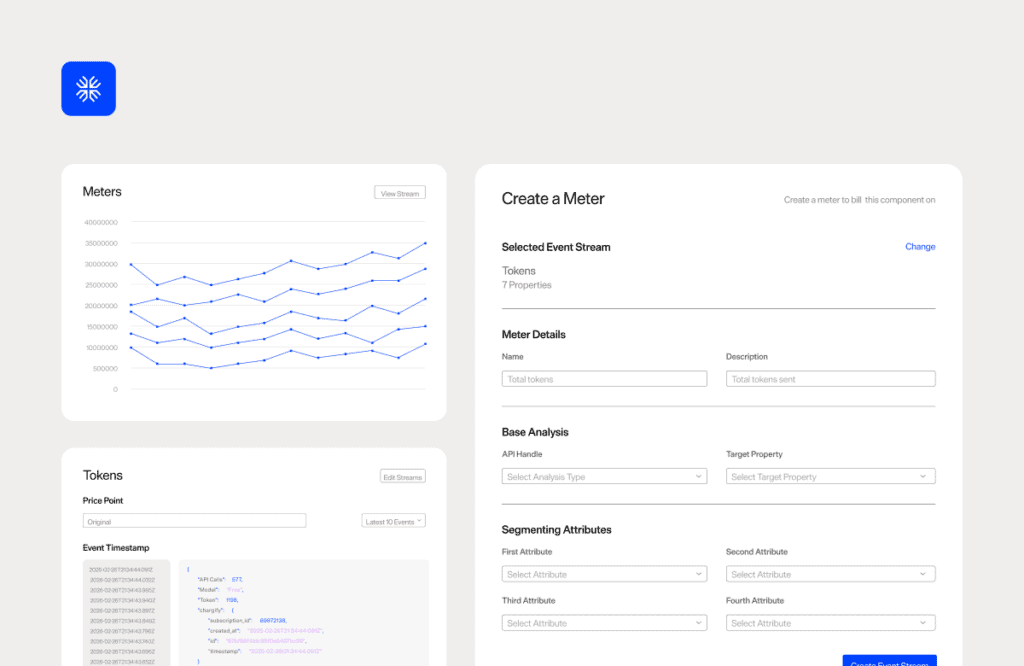
Metered billing at scale. Can your system ingest high-frequency usage events, potentially millions per month for an AI product with active enterprise customers, and rate them accurately against tiered pricing? Batch processing that runs nightly is not sufficient when customers expect real-time or near-real-time usage visibility.
Credit and prepayment management. Can your billing infrastructure track prepaid credit balances at the customer level, apply consumption against those balances in the correct order, trigger replenishment or renewal workflows automatically, and report on remaining credit liability for your balance sheet? This is not a payments problem. It is a billing operations problem.
Hybrid model support. Most mature AI products end up on a hybrid model: a committed base plus metered overage. Your billing system needs to handle both the recurring subscription component and the variable usage component on a single invoice, with correct revenue recognition treatment for each.
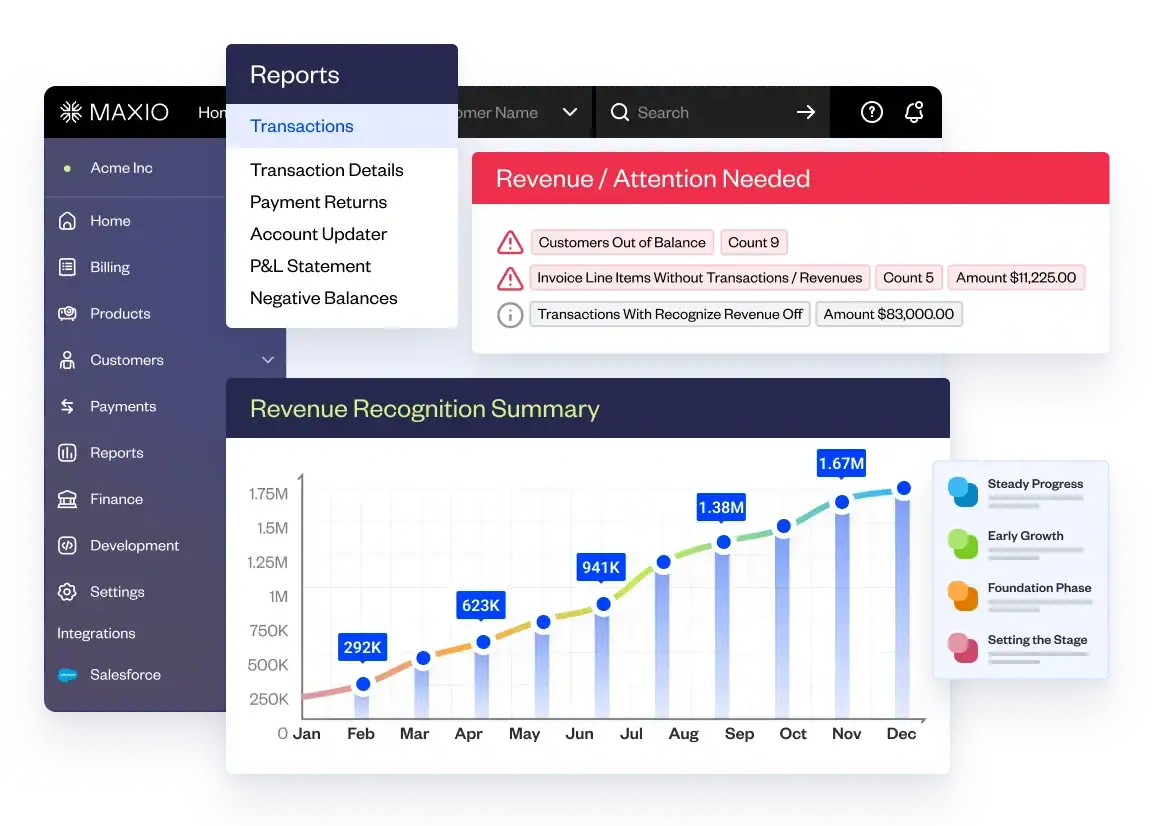
Audit-ready revenue recognition. ASC 606 does not care that your product is AI-powered. Variable consideration, standalone selling price allocations, and performance obligation timing all apply. If your billing system cannot produce a clean revenue waterfall that your auditors can follow, you have a compliance exposure.
For a practical framework on how finance teams are approaching these infrastructure decisions, our CFO’s framework for implementing AI correctly webinar is worth watching before your next planning cycle.
The Cost of Waiting
The companies that feel this most acutely are the ones that added an AI product line to an existing SaaS business without auditing their billing infrastructure first. The product team ships. Sales starts closing deals. Then finance ops discovers the billing system cannot rate usage correctly, invoices are wrong, and the revenue recognition schedule lives in a spreadsheet.
Finance teams managing AI-driven revenue models commonly report a cluster of downstream costs when the billing stack was not ready at launch: delayed cash collection on invoices that customers dispute because amounts look inconsistent, complications tied to revenue recognition treatment of variable consideration, and significant time spent each quarter on manual reconciliation rather than close work. Enterprise customers who expected usage transparency and received none are also a frequently cited churn driver in these situations.
These are patterns, not guarantees. But they are consistent enough that waiting until after launch to address your billing infrastructure is a meaningful risk, not a minor inconvenience.
How to Audit Your Billing Infrastructure Before the Next AI Product Launch
A practical starting point is a billing model audit against your current and planned AI product lines. Ask three questions:
- What is the unit of value your AI product delivers (tokens, calls, minutes, outcomes) and can your billing system rate that unit accurately at the volume you expect in 12 months?
- Does your current billing infrastructure support prepaid credit balances with automatic replenishment, or does that require manual intervention today?
- Can your revenue recognition process handle variable consideration under ASC 606 without a parallel spreadsheet?
If the answer to any of those is no, or not without significant engineering, you have a gap worth closing before your next AI product launch.
Stripe’s data on AI spending growth is a signal worth paying attention to. But the action it should prompt for finance operations is not a pricing strategy review. It is a billing infrastructure audit.
Start there.