Why You Can’t Trust AI Without a Connected Finance Stack




AI is quickly becoming part of the everyday conversation in finance.
Forecasting. Variance analysis. Anomaly detection. Scenario modeling. The promise is that AI will help finance teams move faster, see more clearly, and spend less time buried in manual work. And in many cases, that promise is real. AI has the potential to fundamentally change how finance operates.
But there’s a hard truth that often gets lost in the excitement:
AI doesn’t make finance smarter on its own. It simply reflects the quality of the systems underneath it.
If your finance stack isn’t connected, if your data isn’t clean, consistent, and governed, you can’t trust what AI tells you. And in finance, trust is everything.
AI Doesn’t Fix Broken Data. It Scales It
There’s an understandable assumption that AI will somehow “figure it out.” That it will reconcile inconsistencies, smooth over gaps, and magically turn messy data into insight.
That’s not how it works.
AI models are incredibly good at identifying patterns and extrapolating trends. But they don’t know which numbers are “right.” They don’t understand business context unless that context is embedded in the data itself. When you feed AI fragmented or conflicting inputs, it doesn’t correct them. It amplifies them.
If your CRM says one thing, your billing system says another, and your general ledger reflects a third version of reality, AI won’t resolve the disagreement. It will confidently analyze all three and give you an answer that looks authoritative and is fundamentally unreliable.
In finance, that’s a problem. Speed without accuracy doesn’t create advantage. It creates risk.
Fragmentation Is the Real Barrier to Intelligence
Most finance teams aren’t held back by a lack of effort or talent. They’re held back by fragmentation.
Revenue data lives across multiple systems. Contract changes don’t flow cleanly through billing. Usage data is difficult to reconcile with invoicing. Revenue recognition depends on manual intervention. Reporting metrics vary depending on who pulled them and when.
This fragmentation already makes closing the books harder than it needs to be. It slows down forecasting. It forces finance teams into constant reconciliation mode. It undermines confidence in the numbers — even when everyone is doing their best.
Now add AI to that environment.
Instead of spending time reconciling data manually, you’re reconciling AI outputs. Instead of debating assumptions in a forecast, you’re debating whether the forecast is grounded in reality at all. The work doesn’t go away, it just shifts.
AI exposes weaknesses in system design. It rewards companies that have invested in clean, connected infrastructure, and it punishes those that haven’t.
Finance-Grade AI Requires Finance-Grade Foundations
Finance isn’t like every other function. The bar is higher.
AI that supports finance decisions has to meet standards that go beyond speed or convenience. It needs to be explainable, auditable, and consistent. You need to understand not just what the answer is, but why it’s the answer.
That’s especially true as AI moves from being assistive to being more autonomous. When AI starts surfacing risks, flagging anomalies, or influencing decisions, finance leaders need to be able to trace every insight back to underlying transactions and rules.
That kind of trust doesn’t come from the AI layer. It comes from the data layer.
Until billing events, revenue schedules, contract changes, and reporting metrics are flowing from a single, connected source of truth, AI can’t reliably support the kinds of decisions finance teams are responsible for.
Why Trust Has to Come Before Automation
Finance teams have learned this lesson before: automating a broken process doesn’t fix it. It just helps you repeat mistakes faster.
AI follows the same rule.
Before you ask AI to forecast revenue or explain variance, you need confidence in the fundamentals:
- Contracts reflect reality
- Billing aligns with those contracts
- Revenue recognition follows consistent rules
- Metrics are derived from the same underlying data
Without that alignment, AI isn’t giving you foresight. It’s giving you false confidence.
That’s why so many AI initiatives in finance stall or disappoint. The technology works. The models work. The infrastructure underneath doesn’t.
What Changes When Systems Are Truly Connected
When finance systems are genuinely connected and not loosely integrated, not patched together with spreadsheets, the role of data changes.
Instead of being something you constantly reconcile, data becomes something you rely on.
In a connected finance stack:
- Revenue events flow cleanly from quote to billing to recognition
- Changes propagate automatically instead of triggering downstream clean-up
- Reporting metrics are consistent by definition, not by effort
- Close cycles shrink because fewer questions need to be answered manually
This is the environment where AI starts to deliver real value.
Now AI can:
- Surface anomalies that actually matter
- Identify trends early enough to act on them
- Maintain rolling forecasts instead of static snapshots
- Highlight risks before they turn into surprises
At that point, finance begins to shift from a system of record to a system of action — not because AI is “smarter,” but because the foundation is finally strong enough to support it.
The CFO’s Role Is Evolving Deliberately
CFOs today are expected to provide faster answers, deeper insight, and greater strategic guidance than ever before. That expectation didn’t start with AI, but AI has accelerated it dramatically. Boards want to understand performance in near real time. CEOs want forward-looking insight, not just explanations of what already happened. Investors expect confidence under scrutiny, even as business models and pricing grow more complex.
AI can absolutely help finance leaders meet those expectations. But only if it’s adopted thoughtfully, and only if the underlying systems are designed to support that speed and complexity.
For many CFOs, this represents a real shift in how the role is defined. Finance can no longer operate primarily as a reporting function that looks backward and reconciles after the fact. The role is moving toward something more dynamic: a continuous decision engine that helps the business see what’s coming, understand tradeoffs, and act with confidence.
That shift doesn’t happen by layering AI on top of yesterday’s workflows.
The temptation right now is to chase tools and features—to look for AI that promises instant insight or faster answers. But the more durable approach is to invest in infrastructure and operating discipline first. Intelligence follows structure. It doesn’t replace it.
That means CFOs have to be willing to step back and ask some uncomfortable but necessary questions:
- Where does our revenue data actually originate, and how many times does it change before it reaches reporting?
- How many versions of key metrics exist today across finance, sales, and operations?
- What breaks or requires manual intervention when something changes mid-contract or mid-period?
- How much of our close is true automation, and how much is cleanup driven by disconnected systems?
These aren’t academic questions. They determine whether AI becomes a strategic advantage or just another source of noise.
When finance leaders get this right, the payoff goes beyond efficiency. A connected, trustworthy foundation allows CFOs to move from reacting to results to shaping outcomes—to surface risks earlier, model scenarios with confidence, and guide the business through change instead of scrambling to explain it after the fact.
AI doesn’t eliminate the need for judgment or leadership in finance. If anything, it raises the bar. It forces clarity around definitions, ownership, and data integrity. And it puts the spotlight back where it belongs: on the CFO as the steady hand guiding the business forward, not just the one closing the books.
AI doesn’t eliminate the need to answer these questions. It forces them to the surface — and rewards the finance leaders who are willing to address them head-on.
The Quiet Winners of the AI Era
Over the next few years, AI in finance will be judged less on novelty and more on outcomes. Boards and investors won’t care how advanced your models are if the numbers don’t hold up under scrutiny.
The companies that succeed won’t necessarily be the loudest about AI. They’ll be the ones with:
- Clean, connected financial data
- Systems designed for change, not static assumptions
- Confidence in their metrics, even as complexity grows
In those organizations, AI won’t feel like a separate initiative. It will simply be how finance operates.
Start With Trust
AI is becoming part of finance whether teams feel ready or not. The real question isn’t if you’ll use it. It’s whether you’ll trust it.
And trust doesn’t come from algorithms. It comes from foundations.
Connect the systems. Clean up the data. Build finance infrastructure that reflects how your business actually operates today, not how it operated when pricing was simple, contracts were static, and reporting cycles moved more slowly.
When your finance stack is connected, AI stops being a source of uncertainty and starts becoming a genuine advantage. You can move faster without losing confidence, automate without introducing risk, and make decisions based on signals you actually trust.
If you’re thinking about how AI fits into your finance organization, the best place to start isn’t with a tool. It’s with your foundation.
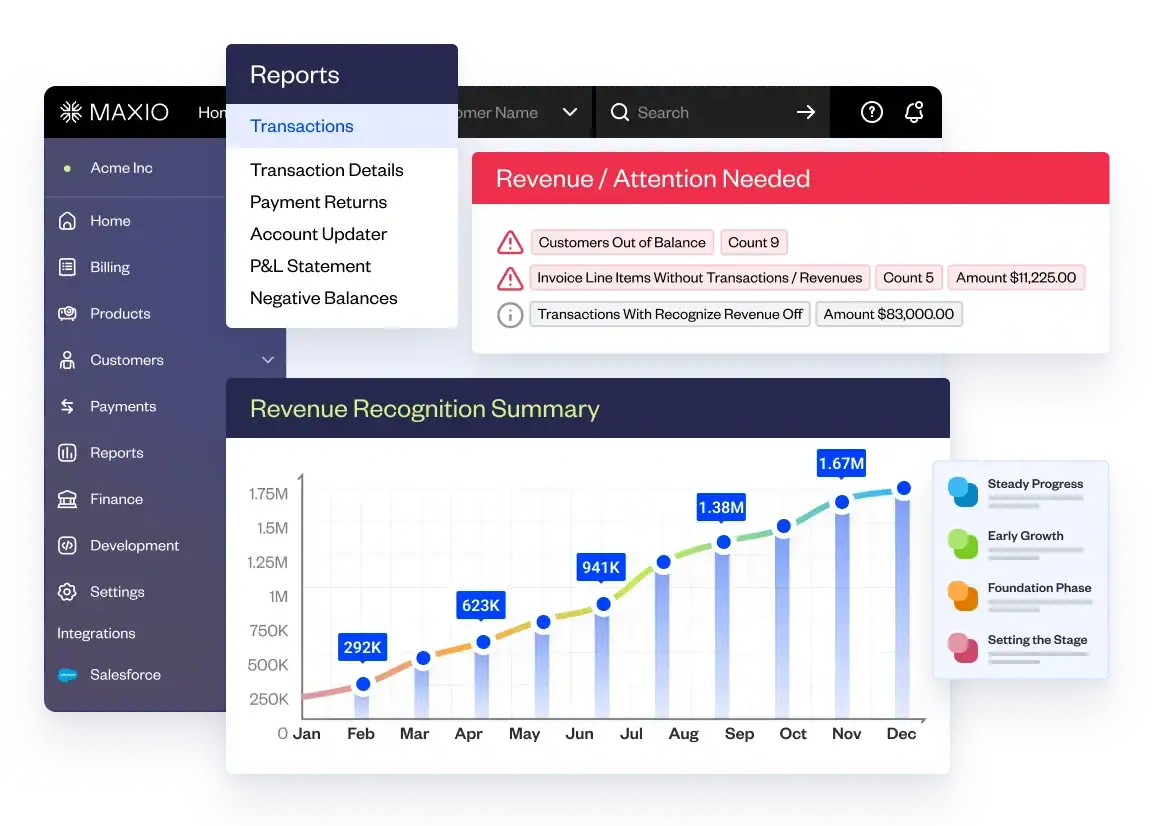
That’s exactly what Maxio is built to provide. We help finance teams unify billing, revenue recognition, and reporting into a single, trusted system so when you’re ready to move faster and operate smarter, the data is already there.
If you’d like to see what that looks like in practice, you can request a Maxio demo and explore how a connected finance stack can support intelligent, confident finance operations as your business scales.