The Next Frontier of Finance: How AI Builds on Unified Data



AI is changing the conversation in finance—but not in the way most people expect.
Instead of simply accelerating existing workflows, AI is exposing how finance data is structured, where systems break down, and whether insight can actually be trusted.
Much of the discussion focuses on models, tools, and features: what AI can automate, how fast it can analyze data, or which workflows it can replace. Those conversations aren’t wrong, but they miss the more important point. In finance, AI doesn’t create intelligence on its own. It depends entirely on the shape, consistency, and connectivity of the data underneath it.
That’s why some finance teams are seeing meaningful gains from AI today, while others are left with impressive demos that don’t translate into real decisions or confident action. The difference isn’t the sophistication of the AI. It’s whether the underlying finance data is unified.
AI Is Only as Good as the Data It Can See
At a technical level, this isn’t a new idea. Any system designed to analyze or predict outcomes depends on clean inputs. But finance data presents a unique challenge.
Revenue data is rarely housed in a single place. Customer records live in CRM systems. Contracts define commercial terms. Billing systems generate invoices and usage charges. Revenue schedules apply accounting rules. General ledgers roll everything up for reporting. Each system plays a role—but too often, they operate in partial isolation.
When those systems aren’t aligned, AI doesn’t fail loudly. It fails quietly—and that’s what makes the problem hard to spot.
Forecasts drift. Anomaly detection flags false positives. Trend analysis produces conflicting signals. The output looks polished, but finance teams still have to reconcile the answer before they can trust it. At that point, AI hasn’t removed work—it’s just shifted it.
Why Unified Data Changes the Equation
Unified finance data doesn’t just make reporting easier. It fundamentally changes what AI can do—and how useful it is to finance teams day to day.
When quote-to-cash data flows cleanly from CRM to billing to revenue recognition to the general ledger, every downstream analysis benefits. AI models no longer have to infer relationships between mismatched datasets. They operate on a coherent picture of how revenue is actually generated, billed, and recognized.
That coherence unlocks intelligence that isn’t possible in fragmented environments.
Instead of reconciling numbers, finance teams can focus on interpreting signals and making decisions while the information is still timely. Instead of debating which metric is correct, they can spend time understanding why it changed and what it means for the business.
Where AI Actually Delivers Value in Finance
When finance data is unified, AI becomes practical rather than theoretical. Some of the most impactful use cases aren’t flashy—they’re foundational.
Forecasting That Updates With Reality
Traditional forecasts are point-in-time exercises. They rely on historical data snapshots and manual assumptions, which quickly become outdated as deals change or usage patterns shift.
With unified data, AI can maintain rolling forecasts that update as new signals arrive—new bookings, contract changes, usage spikes, or churn indicators. The forecast doesn’t just move faster; it stays closer to reality.
Anomaly Detection That Finance Teams Can Trust
Anomaly detection is only useful when teams trust the baseline. In fragmented systems, AI often flags issues that turn out to be artifacts of timing differences or data mismatches.
Unified data removes much of that noise. When billing, revenue, and reporting are aligned, anomalies are more likely to reflect real issues—missed charges, contract misconfigurations, or unexpected usage behavior—rather than reconciliation artifacts.
Trend Analysis with Context
AI is excellent at spotting patterns, but patterns without context can be misleading—especially in revenue data, where timing, contract structure, and usage all matter. Unified data gives AI the context it needs: contract terms, pricing models, usage metrics, and revenue treatment all connected in one view.
That allows finance teams to distinguish between healthy growth, temporary spikes, and emerging risks—without stitching together multiple reports to get the full picture.
Why AI Struggles in Fragmented Finance Stacks
It’s tempting to assume that better or more advanced models will solve these problems. In practice, the limitations are structural.
When CRM, billing, and accounting systems aren’t connected:
- AI has to reconcile differences before it can analyze trends
- Forecast accuracy depends on manual overrides
- Insights require explanation before they can drive action
In those environments, AI becomes an analytical layer that sits on top of broken workflows instead of reinforcing them. The result is intelligence that looks impressive but feels unreliable.
Unified data flips that dynamic. AI becomes embedded in the workflow rather than bolted on after the fact.
Intelligence Emerges from the System Design
One of the most common misconceptions about AI in finance is that intelligence is something you add on top of existing systems.
In reality, intelligence emerges from how systems are designed to work together.
When finance teams invest in unifying their revenue stack—connecting CRM, billing, revenue recognition, and reporting—they create the conditions where AI can operate continuously. Signals flow naturally. Metrics stay aligned. Insights don’t require translation.
In that environment, AI doesn’t replace human judgment. It supports it by surfacing patterns early, maintaining context, and reducing the manual work that slows decision-making.
What This Means for Finance Teams
For finance teams thinking about AI, the takeaway is straightforward but often overlooked: start with the data architecture, not the tooling.
Before asking what AI can do, ask:
- Are our core revenue systems connected?
- Do we have a single source of truth for key metrics?
- Can changes flow through the system without manual cleanup?
If the answer to those questions is no, AI initiatives will struggle to deliver consistent value—no matter how advanced the tools are.
Building Toward Intelligent Finance Operations
The finance teams seeing the most value from AI aren’t chasing every new capability. They’re building toward a unified foundation that supports intelligence by design.
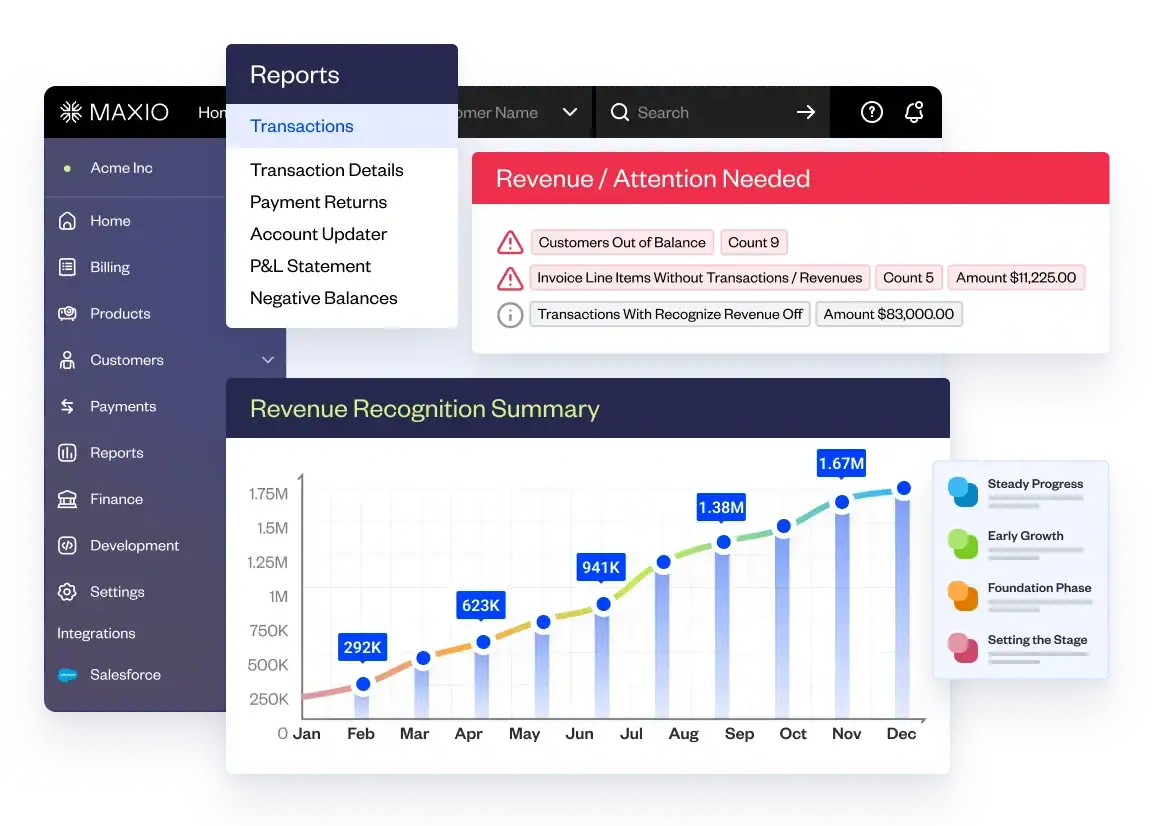
That’s where platforms like Maxio come in. By unifying billing, revenue recognition, and reporting, finance teams can create the clean, governed data flows that AI depends on. Intelligence becomes a natural extension of daily operations—not a separate project.
When data is unified, AI stops being a promise and starts becoming a practical advantage. Finance teams move faster, make better decisions, and spend less time questioning the numbers behind the insights.
If you’re exploring how AI fits into your finance organization, the most effective first step isn’t choosing a model or a tool. It’s unifying the data that powers your revenue lifecycle.
You can request a Maxio demo to see how a connected finance stack supports intelligent, data-driven finance operations as your business scales.