Your Usage-Based Pricing Model Is Only as Good as Your Metering



Usage-based pricing is one of the most powerful alignment tools in SaaS: customers pay for what they use, revenue scales with value delivered, and the pricing model itself becomes a growth mechanism. For AI products especially, it’s the only model that accurately reflects how value is generated.
But the model is only as good as the data behind it. Metering, the infrastructure that captures what your product does and translates it into billable events, is what makes usage-based pricing work in practice. Get it right and you have a pricing engine that scales with your product. Get it wrong and the model that was supposed to align you with your customers starts working against you.
This is not an argument against usage-based pricing. It’s an argument for building the foundation correctly from the start.
Why Metering Is the Foundation, Not a Feature
Every billable action in a usage-based model has to be captured accurately, consistently, and in a format your billing system can use. For AI products, that means simultaneously tracking agent executions, workflow runs, tokens processed, API calls, and data volume across different customer environments with different timing and granularity requirements.
The margin for error is low, and not because customers are adversarial. It’s because they’re paying close attention. When billing is tied directly to consumption, customers check their numbers. When your numbers and theirs diverge, trust erodes quickly regardless of who is actually right.
There’s also a timing problem that catches many teams off guard. Early metering implementations often rely on batch processing: collecting usage events throughout the day or week and reconciling them on a delay. That works until customers start asking why their usage dashboard doesn’t match their invoice, or why charges appeared for a period they believed had already closed. Real-time metering addresses the problem, but it introduces infrastructure requirements around event ingestion, deduplication, and latency that are easy to underestimate.
The honest reality: metering infrastructure requires more investment than most companies initially budget for. It is not a footnote in the implementation plan. It is the implementation plan.
What Good Metering Actually Looks Like
Companies that get this right share a consistent approach.
Real-time usage data capture. Billable events are recorded as they occur, not approximated from system logs or batched for later processing. This gives finance teams and customers reliable visibility into consumption as it happens, which reduces disputes and simplifies close cycles.
Flexible tracking of custom metrics. No two products measure value the same way. Solid metering infrastructure supports custom value metrics across tokens, tasks, API calls, and transactions without requiring engineering work every time the pricing model changes.
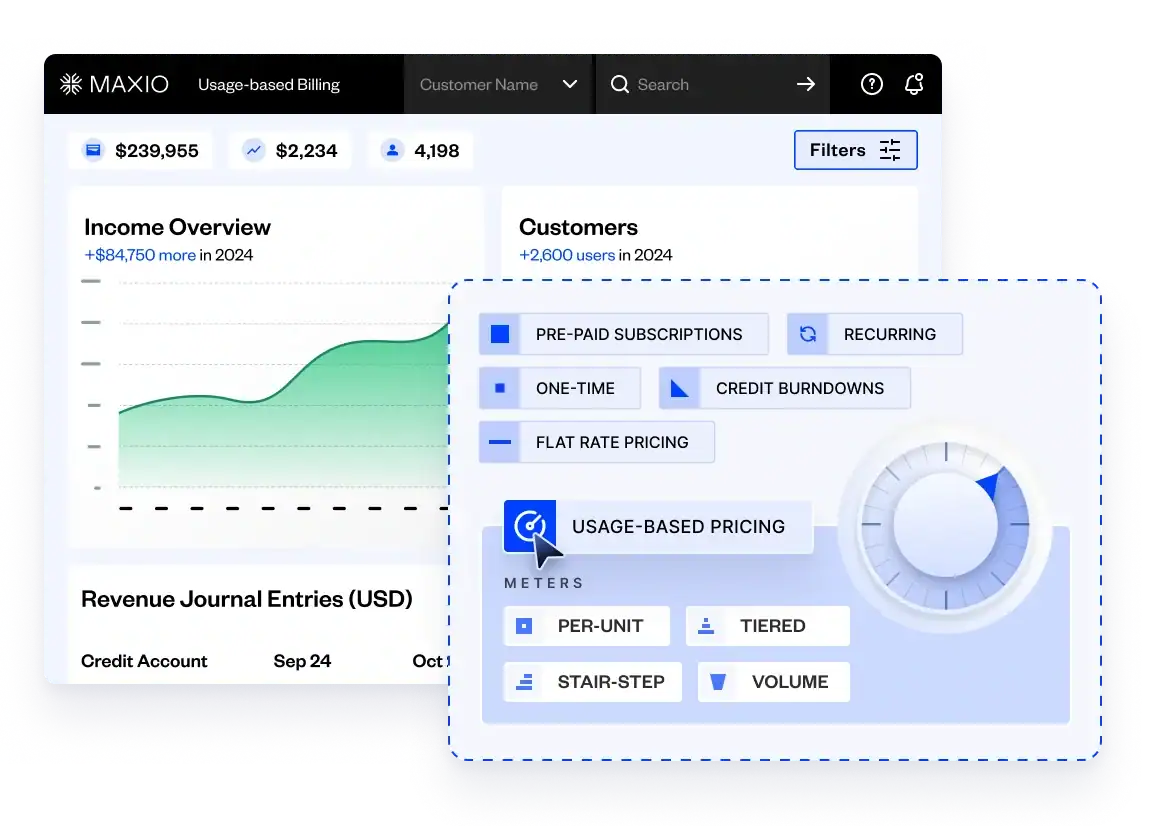
Rules-based pricing engines. Usage data needs to flow into a pricing engine that handles tiers, overages, minimum commitments, and hybrid structures. Without that layer, even accurate usage data produces incorrect invoices.
Scalability for usage spikes. AI workloads generate sudden, significant increases in event volume. A metering system that keeps pace at average load but falls behind during spikes creates exactly the gaps that produce billing errors. The infrastructure needs to scale with demand, not just handle it on a good day.
Audit trails customers can trust. Customers on consumption models want visibility into their usage. Making that data accessible through dashboards or invoices reduces disputes before they start and supports the long-term trust that holds accounts together at renewal.
What Happens When It’s Built Poorly
The failure modes follow a predictable pattern and tend to compound.
Billing errors and disputes. Incomplete or inconsistent usage data produces invoices that don’t reflect reality. Some customers get overcharged and push back. Others get undercharged, and the revenue loss goes unnoticed until someone runs a reconciliation.
Revenue leakage. Undercounting is the quieter and more dangerous failure. When your metering system misses events due to dropped API calls, batch processing delays, or gaps in event capture, you’re delivering value you’re not getting paid for. For AI products where a single workflow run can trigger hundreds of downstream events, a metering gap of even a few percent translates to meaningful lost revenue at scale.
Downstream reporting failures. Unreliable usage data produces unreliable financial reporting. Revenue recognition becomes harder to defend, forecasting models lose their grounding, and as consumption-based models become more prevalent, auditors are paying closer attention to how companies recognize revenue from usage-based contracts. Metering records that can’t withstand scrutiny aren’t just an operational problem. They’re a financial reporting liability.
Customer trust erosion. When customers can’t independently verify their usage or reconcile their invoices, they begin to question the pricing model itself. Disputes that better data visibility would have prevented turn into contract renegotiations or churn.
Usage-based pricing done well is a competitive advantage. It aligns your revenue with the value you deliver, lowers acquisition barriers, and creates a natural growth engine as customers expand their usage. The companies that capture that upside are the ones that treat metering as a first-class investment, not an implementation detail to revisit later.
Building it correctly from the start costs less than fixing it after your customers have already found the problems.
Ready to build on metering infrastructure you can trust? See how Maxio handles usage capture, billing automation, and real-time reporting for SaaS and AI businesses.