Ordway vs. Maxio: Which Model Fits Your Finance and RevOps Stack?

Ordway and Maxio share a similar goal: to give growing SaaS companies more control over how revenue flows through their business. Both were built for teams that have outgrown Stripe’s developer simplicity and need something more flexible than Recurly’s subscription engine.
Where they differ is in philosophy.
- Ordway believes control should live in configuration: the freedom to model any pricing scenario, workflow, or exception.
- Maxio believes control should live in structure: one unified system where contracts, billing, and revenue recognition stay in sync by design.
For many teams, Ordway’s flexibility is a welcome change. It lets you adapt quickly, test new models, and move faster without engineering support. But as complexity grows, that same flexibility can start to feel like fragility. Each new rule, product, or discount adds another layer of configuration to maintain, and the balance between control and consistency begins to slip.
Let’s take a closer look at what Ordway does well, where its approach can start to strain as you scale, and how Maxio offers a different path to the same goal: smarter, more reliable control over your revenue.
Where Ordway Shines (and Why Teams Choose It)
Ordway earns its reputation. It’s a functional platform, built for teams who actually live inside their billing systems. If Stripe is developer-first and Zuora is enterprise-first, Ordway is operations-first, a sandbox for teams that like to tweak, tune, and fine-tune again.
For SaaS companies with multiple product lines or unconventional deal structures, Ordway’s configurability feels like freedom. It’s tailor-made for teams that outgrew Stripe’s simplicity but aren’t ready for Zuora’s six-month implementation cycle.
It also plays nicely across the ecosystem. Integrations with CRMs like Salesforce, ERPs like NetSuite or Intacct, and payment gateways like Stripe, Chargebee, or Recurly give it credibility as a flexible middle ground—more customizable than plug-and-play tools, but far lighter than enterprise billing stacks.
And to its credit, Ordway’s customer success team has built a reputation for responsiveness. They’ll roll up their sleeves and help you build exactly what you want, even if what you want is complicated.
But that’s where the story starts to shift. Because the same flexibility that makes Ordway powerful also makes it precarious. When your billing logic starts needing its own version control, something’s off.
How Configuration Debt Builds (and Why It Hurts)
Every team starts with good intentions. A quick rule here, a custom workflow there, and just enough configurations to make the system “fit how we work.”
Before long, you’ve got a billing system that technically works — but only because a few people know exactly how it works.
This is configuration debt. It’s not the result of bad decisions; it’s the accumulation of reasonable ones. Each configuration layer fixes something local but adds another point of failure globally. You end up with a system that’s “tailored,” but only in the way an overpatched quilt is: unique, functional, and one tug away from unraveling.
Documentation also rarely keeps pace with the rate of change. Ownership gets tribal. RevOps becomes the keeper of “how things are wired.” Finance stops asking why revenue numbers look off and starts asking who to talk to.
By the time teams notice, the billing platform has stopped being a system of record and become a system of memory, dependent not on rules, but on the people who remember them.
The Billing Control Curve: From Configuration to Command
Every SaaS company eventually has to answer one uncomfortable question: Are we running our billing system or is it running us?
For teams on Ordway, that answer often depends on where they are in their operational maturity. What starts as agility slowly becomes overhead, and the system that once gave you control starts demanding more of it.
Below is what that evolution usually looks like:
| Stage | Mindset | Typical Stack | What Works | Where It Breaks | What You Need Next |
| 1. The Builders | “We can make it do anything.” | Ordway + CRM + Sheets | Total control, rapid iteration, endless customization. | Rule sprawl, dependency confusion, slow audits. | Standardization + policy governance. |
| 2. The Operators | “We can manage it.” | Ordway + ERP + custom integrations | Partial automation, flexible workflows that support complexity. | Maintenance fatigue, version drift, and manual reconciliation. | Centralized contract logic + unified data model. |
| 3. The Controllers | “We can trust it.” | Maxio + ERP + CRM | Structured automation, finance-grade integrity, audit-ready reporting. | — | Predictable, scalable revenue command. |
You can almost plot the pain curve alongside ARR growth:
- Stage 1 feels empowering because you’re building fast, shipping faster, solving problems in real time.
- Stage 2 feels responsible because you’re managing the chaos, adding structure, closing the books (eventually).
- Stage 3 feels different because it is calm, predictable, and boring in the best possible way.
At this stage, Finance isn’t chasing down exports or wondering which automation is correct, RevOps isn’t patching workflows to keep up with exceptions, and leadership isn’t asking, “Which number should we use?”
What Maxio Actually Changes (Beyond ‘Automation’)
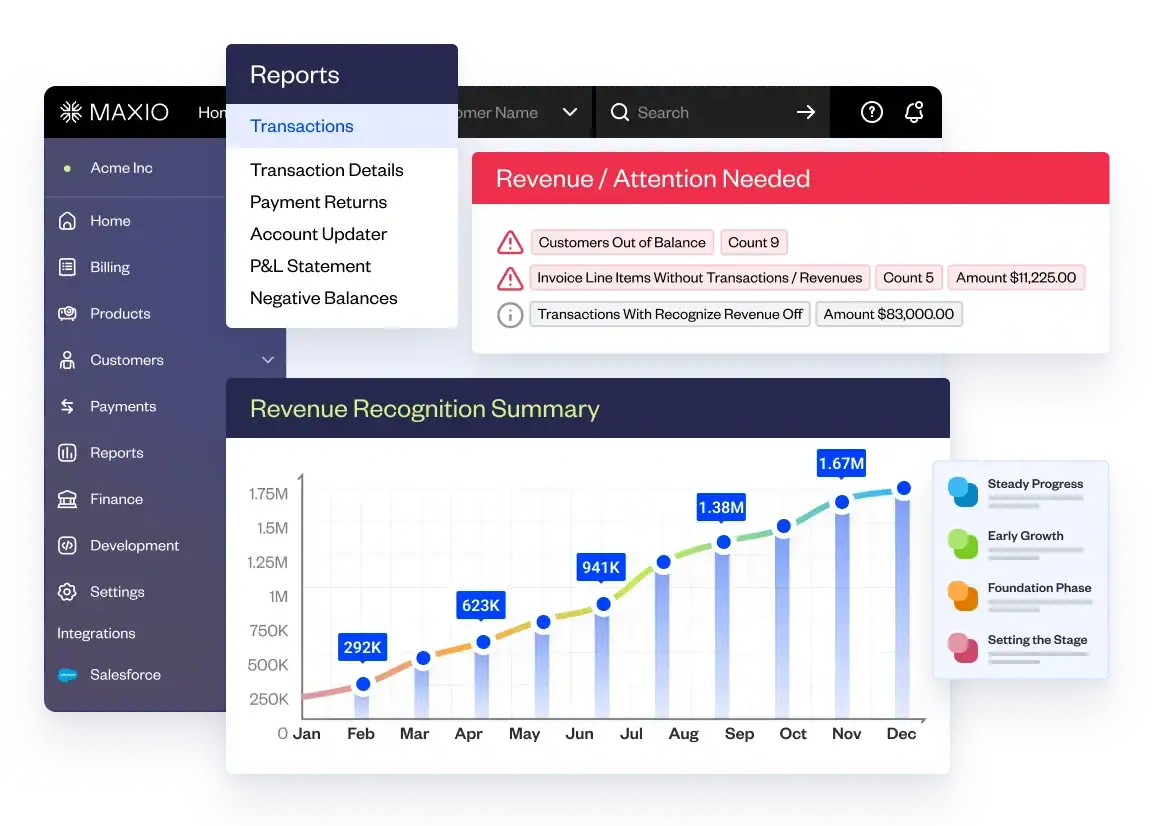
Maxio doesn’t offer automation for automation’s sake. It offers structure that scales. Where most systems trade flexibility for control, Maxio gives you both, but in the right order. It lets Finance set the rules and Revenue Ops adapt within them, instead of the other way around.
Here’s what that looks like in practice:
- Policy-driven automation: Define once, apply globally. Billing cadence, revenue recognition, and amendment logic all live inside one policy engine. The rules stay consistent whether you’re sending one invoice or one thousand.
- Unified contract model: One source of truth from quote to cash. The same contract data powers your CRM, your invoices, and your GL, eliminating the translation layer that causes revenue drift between systems.
- Governed flexibility: Pricing or billing changes no longer require reengineering. Guardrails keep everything compliant, so Finance can approve a new rule without worrying about what it breaks downstream.
- Finance-grade precision: ARR, NRR, churn, and expansion all flow directly from contract events—not from stitched-together exports. Your metrics finally match your books, and your books match what you tell investors.
- Audit clarity: Every rule, every event, every schedule is explainable. Auditors get lineage, not lore.
Configuration vs. Control: How Ordway and Maxio Differ in Practice
By the time you’re comparing Ordway and Maxio, you’re not shopping for features, you’re evaluating operating models.
Ordway’s flexibility lives in configuration. Maxio’s control lives in structure. Both can get you to the same billing outcome, but only one will get you there without adding another layer of maintenance.
Here’s how the two philosophies play out in practice:
| Capability | Ordway | Maxio |
| Configuration flexibility | Extensive, manual rules and the freedom to build anything + the burden to maintain everything. | Policy-based, governed automation that scales without manual intervention. |
| Revenue recognition (ASC 606) | Custom scripts or spreadsheets; partial automation dependent on ops oversight. | Native, event-driven schedules tied directly to contract activity. |
| Policy governance | Ad-hoc, user-dependent; logic distributed across admin settings and workflows. | Centralized, version-controlled policy engine managed by Finance. |
| Change management | Manual testing, fragile dependencies; risk of regression with every update. | Safe, auditable workflows that adapt without re-engineering. |
| Multi-entity support | Configured separately per entity; limited consolidation visibility. | Built-in global consolidation with automated rollups. |
| Data model | Disconnected objects; billing, CRM, and ERP each tell a slightly different story. | Unified contract schema—one system, one truth. |
| Audit trail | Log-based; good for tracking activity, not for explaining outcomes. | Full event lineage from quote → contract → invoice → GL. |
| Maintenance load | High; requires ongoing ops oversight and periodic rebuilds. | Minimal; rules live in policy, not configuration sprawl. |
| Implementation time | 3–6 months typical, plus continual tuning. | Weeks to first value, built to stay consistent as you scale. |
Ordway gives you every wrench in the toolbox and trusts you to build carefully. Maxio gives you the blueprint and the confidence to build right the first time.
Ordway vs. Maxio FAQs
If you’ve been living in Ordway for a while, switching platforms can sound like swapping one kind of complexity for another. Totally fair. Let’s talk through what really changes, and what doesn’t.
Can we keep Ordway for a while?
Yes. Maxio integrates cleanly with Ordway, so you can migrate in phases. Many teams start by connecting revenue recognition and reporting first, then move billing when it makes sense. No rip-and-replace, no disruption to collections.
Isn’t Maxio less customizable?
It’s more structured, not less flexible. You still configure; you just stop breaking things in the process. Maxio gives you flexibility inside guardrails, which means pricing experiments, usage tiers, and contract amendments can evolve without creating new reconciliation work for Finance.
Does Maxio play well with Stripe, Zuora, or Recurly?
Absolutely. Maxio often complements or replaces parts of those stacks depending on your scale. Keep Stripe for payments if you want, keep Recurly for renewals, and use Maxio as the financial source of truth that ties everything together from contracts, to recognition, and reporting.
How fast can we see ROI?
Most teams close a clean, reconciled month within their first quarter on Maxio. Implementation is measured in weeks, not fiscal years. You’ll spend less time fixing exports and more time analyzing results that actually match your books.
Who owns it?
Finance leads. RevOps enables. Everyone trusts the output. That’s the whole point—one system that supports both teams instead of sitting between them.
Change is always uncomfortable, but it doesn’t have to be chaotic. With Maxio, you can keep what’s working, clean up what’s not, and finally give both Finance and Ops a system that speaks the same language.
Should you move from Ordway to Maxio?
Ordway gives you the flexibility and power to shape billing around your business, and Maxio gives you structure—a system that scales without constant reconfiguration.
You don’t need to rebuild everything you’ve made. You just need to decide whether the way you manage revenue today still fits the way your business operates now.
If configuration has become maintenance, it’s probably time for structure. Maxio turns that structure into finance-grade confidence so you can grow without the drag of configuration debt.
See how Maxio brings order to complex billing and gives Finance and RevOps a system they can finally trust. Get a demo.