
Recurly vs. Maxio: The Finance Buyer’s Guide to Outgrowing Subscription Management



Recurly is the billing comfort zone. It’s clean, dependable, and easy to love—the kind of system you set up once and then forget about. It hums in the background, handling renewals, retries, and receipts while you focus on growth.
And for a long time, that’s exactly what you need. No fuss. No firefighting. Just recurring revenue doing what it’s supposed to do: recur.
But growth changes the equation. Suddenly, the questions get harder:
- “Can we recognize revenue by contract instead of by invoice?”
- “How do we report ARR across currencies?”
- “Can Finance see what’s happening without exporting everything to Excel?”
That’s when you realize you’re running a business on billing data that’s technically correct, but not financially complete. The system still “just works,” but only for the part of the business that stopped evolving years ago.
Let’s talk about where Recurly shines, what starts to slip as you scale, and how Maxio helps you keep the stability you love while gaining the financial visibility, predictability, and confidence your investors expect.
Why Recurly Works (Until You Need More)
Recurly earns its reputation. It’s simple, stable, and shockingly easy to get along with. Set up your plans, connect your payment processor, turn on retries, and boom: you’re collecting revenue.
That’s why so many SaaS teams stay on Recurly long after they’ve outgrown it, because for years, it’s been the least of their problems.
But billing systems age quietly. The same simplicity that makes Recurly effortless at $2M ARR starts to feel limiting at $20M. What once gave you peace of mind now gives you pause.
Where Recurly shines
- Predictable renewals: Subscriptions charge, payments clear, and the revenue wheel keeps turning.
- Polished UX: Clean dashboards, intuitive settings, zero learning curve.
- Payment performance: Automated retries, dunning, and gateway reliability baked in.
- Low maintenance: It’s the billing equivalent of “set it and forget it.”
For finance teams, that reliability is gold until the books need reconciling.
Where the cracks start showing
- Revenue recognition lives in Excel. Spreadsheets quietly multiply in the background like gremlins after midnight.
- Contract logic gets messy. Upgrades, discounts, credits, and pauses don’t fit neatly into “recurring billing.”
- Data gets siloed. Billing says one thing, CRM says another, and the ERP is Switzerland.
- Finance visibility fades. You’re running month-end with screenshots and crossed fingers.
Recurly does exactly what it promises: it bills recurring revenue. It just doesn’t manage everything that comes after.
It’s the difference between processing payments and commanding revenue. And that’s where Maxio steps in, turning recurring billing into finance-grade revenue command.
The Recurly Visibility Problem
On the surface, everything looks fine. Invoices go out, payments come in, dashboards stay green.
If you’re the CFO, you might even say, “Billing’s fine. Don’t touch it.” But look a little closer, and the cracks start to show.
A renewal didn’t line up with an upgrade. A credit memo got lost in the shuffle. ARR looks one way in Salesforce and another in Recurly. And the finance team? They’re pulling their “last” export of the month for the fourth time.
No one panics, because technically, Recurly is working. It’s just not telling the whole story.
Here’s how that story plays out inside the company:
- Slack: “Hey, can someone resend that export?”
- Google Drive: “Final_Revenue_Actuals_v7_FOR_REAL.xlsx”
- Board Prep: “Wait, which number are we presenting again?”
- Audit Week: “We’ll fix it next quarter.”
Everyone’s doing their job. But they’re all doing it blind.
Product assumes billing is fine. Sales assumes Finance has it covered. Finance assumes there’s a single source of truth somewhere.
There isn’t.
Recurly gives you recurrence. But without visibility, recurrence turns into a repetition of the same month-end fire drill, over and over.
Comparison to Maxio
The table below compares Maxio and Recurly across key capability areas, drawn from Maxio’s comparison page.
| Billing & Subscription Management | ||
| Feature | Maxio | Recurly |
| Subscription billing | ✓ | ✓ |
| Contract billing | ✓ | ✗ |
| Self-service portals | ✓ | ✓ |
| Multi-attribute rating | ✓ | Limited |
| Advanced prepaid subscriptions | ✓ | Basic only |
| Multi-gateway payments | ✓ | ✓ |
| Go-to-Market | ||
| Product-led | ✓ | ✓ |
| Sales-led | ✓ | Limited |
| Hybrid | ✓ | Limited |
| Revenue & Expense Reporting | ||
| Revenue recognition | ✓ | ✓ |
| End of period reporting | ✓ | ✗ |
| Carve-outs / Reallocations | ✓ | ✗ |
| Expense recognition | ✓ | ✗ |
| Integrations | ||
| Salesforce (two-way) | ✓ | Limited |
| HubSpot (two-way) | ✓ | Limited |
| Xero (two-way) | ✓ | ✓ |
| QuickBooks (two-way) | ✓ | ✓ |
| NetSuite (two-way) | ✓ | ✓ |
| QuotaPath | ✓ | ✗ |
| Clearbit | ✓ | ✗ |
Who is this ideal for?
Maxio is ideal for:
- SaaS and AI companies scaling beyond simple subscription management
- Finance teams that need revenue recognition tied to contract events, not just invoice dates
- Companies managing contract complexity — upgrades, credits, co-terms, and usage overlays
- Organizations where billing, CRM, and ERP need to share a single source of truth
- Teams preparing for audits, board reporting, or investor due diligence
- Businesses with multi-entity or multi-currency reporting requirements
- Finance leaders who want to run the system, not the other way around
Maxio Pros:
- Purpose-built for SaaS and AI companies with complex revenue models
- Native ASC 606 / IFRS revenue recognition tied to real contract events
- 150+ out-of-the-box SaaS metrics (ARR, NRR, churn, cohorts, CLV:CAC)
- Two-way native integrations: Salesforce, HubSpot, NetSuite, QuickBooks, Xero
- Supports both product-led and sales-led growth motions
- Dedicated onboarding specialists for all customers
- Multi-entity and multi-currency support built in
- Volume-based pricing discounts as you scale
- End-to-end quote-to-cash automation, finance-led
Drillable reporting trusted by investors and auditors
Maxio Considerations:
- Designed for companies ready to invest in a purpose-built finance platform — not a transactional payment tool
- Migration from Stripe is a structured process, ensuring your billing logic and revenue data are set up correctly from day one
- Built for finance and RevOps teams, not just developers — teams that want deeper control will find it worth the onboarding investment
- Best suited for companies that have outgrown simple pricing models and are ready to scale with confidence
Recurly is ideal for:
- B2C companies with high-volume, low-complexity subscription models
- Teams that prioritize clean UX and low-maintenance billing infrastructure
- Businesses with flat-rate or simple tiered pricing and predictable renewal cycles
- Companies in early stages where billing reliability is the primary need
- Teams that want AI-driven dunning and retry logic built in
- Organizations that don’t yet require audit-ready revenue recognition or ERP integration
Recurly Pros:
- Clean, intuitive UX with minimal learning curve — easy to set up and manage
- Reliable subscription renewals with automated retry and dunning logic
- Recurly Compass (launched October 2025): agentic AI that goes beyond dashboards to generate API snippets,launch growth plays, adjust pricing, and trigger retention flows via natural language
- Strong payment performance with multi-gateway support, 140+ currencies, and 140+ payment methods including Pix, MercadoPago, SEPA, and ACH
- Recurly Commerce: Shopify Plus Technology Partner with purpose-built eCommerce subscription management for physical goods brands
- Low-maintenance — billing runs predictably with little ongoing configuration
- Includes native ASC 606 and IFRS-15 revenue recognition for standard subscription billing scenarios
- Good fit for high-volume B2C and eCommerce subscription models
Recurly Considerations:
- Optimized for straightforward subscription models — a natural starting point that many companies outgrow
- Revenue recognition covers standard scenarios but has limitations for complex contract logic such as co-terms, carve-outs, and mid-term modifications
- Salesforce and HubSpot integrations are limited — full two-way sync requires customization or third-party tools
Finance visibility across multi-entity and multi-currency operations requires manual effort - Sales-led and hybrid go-to-market motions have limited native support
- Audit readiness for complex contract portfolios and ERP sub-ledger alignment typically require additional tooling
The Lifecycle of a Subscription Stack
Every SaaS company that starts on Recurly follows a similar path.
At first, Recurly does everything you need. But over time, the demands on billing shift from collecting cash to managing revenue, from renewals to reporting, from efficiency to precision.
Here’s what that progression looks like in practice:
| Stage | Typical Setup | What Works Well | Where It Starts to Break | What You Need Next |
| 1. Early Stability | Recurly + Stripe + Sheets | Simple subscription renewals, clean payment flow, minimal upkeep. | Revenue recognition lives in Excel. Finance has limited visibility into billing events. | Basic automation and consistent reporting. |
| 2. Growing Complexity | Recurly + CRM + ERP exports | Stable billing and solid MRR reporting. | Contract changes, credits, and upgrades require manual fixes. Revenue data lives in silos. | A unified system connecting billing, contracts, and recognition. |
| 3. Financial Maturity | Maxio + ERP + CRM integration | Complete quote-to-cash alignment, automated RevRec, finance-grade metrics. | — | Sustainable visibility and audit-ready confidence. |
Most companies spend longer than they should in Stage 2. It’s the “controlled chaos” phase where the system isn’t broken, but Finance is spending too many hours reconciling exports and building manual workarounds.
That’s usually the signal it’s time to evolve.
You don’t outgrow Recurly because it failed. You outgrow it because your business stopped being just a subscription engine and became a financial operation that demands accuracy, foresight, and confidence in every number.
What Maxio Actually Changes (Beyond Subscriptions)
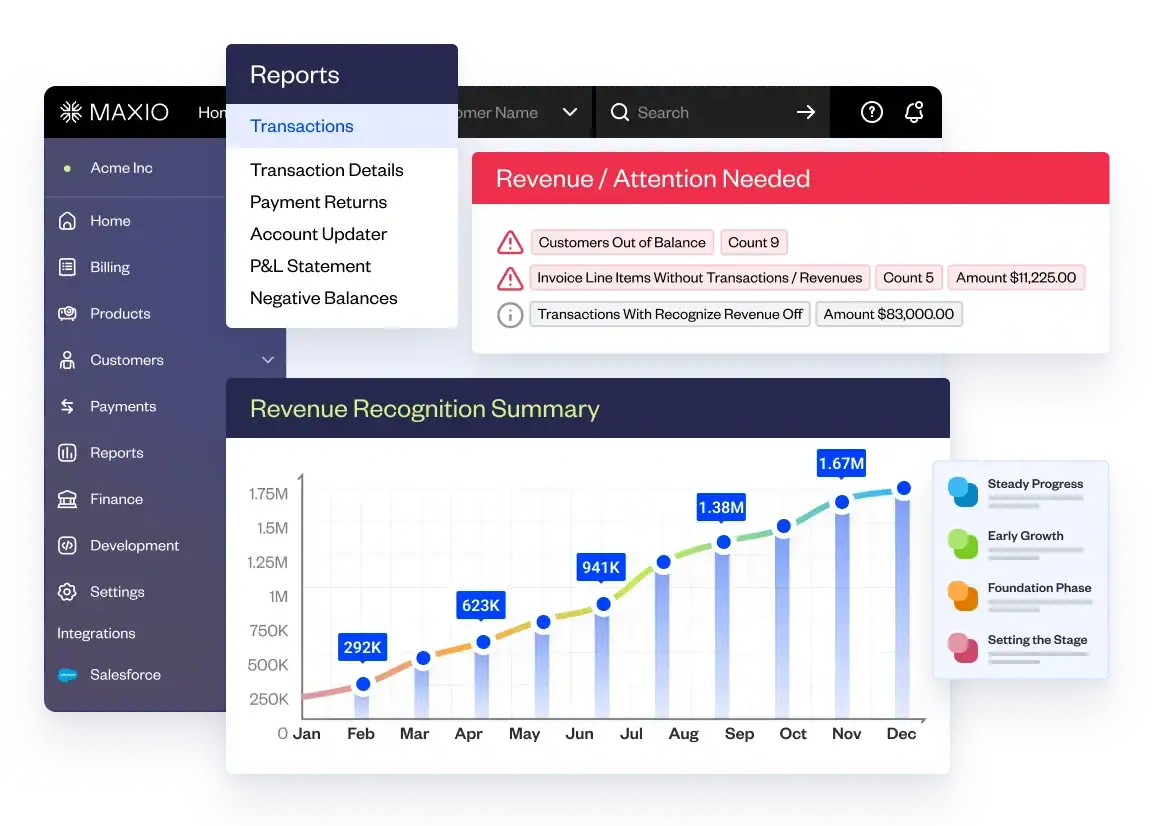
Where Recurly keeps subscriptions running smoothly, Maxio extends that stability across your entire revenue process. It adds the structure, automation, and visibility your finance team has been building manually for years, and connects those systems into a single source of investor-ready truth.
Here’s how:
- Finance-grade automation: Revenue schedules, contract modifications, and recognition entries happen natively inside Maxio. No Excel formulas. No offline models. No “final_v8” files.
- Cross-system alignment: CRM, billing, and ERP finally share one version of the truth. When Sales closes a deal, the contract automatically flows through billing, invoicing, and recognition—with zero reconciliation lag.
- Multi-entity confidence: Subsidiaries, currencies, and consolidations become structured, not stressful. Maxio’s built for multi-entity accounting, so rollups happen automatically, and your global revenue picture is always accurate.
- Metrics that matter: ARR, NRR, churn, expansion, and cohorts are all calculated from contract-grade data, and not stitched together from exports. Your reports match your books, and your books match what you told investors.
- Audit readiness: Every transaction is traceable, every recognition rule is documented, and auditors get evidence.
Who Owns What: A System Visibility Map
When your billing system is small, ownership doesn’t matter much. Engineering sets up plans, Finance tracks renewals, and everyone assumes the numbers will add up.
But as your operation grows, ownership becomes the difference between visibility and vulnerability.
That’s where most teams start to feel the limits of Recurly. It keeps billing stable, but control is scattered. Every department owns a piece of the puzzle, and no one owns the full picture.
Maxio changes that. It unifies ownership under Finance without forcing Product, Sales, or RevOps to change the way they work. Everyone still sees what they need, but Finance finally runs the system, not the other way around.
| Process Area | In Recurly | In Maxio |
| Billing rules | Managed by Engineering or RevOps through manual setup. | Managed by Finance with configurable logic and audit trails. |
| Revenue recognition | Modeled externally in Excel or third-party tools. | Automated and compliant inside the platform. |
| Contract changes | Adjusted manually; tracking lives in exports or notes. | Fully system-driven with linked billing and recognition updates. |
| Data ownership | Split between Billing, CRM, and ERP—multiple “sources of truth.” | Unified and synced across systems through native integrations. |
| Audit trail | Limited to transaction logs. | Full event lineage from quote to close. |
| Metrics and reporting | Marketing and ops dashboards only. | Finance-grade reports tied directly to contract data. |
| Month-end close | Reactive and manual. | Predictable and repeatable. |
When Finance has clean visibility, operators win too. There’s less firefighting, fewer last-minute exports, and more time spent improving the business. That’s how you scale operations without scaling chaos.
Recurly vs. Maxio FAQs
You’re not the first team to ask these questions, and you shouldn’t be the last. When you’ve been relying on Recurly for years, change can feel like overkill. So let’s clear up what actually changes (and what doesn’t).
“Do we have to give up Recurly entirely?”
No. Many teams keep Recurly for what it does best—renewals, payment retries, and subscription stability. Maxio simply takes over where Recurly stops: the financial layer. Billing data flows from Recurly into Maxio, where it’s turned into clean, auditable, investor-ready revenue.
“Will it slow down our billing?”
No, it’ll actually speed up everything that happens after billing. Recurly handles transactions. Maxio handles recognition. Instead of Finance waiting on exports and reconciliation, data flows cleanly between systems.
“How long does it take to implement?”
Weeks, not fiscal years. Maxio integrates quickly with systems you already use, including Recurly, Salesforce, and major ERPs like Intacct or NetSuite. Most teams see value within their first quarter.
“Will Finance finally stop asking for exports?”
Yes. And they’ll thank you. Maxio eliminates reconciliation spreadsheets, manual rollups, and late-night CSV digging. All of your key metrics, including ARR, NRR, churn, expansion, and deferred revenue are calculated automatically from contract data.
“Isn’t this overkill for us?”
Not if you’ve ever postponed a close, lost time to reconciliation, or had to explain conflicting revenue numbers to leadership. You don’t need a bigger system, but you need a more connected one and Maxio gives you structure without the overhead.
So, Should You Move from Recurly to Maxio?
If you’re using Recurly today, it means you made the right call early on. You built a reliable, recurring revenue engine that just works, and it’s probably still doing its job.
But the same systems that made you efficient in the beginning can quietly hold you back as you scale.
Because when Finance can see the same truth that Product, Sales, and RevOps are working from, everything runs smoother: your close is faster, your reports are consistent, and your forecasts inspire confidence from the boardroom down.
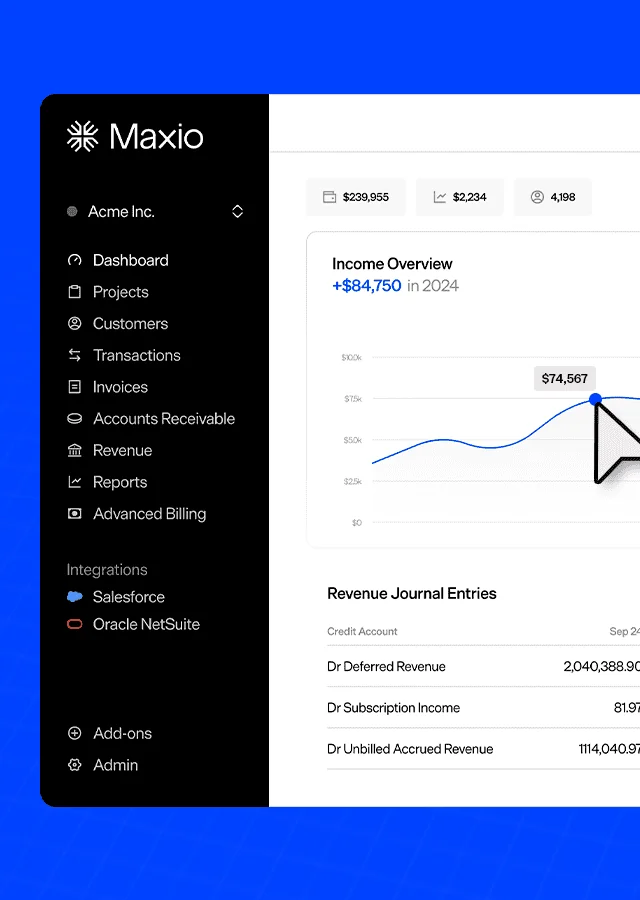
See how Maxio brings full financial visibility to your subscription operations. Request a demo.