Subscript vs. Maxio: When Analytics Alone Aren’t Enough




As B2B finance teams scale past the spreadsheet era, tools like Subscript offer a modern, affordable way to get billing and metrics under control. But visibility built on a shallow foundation isn’t the same as financial control. Here’s where Subscript shines, where it hits its ceiling, and why finance teams heading toward $20M+ ARR choose Maxio.
Subscript is easy to root for.
It was built by people who were frustrated with legacy billing platforms, the same platforms that made finance teams feel like they needed a consultant just to update a contract term. Subscript showed up with a clean interface, a reasonable price tag, and a genuine commitment to helping small finance teams stop living in spreadsheets.
And for a lot of companies, it works exactly as advertised.
But “it works” and “it scales” are different things, and the distance between them tends to show up right when the stakes get highest. Before a board meeting. During investor diligence. In the middle of a month-end close that shouldn’t be this hard.
The issue is rarely whether finance can see ARR, churn, or new customer growth. It is whether those numbers can be trusted at close, reconciled to contracts and accounting, and used without rebuilding the answer manually in spreadsheets.
That’s the conversation this post is really about.
This isn’t an argument that Subscript is a bad product. It isn’t. It’s an honest look at what Subscript was built to do, what it wasn’t, and how to know which side of that line your company is on.
Why Finance Teams Discover Subscript
The typical path to Subscript looks like this: a SaaS company outgrows its combination of Stripe and spreadsheets, or hits the limits of an early-stage billing tool, and goes looking for something better. They want metrics. They want automation. They want a system that doesn’t require a developer to make routine changes.
Subscript finds them at exactly that moment. The pitch is compelling: modern UX, 60+ SaaS metrics out of the box, billing automation for common pricing models, and flat-rate pricing that doesn’t grow in lockstep with your ARR. Onboarding takes weeks, not months. The tool feels like it was built for finance people, not IT departments.
That pitch resonates because it’s true. Subscript genuinely delivers on those promises for the right kind of company. The question that most teams don’t ask until later is whether they’re still the right kind of company six months from now.
Where Subscript Works Well
Subscript earns its place at companies that match a specific profile. If you’re here, it’s a solid fit:
Early- to mid-stage B2B SaaS. Companies in the $2M–$15M ARR range with relatively clean contracts and predictable billing cadences get real value from Subscript. The tool was designed for this stage, and it shows.
Finance teams that need metrics fast. If the CFO’s biggest pain point is manually updating ARR spreadsheets and waiting days for answers to basic retention questions, Subscript solves that problem quickly. The analytics layer is genuinely accessible and well-designed.
Companies with straightforward pricing models. Flat-rate subscriptions, annual contracts, usage-based billing — Subscript handles the common models well. If your contracts don’t have a lot of edge cases, mid-term amendments, or complex co-term logic, you may not notice the ceiling.
Startups that prioritize fair vendor economics. Subscript’s flat-rate pricing, not a percentage of your ARR, is a real differentiator and a legitimate reason to choose them. Finance teams that feel burned by percentage-based billing models will find Subscript’s stance refreshing.
Teams who want fast onboarding and low administrative burden. Subscript’s implementation is genuinely fast, and the tool doesn’t require dedicated admin resources to keep running. For lean finance teams, that matters.
If your company matches most of the above, Subscript may be the right call today. The more important question is whether it’s still the right call at your next stage of growth.
The Insight Gap: When Analytics Outgrows Its Foundation
Here’s the uncomfortable truth about analytics tools: your metrics are only as accurate as the system generating them.
It sounds obvious. But it’s easy to forget when you’re looking at a clean dashboard with ARR, NRR, and churn all neatly organized. The dashboard looks right. The numbers feel right. But if the billing layer beneath it doesn’t fully capture mid-contract amendments, or if revenue recognition is happening in a separate workflow that doesn’t sync cleanly with what got invoiced, those beautiful charts are telling you a story, just not necessarily a true one.
The Insight Gap is the growing distance between what your analytics tool reports and what your auditor, your board, or an acquirer will actually see when they go looking.
Subscript helps finance teams move beyond spreadsheet-based SaaS reporting by centralizing visibility into key metrics like ARR, churn, and customer growth. But as companies scale, the requirement shifts from visibility to control. Finance teams need to know not only what the metrics are, but whether those metrics reconcile to contracts, invoices, revenue schedules, and accounting outputs. That is where analytics alone can fall short, and where Maxio’s broader finance platform becomes more relevant.
The Insight Gap tends to be invisible when contracts are simple and business is predictable. It starts to show when things get complex:
- A customer signs a multi-year deal with a ramp-up in year two. How does that affect CARR vs. ARR right now?
- A mid-contract upgrade happens. Does the billing system, the revenue recognition schedule, and the metrics layer all agree on what changed?
- A sales rep closes a deal with non-standard payment terms. Is that reflected correctly in your DSO reporting?
- Billing depends on a milestone, but revenue recognition needs to begin when the contract goes live. Can the system manage those as connected but distinct workflows?
- Expansion revenue includes a mix of upsell, seat growth, and contractual uplift. Can finance separate those movements cleanly for board reporting?
At small scale, these edge cases are manageable. Finance teams paper over them manually. But at $20M, $30M, $50M ARR, the edge cases stop being edge cases. They become the business. And a lightweight analytics layer sitting on top of a billing system that wasn’t built for that complexity starts to crack.
The Insight Gap isn’t a crisis until it is. And it tends to become a crisis at the worst possible time: when you need your numbers to be unimpeachably right.
What Changes as You Scale
Growing SaaS companies don’t just get bigger. They get more complex. Here’s what starts to matter as you move past the early stage:
Mid-Contract Flexibility Becomes Business-Critical
In early-stage SaaS, most contracts are simple: a customer signs, renews, or churns. As you scale, your contracts evolve. Customers upgrade mid-term, add seats, renegotiate terms, or request co-termination across multiple products. Handling these changes cleanly , keeping billing, revenue recognition, and metrics all in sync , requires a system built for that complexity from the ground up.
Subscript handles the common cases well. But for companies operating with complex, frequently-amended contracts, its flexibility has limits. Maxio was purpose-built for exactly this: mid-term changes, co-terms, amendments, and ramp deals that need to flow correctly through billing, rev rec, and reporting without manual reconciliation.
Billing Logic Starts to Mirror Contract Reality
[As companies scale, billing does not always follow a simple subscription start date. A company may need to delay invoicing until an implementation milestone is complete, while revenue recognition begins when the contract goes live. Others may need to support multi-phase rollouts, milestone gates, or billing schedules that do not align neatly with revenue schedules.
Subscript is a better fit for straightforward billing motions where invoice timing, subscription terms, and reporting needs are relatively aligned. Maxio is better suited for contract-driven billing complexity because billing and revenue recognition can be managed as connected but distinct workflows.
Quote-to-Cash Alignment Becomes a Revenue Operations Priority
As your sales team grows, the gap between what gets quoted and what gets billed becomes a real operational risk. Discounts get applied inconsistently. Payment terms vary by deal. One-time fees get missed. Without a native CPQ (Configure, Price, Quote) layer connected directly to your billing and revenue recognition system, finance teams end up doing forensic accounting on every deal.
Subscript does not offer a native CPQ module. Maxio does, and it’s built to connect quoting directly to billing and revenue recognition, closing the loop between sales and finance in a single system.
Revenue Recognition Needs to Be Audit-Ready
Both Subscript and Maxio offer ASC 606-compliant revenue recognition. But there’s a difference between meeting the standard and being ready for an auditor to scrutinize every schedule.
The deeper distinction is operational. Reporting revenue is different from running revenue recognition as a finance function. Scaling teams need support for journal entries, accrual visibility, contract-level traceability, and reconciliation workflows that hold up during close, audit, and diligence. Maxio is built for that level of revenue operations, while Subscript is better suited for teams with simpler revenue recognition needs.
As companies approach Series B, prepare for due diligence, or move toward an IPO, the revenue recognition engine needs to generate schedules that trace directly back to contracts, handle edge cases automatically, and produce documentation that survives external review. Maxio’s revenue recognition has been hardened through that process with customers at scale.
The Metrics Question Goes Deeper Than Dashboards
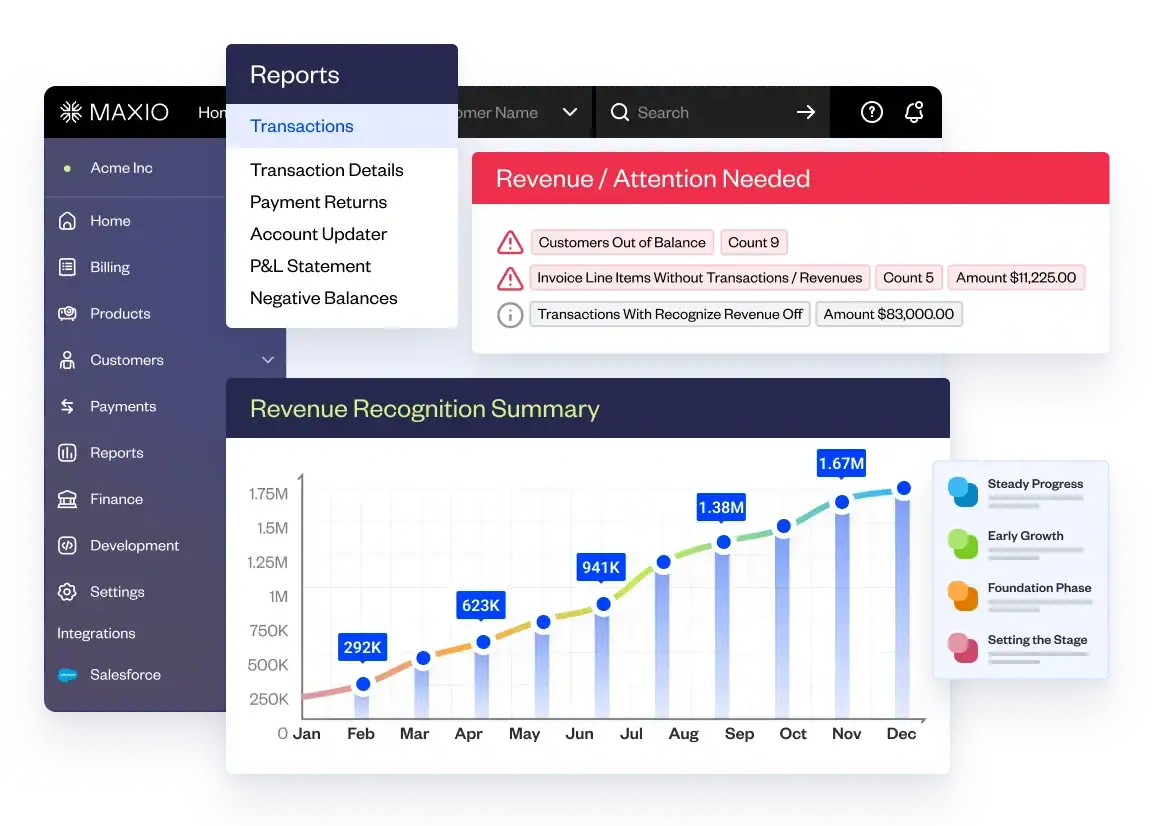
Subscript offers 60+ SaaS metrics. That’s a solid foundation. But the number isn’t the point , the quality of the data underneath is. Maxio’s metrics are calculated directly from live contract and billing data. When an amendment is processed, when a usage charge is metered, when a revenue schedule shifts , the metrics update in real time, from the same source of truth. That’s the difference between metrics-as-reporting and metrics-as-financial-intelligence.
This becomes especially important in expansion reporting. A basic SaaS metrics layer may show expansion ARR, but finance leaders often need to separate upsell, cross-sell, seat expansion, contractual uplift, and price increases. Those distinctions matter in board reporting because they tell different stories about growth quality. Maxio’s contract-grade metrics are designed to preserve that nuance instead of forcing finance to rebuild it manually.
Multi-Entity and Multi-Currency Requirements Emerge
Acquisitions happen. International expansion happens. Subsidiaries get created. None of these are things Subscript was primarily designed to handle , and the workarounds tend to accumulate technical debt in the finance stack at exactly the moment a company can least afford it. Maxio handles multi-entity and multi-currency natively: local compliance, clean entity-level reporting, and consolidated roll-ups that finance owns without needing IT to get involved.
Why Finance Teams Choose Maxio
Maxio wasn’t built to compete with early-stage billing tools. It was built for the moment when finance needs to stop reporting on the business and start leading it. Here’s what that looks like in practice:
One system for billing, revenue recognition, and metrics. There’s no reconciliation gap between what got invoiced, what got recognized, and what shows up in the board deck. Everything traces back to the same contract-grade source of truth.
As companies scale, the alternative is often not one competing system. It is a patchwork: one tool for SaaS metrics, another for accounting, another for contracts, and spreadsheets to reconcile the differences. The problem is not any one tool. It is that no single system owns the full revenue lifecycle.
Native CPQ that closes the quote-to-cash loop. Sales quotes flow directly into billing and revenue recognition. No more forensic accounting on deal terms. No more missed one-time fees or unapplied discounts.
Contract-grade metrics across the full revenue lifecycle. Metrics calculated from live contract and billing data , not a separate analytics layer , so your ARR, NRR, churn, and expansion numbers are always in sync with what actually happened.
Revenue recognition that’s audit-ready by design. ASC 606-compliant schedules that trace directly to contracts, handle edge cases automatically, and produce documentation that survives due diligence.
Full support for mid-contract complexity. Ramp deals, co-terms, upgrades, credits, non-standard payment terms , all handled natively, without workarounds or manual reconciliation.
Billing and revenue recognition workflows that can move together or apart. Delayed invoicing, milestone-based billing, implementation gates, and revenue schedules tied to contract start dates can be managed without forcing finance into manual side schedules.
Board-ready revenue movement reporting. Maxio helps finance distinguish new ARR, upsell, expansion, and contractual uplift so leadership can understand not just whether revenue grew, but how it grew.
Multi-entity and multi-currency built in. Each entity follows local rules. Everything rolls up cleanly into consolidated reporting that finance owns directly.
Finance-first design, no developer dependencies. Finance defines billing rules, policies, and workflows in the UI. Changes happen in hours, not sprints.
Scales from $5M to $200M+ ARR without a platform change. Maxio grows with the business. There’s no moment when you outgrow it the way you can outgrow a simpler tool , because it was built for the complexity that scale creates.
Subscript vs. Maxio: Full Side-by-Side Comparison
| Capability | Subscript | Maxio |
| Billing Automation | Strong for common models | Deep support, including complex contract logic |
| Pricing Model Support | Flat-rate, usage-based, annual contracts | Fixed, usage-based, hybrid, ramp, milestone, and complex tiered models natively |
| Revenue Recognition | ASC 606 / IFRS 15 compliant | Native, audit-ready engine with full contract traceability |
| Revenue Recognition Operations | Suited for simpler rev rec needs | Supports journal entries, accrual visibility, audit trails, and contract-level traceability |
| SaaS Metrics | 60+ metrics | Contract-grade metrics across the full revenue lifecycle |
| Expansion Segmentation | Core SaaS metrics visibility | More granular movement reporting across new ARR, upsell, expansion, and contractual uplift |
| CPQ / Quote-to-Cash | No native CPQ | Native CPQ module connecting quoting to billing and rev rec |
| Mid-Contract Flexibility | Limited | Full support: amendments, co-terms, upgrades, ramp deals |
| Billing / Rev Rec Decoupling | Better fit for straightforward billing motions | Supports delayed invoicing, milestone billing, and revenue schedules tied to contract reality |
| Month-End Close Support | Strong for SaaS reporting and visibility | Built to support finance-controlled close workflows across billing, rev rec, and metrics |
| Multi-Entity / Multi-Currency | Limited | Built-in with local compliance and consolidated roll-ups |
| AR Management | Collections automation and AR aging | Embedded in end-to-end billing workflows |
| Payments Infrastructure | Integration-dependent | Native payment processing and gateway management |
| Pricing Model | Flat-rate, $15K–$150K/year | Transparent SaaS pricing |
| Implementation | Weeks | Weeks |
| Engineering Dependence | Low | Minimal |
| Best Fit | Early-stage SaaS, $2M–$15M ARR | Scaling B2B SaaS, $10M–$200M+ ARR |
Both tools are built for finance leaders. The difference is the stage , and the complexity , they were built for.
Final Takeaway
Subscript is a genuinely good product for the company it was built for: an early-stage B2B SaaS finance team that wants clean metrics, billing automation, and a fair price tag, without the weight of an enterprise platform.
If that’s you right now, Subscript may be exactly what you need.
The question worth asking , before a fundraise, before a due diligence process, before a board meeting where the numbers get scrutinized , is whether it’s still the right fit for where you’re going.
When contracts get complicated, when the sales team starts closing deals with non-standard terms, when auditors start asking questions your analytics tool wasn’t built to answer, that’s the moment the Insight Gap becomes visible. And that’s the moment finance teams choose Maxio.
Subscript is strong when the job is visibility into SaaS metrics. Maxio is stronger when the job becomes finance control across billing, revenue recognition, close, and board reporting.
Maxio gives finance leaders the control they need to lead the business, not just report on it. Clean data. Audit-ready records. A single source of truth across billing, revenue recognition, and metrics , built to scale alongside the company, not behind it.
Ready to See Maxio in Action?
Maxio helps scaling finance teams take control of billing, revenue recognition, and metrics, all in one platform built for growth. Request a demo to see how Maxio can support your team’s next stage.