
On-Demand Webinar
AI in Finance: What Investors Really Want to See in Your AI Strategy
Investors want to know how companies are using AI, but simply checking the box isn’t enough. They’re looking for evidence that AI is improving decisions, strengthening operations, and ultimately creating shareholder value.
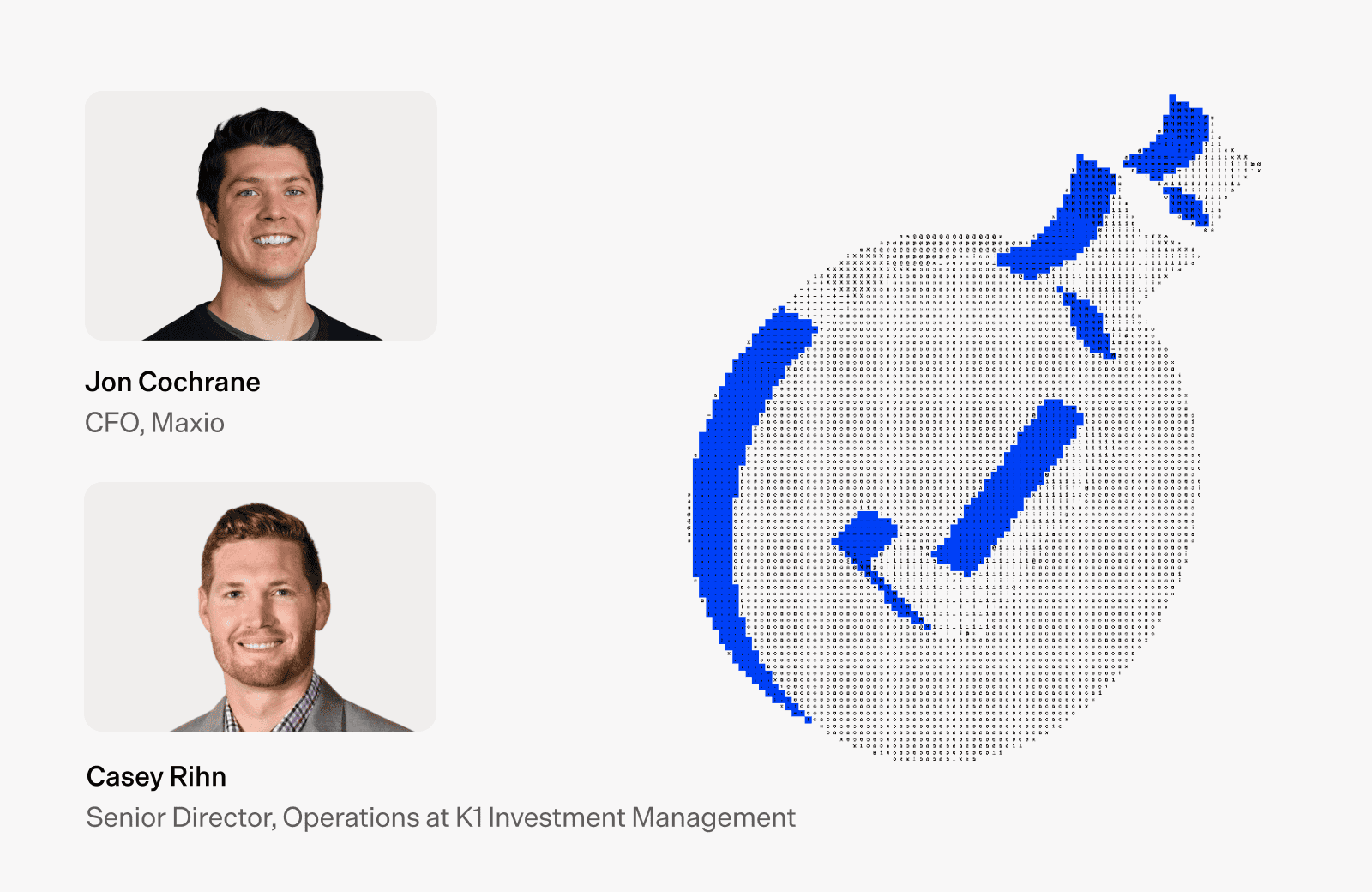
Join Maxio CFO Jon Cochrane and Casey Rihn, Senior Director of Operations at K1 Investment Management, for an investor’s perspective on where AI is delivering meaningful results. They’ll discuss how board expectations are changing, what separates genuine progress from AI theater, and where AI is having the greatest impact on finance teams today.
During this session, you’ll learn:

The pressure investors are putting on portfolio companies to adopt AI, and where they expect results first
Why the SaaS spend increase (roughly $1.2T to $1.4T) is almost entirely AI
Time-to-decision as the real finance metric, beyond a faster close
Weekly dashboards with bookings and churn forecasts to build the “forecasting muscle”
Transcript
Jon Cochrane: [00:00:00] All right. Awesome. Hey, everyone. Thank you for taking the time to join us today, whether now or on the virtual recording later. But I’m Jon Cochrane, I’m the CFO at Maxio. If this is your first time joining us, we’ve been doing a four-part series where we’re just talking about real-life uses of AI in the office of the CFO.
[00:00:20] It’s been a really good discussion. You can catch any of those videos on demand. Today, we’re gonna be diving into the viewpoint between really of interacting between the office of the CFO and your investors. And so to talk about that is a longtime friend of Maxio, but also a great partner to us, Casey Rihn.
[00:00:43] Casey works over at K1, and I won’t do your introduction for you, Casey, but it would be great if you could just give everybody an introduction of who you are, what you do, and your background.
Casey Rihn: [00:00:55] Yeah, no, of course. And happy to be here. Glad to be, Jon, [00:01:00] talking about some interesting stuff around AI in the office of the CFO, which is basically what we do on a day-to-day basis.
[00:01:06] You know, we… I lead the team called the finance operations team. Essentially, we have two key tenets really. One is to instill best practices within the portfolio, primarily in the office of the CFO. We’re investing in businesses between 5 and 50 million generally. So you could imagine that all of these businesses are probably under-invested in finance at the time of investment, so have a decent amount of wood to chop.
[00:01:33] And then the other part of this is that we work primarily as an internal FP&A function at K1, so we ingest all of the financial information across the portfolio, and then provide feedback to the leaders at K1 based on that analysis.
Jon Cochrane: [00:01:49] That’s, what, you know, Casey, maybe walk people through just a little bit.
[00:01:54] I know you have… You’ve been doing this for a while now. So before you even came to K1, you had a background in [00:02:00] Deloitte. Maybe just share a little bit more about your background. And then the other thing I’d encourage, too, is for anybody in the audience, if you have questions as we go throughout, as Casey and I are chatting today and trying to…
[00:02:11] You know, one of the things I like to do on these, too, is to share, call it some inside baseball. We’re not trying to just do thought leadership here. But one of the things that’s important to me is to have real conversations about the transformation that our own finance team is going through at Maxio.
[00:02:28] But then also what Casey has been through personally throughout his career, what he’s seen other companies go through. And so yeah, that’s kind of our goal here. So all that to be said, use the Q&A if you have questions. We will stop, we will answer that. But yeah, Casey, back to you.
Casey Rihn: [00:02:43] Awesome. Yeah, and maybe just a disclaimer is, these opinions are mine, not K1. So I really do want to be candid about the things that I say in here. One, to make sure I don’t get my hands slapped by compliance, but also to just make these conversations real. So yeah, I started at Deloitte.
[00:02:59] I started [00:03:00] in audit. Got out of audit pretty quickly. Joined the consulting group at Deloitte, and then eventually found my way into the M&A transaction group. And I spent probably like a decade at Deloitte, and then came straight from Deloitte to K1. So I’ve kind of seen a broad scope of client experiences, and then got really into the weeds of being an operator while at K1.
[00:03:26] So most of what I learned about the internal operations and the sausage-making, as it were, as from the CFO has been my five years here at K1, which has been quite a learning experience, but also super fun.
Jon Cochrane: [00:03:42] And somewhere along, I don’t know, Casey, if you deserve the credit on this or if your wife deserves the credit on this, but somewhere you’ve also picked up design skills because that’s a real background behind you.
Casey Rihn: [00:03:51] It is. What’s funny is that my internet wasn’t working, and Jon knows this, in the room that we were going to go in. And K1 is in office five days a [00:04:00] week, which I think we’ll get into a little bit later in this discussion. But there’s… That room is completely white. There’s nothing on the walls ’cause it was my job to decorate it.
[00:04:08] So I had to come to the living room, which is more my wife’s domain, and that’s why you get the better background. So I’ll give her the credit.
Jon Cochrane: [00:04:15] Yeah. I’m personally coming to you live out in California. I’m here actually in my wife’s childhood bedroom. So I hope all of you enjoy this.
[00:04:24] This is also my office right now. Not quite the same feng shui as what you got going on, Casey, but you know, we’ll… I’ll take my single piece of artwork here.
Casey Rihn: [00:04:33] I’ll make sure my wife knows how much you liked it, Jon.
Jon Cochrane: [00:04:36] Yes. Well, one of the things I wanna dive into here, and I actually wanna queue up a poll for this group, as well, so we’ll get that poll queued up for the audience here.
[00:04:48] But, you know, I feel this personally, you have been living this now for a while, Casey, but one of the things that there’s a lot of pressure on is to show, kinda show your investors, [00:05:00] show your leaders in the board, like how you’re leveraging AI within the office of the CFO. And so I’m just curious, how much pressure, and what is the guidance in…
[00:05:12] that you’re putting on your companies to show that they are adopting AI? What are you looking for? What’s the pressure you’re putting on your companies right now to- Yeah …to show something there?
Casey Rihn: [00:05:23] It’s a great question. I’d say the pressure is pretty immense, right? This is a transformational tool that all of our businesses have now been provided.
[00:05:33] And so we expect that you are able to transform the business using this tool. I think where our focus has been primarily is not just how you’re using AI but building all of your operational focus around AI. Most of the pressure that we’ve been putting onto companies has been related to product development, right?
[00:05:59] With [00:06:00] this new AI, we should be reimagining how we can bring products to our customers to solve their problems. And so I think all of the ELT and leaders within our portfolio have gotten that ask, gotten that task, and are working pretty diligently to figure that out, in each of the functional areas.
Jon Cochrane: [00:06:23] It’s interesting that right now more of your focus is on the product and development org, or at least… I don’t wanna put words in your mouth, but it seems like that is where you’re expecting to see the most results right now, is in product and development. Maybe not so much- Yeah …in finance.
Casey Rihn: [00:06:42] Yeah, I’d say it’s definitely we’re asking each of the functional areas to use AI as best they can, right?
[00:06:49] To drive enterprise value, and I think it all comes back to that, is how do we drive enterprise value at our businesses? As an example, I think one of the things that we talked [00:07:00] about previously, Jon, was the time to close, right? It’s great that you can get your time to close from 20 days down to 10, which is a great feat by the way, if you guys are doing that, like, you know, kudos to you guys.
[00:07:13] But then what are you doing with that extra time, right? How are you driving enterprise value given the additional, whatever it is, 10 days that you have with your team, to then provide that information back to investors, make decisions more quickly, right? What is the enterprise value getting driven from each one of those things, right?
[00:07:34] And so the reason why we were putting so much emphasis on product is right now, SaaS as it was before AI, is probably a pretty static growth business, right? If we’re thinking about SaaS spend across all organizations, right? I think it was… I saw something [00:08:00] like in 2025 it was like 1.2 trillion.
[00:08:03] In 2026 it’s expected to be like 1.4 trillion. And I’ve seen pretty wide, or I think I saw something that was like more like 3 trillion, but for the purposes of this conversation, that increase though from 1.2 to 1.4, that is almost entirely AI, right? People are buying AI products within the software sphere.
[00:08:23] So if you’re not taking advantage of that, then you’re missing the boat and you’re gonna be part of that flat SaaS business, not part of that 20% growth software- Interesting …with AI business. Yeah.
Jon Cochrane: [00:08:36] So I’ll say it back to you just to make sure everybody kinda to grasp that.
[00:08:43] So like you had done, in your research and how you’re looking at people spending on software subscription tools, SaaS tools, AI tools, and the baseline right now is about 1.2 trillion and we’re forecasting that it’s gonna grow or the forecasts are saying it’s gonna expand from like 1.2 to 1.4, [00:09:00] but that’s entirely concentrated on additional AI spend, not new software tool spend.
Casey Rihn: [00:09:05] Correct. Correct. So yeah, and so our ask to folks is, hey, what are those green shoots with AI products, right? That you can deliver to your customers, like the reimagining the solutions to your customers’ problems through the use of AI. And if you’re not part of that AI spend category, you could be subject to that pretty flat growth that we’re seeing in SaaS businesses.
Jon Cochrane: [00:09:31] Yeah. Well, I think there’s always been pressure to grow. Anytime you’re gonna be in a venture backed, whether it be VC-backed, PE-backed, like you’ve gotta find a way to show growth. I think one of the things that we look at closely here at Maxio, and we’re actually gonna be putting out some reports in the coming weeks, probably in about three weeks from now.
[00:09:54] We have a B2B growth report that we published, and what we’re seeing is that growth, even though [00:10:00] there are a lot of folks who are, I don’t know if you wanna call it Instagram versus reality life, right? And it used to be the same back in the day. Lots of folks are saying, “We are growing,” like up and to the right.
[00:10:10] We’re actually seeing there’s… Like, it is harder than ever, especially for an early stage business, to grow. And I mean, you see this in the public markets too, like growth is slowing down. So that does seem to align with your finding of, hey, 1.2 to 1.4, the growth is concentrated in like AI tool spend.
[00:10:28] And if you don’t have kinda AI tool spend within your product, then your growth is not gonna be quite where it was maybe in the past.
Casey Rihn: [00:10:37] Yeah. I think that’s basically what we’re trying to convey to our businesses so that to instill with them that this is not really something that is on top of your business, right?
[00:10:49] This should be your business. Your business should be to create these new products, these new ways of transforming your business so that you [00:11:00] can ride that wave of AI growth, right? So this is definitely something that we’re instilling in folks. There’s different ways that you can do this.
[00:11:08] You can, especially around product and development, what was, I think it’s called AI DLC, right? Where you’re creating these pods. You’re shipping your product faster, so your ability to ship that product is now becoming a more tightly knit cycle, right?
[00:11:26] They should be communicating, these organizations, or the different functions in your business, right? From your CS to your product to your dev, right? And then your go to market, like should all be very tight cycles. Faster go to market, right? And so what we’re trying to deploy at our businesses is creating that cycle within those businesses, creating more products, more solutions, and really redefining what’s possible.
Jon Cochrane: [00:11:55] Now, one thing, so I wanna go back to a few things that you had [00:12:00] talked about previously. You talked about, hey, if you’re on a finance team and you’re going from 20 days down to 10 days, like that’s a really great accomplishment. Yeah. You know, I’d been at two different businesses myself where we got the close down to, and even at our current business at Maxio, like we have a five-day close.
[00:12:17] And so we take a lotta pride in that. Many times that was like the greatest accomplishment that I had done to that point on that finance team was like, “Hey, we got our close down from like a month to five days, but now we have like 25 days left in the month, 20 days left in the month.”
[00:12:33] Mm-hmm. And then you had talked about creating enterprise value, doing other things that really move the needle for the business. I wanna weave in the poll here that just closed. But the poll here that we’d asked folks was: how does your board or investors currently ask about AI?
[00:12:52] And 70% of the people who answered that said there’s no clear framework yet. Like, we don’t really know what the framework is. [00:13:00] And that kind of aligns to the conversations I’m having with CFOs, call it the feelings, like, what is real in this creating enterprise value. Like, this is what we’re spending on, on the remaining 20 days that really moves the needle.
[00:13:16] I’m curious your take on those 20 days in the month, and what are some of the things that you’re seeing in some of, call it your, the folks in your orbit that are really starting to move the needle and figure this out? What are some of those characteristics that you know, hey, this is real.
[00:13:36] They’re actually creating enterprise value. This is what you need to start thinking about.
Casey Rihn: [00:13:40] Yeah, it’s a great question. From finance particularly, I think it’s not clearly defined. I think there’s a lot of people doing a lot of really good things, but there is no, like, tool set that you’re gonna go implement day one because you have AI in finance.
[00:13:57] Some of the things that it… [00:14:00] I guess, like, from your reduction in close, I would say it’s time to decision, right? Like, that is a super critical thing that does drive a lot of value. If you can get your monthly meeting from, like, the 25th of each month to, like, the 15th, right?
[00:14:18] You’re able to make decisions more quickly. And on top of that, if you’re, a lot of our businesses now are building weekly dashboards that have some critical information that you’re able to gather on a weekly basis so that your different functional areas, your ELT, and your board are lockstep, not even at month-end when you’re delivering numbers or quarter-end during your board meetings, but on a weekly basis.
[00:14:46] What does a good week, bad week look like, right? And you’re able to provide that information almost automatically, right? Through AI, through dashboards, through that sort of thing. Some of those things are really powerful [00:15:00] in our ability to see kind of around the corner when things are coming, so we’re not a quarter late on making decisions, right?
[00:15:08] So I’d say from a finance perspective, if you can get the critical information in the hands of decision-makers quickly and have confidence in that information, that is wildly useful for everyone involved.
Jon Cochrane: [00:15:25] One of the things that I’ve been starting to talk about a little bit and I feel too just in seeing how quickly, from the different businesses I’ve been at is finance has to be able to operate at the speed at which decisions are getting made.
[00:15:39] And decisions are getting made in businesses faster than ever. I really- 100%.
Casey Rihn: [00:15:44] So true…
Jon Cochrane: [00:15:46] if you’re, I think finance many times can hang their hat on, “Okay, we got a five-day close, we got a 10-day close,” and then it’s like, “My job’s done. Everybody has the information.” But to your point, really meaningful decisions are getting made on a weekly, daily basis right now. [00:16:00]
[00:16:00] And if finance isn’t in the room on those, well, the decision’s getting made without you. Right. So now you gotta start with- Or,
Casey Rihn: [00:16:05] or without the right information, right? You know- Awesome …it could be information that was pulled from, oh, downloaded from a CRM, right? That’s, that’s good. It’s our system, right?
[00:16:12] So if finance doesn’t have its hands on it, then you get this feedback loop of information. And that can create a lot of complexity within your business if you’re making decisions on one piece of information and then reporting accurately on some different piece of information, right?
[00:16:27] So I completely agree. Sorry, I didn’t mean to cut you off.
Jon Cochrane: [00:16:30] No. If anything you’re seeing my decisions getting made out of a CRM system, I think anybody who’s been in finance knows if your CRM is your system of record, well, you’re gonna have a few things to untangle down the road unless finance is the one who is populating that source of truth within the CRM- Right
[00:16:49] which many times is not the case. I’m actually kinda curious if anybody is brave enough to jump into the chat and, I’d be curious if any of you have good examples of [00:17:00] what you all are doing to kind of move the needle and maybe you are in these weekly meetings or daily meetings and how you actually think about serving up information to your teams.
[00:17:10] Actually, Vera just contributed there and said her stakeholders want to see forward-looking reports to help future decision as they can’t control what’s in the past. Vera, you hit on one of the hardest, almost like the division of labor within finance and accounting. It’s almost like you have your FP&A, which are the forward future tellers, and then your controllers who report on the past.
[00:17:37] And many times, those two have to be in lockstep, otherwise you’re just kind of… I can’t tell you the amount of times I’ve seen forecasts that aren’t rooted in, like, controllership-grounded- Yeah …numbers and then all of a sudden it’s just like a nice idea.
Casey Rihn: [00:17:52] Yeah.
Jon Cochrane: [00:17:52] I’m sure you never see that, Casey.
Casey Rihn: [00:17:54] No, no, of course not. I was gonna say, I mean, Vera, that’s so [00:18:00] salient to what’s going on right now. And a part of the weekly dashboards that we’re trying to instill in the businesses includes quarterly forecasts in bookings and churn. And so not only is it trying to get information quicker, it’s building that forecasting muscle.
[00:18:16] And a lot of times if you don’t have that muscle, you’re not able to provide that forecasted information timely when you’re asked for forecasted information, and it’s less accurate if you’re not dealing with it day in and day out. So having, like, those weekly dashboards include forecasted information, and tweaking repeatedly, it’s usually not as accurate when you’re asked to do it on a monthly or quarterly basis.
[00:18:48] I think there’s also… I think Phil Tetlock wrote a book about super forecasting. I read this, like, a long time ago, but this just jumped into my mind about the best super forecasters, [00:19:00] basically were making assumptions, general assumptions, but then would tweak it continuously throughout the period.
[00:19:06] And it was the people that did that the most often that were the most accurate about their forecast, whatever it was. It was about this country would go to war or, like, whatever it had been. So if you’re not doing that in finance on the numbers, looking at it day to day, talking with the functional groups day to day, week to week, you’re kind of missing out on a lot of that information.
Jon Cochrane: [00:19:28] Yeah, Casey, that is a very… If you’re looking at it at least on a weekly basis, your numbers and kinda what you’re predicting. The fact that you, A, have to put together a forecast and say, “This is what I think it’s gonna be,” and then you have to report. If you can start being consistent in saying, “I thought it was gonna be this, it was actually this, and here’s why,” and then you refine that on a weekly basis, it’s no surprise to me why the people who do that the most are the ones who are best forecasting.
[00:19:53] Because you all of a sudden start figuring out what are the drivers. Um- Right …Owen actually has a pretty good [00:20:00] example here where how they’ve been leveraging kind of this, the tying together of systems is enriching data, reconciling the CRM data. This a- these folks actually seem to use Maxio, so reconciling the CRM data to Maxio and laying the groundwork by enriching this data for AI to do better analytics on top of it, with more enrichment and more context.
[00:20:21] So that’s quite a good example there, Owen. Adding-
Casey Rihn: [00:20:26] Owen, was that a staged comment talking about Maxio? Looks like…
Jon Cochrane: [00:20:30] No, no staged comments here, Casey. None of that. Like yours? No. But, Owen, I do think enriching data is one of the most valuable things that you can do when you think about unlocking AI tools- Mm-hmm
[00:20:43] and then correlating that stuff together. Casey, you see a lot, you see, you… I think one thing that I respect a ton about folks in your shoes is you can… Owen, that is funny. [00:21:00] Sorry, you got me there. Casey, you have a really good nose for sniffing out what’s real, what’s fluff.
[00:21:09] Like, when you see, like, what are some really good adoptions of AI within the office of the CFO, like- What are some really good examples that you’ve seen of people who have figured this out and how they’re deploying it within kind of their daily, weekly, monthly operations?
Casey Rihn: [00:21:27] And maybe I’ll start…
[00:21:28] I mean, obviously there’s the ability to do these dashboards and these forecasts is like one of the biggest things you can do, right? Because forecasts are not easy, right? Talking to folks on a continuous basis, building out that functionality so that it’s somewhat automated is not easy, right?
[00:21:43] But using AI with these tools is pretty critical. So I would say first and foremost, if you can do that, like, you are on the right track. I would say some of the other use cases, if I had to think about what I’ve been tackling with folks over the [00:22:00] last probably month or two, there was one company who, we were trying to get segmented and industry level information.
[00:22:07] So call it, like, size of contracts, right? Average size of contracts, cohorted by, like, your SMB versus enterprise versus middle market. And in industry, it’s like who you’re actually selling to, right? The taggings of that information, and I guess the definition of what those were, were just all over the place at this business.
[00:22:27] So we couldn’t really cohort the ARR information and the retention information that we wanted to. But we basically used AI… When I say me, I mean mostly the finance team, and we were just kind of overseeing. Was able to use AI and get to something that everyone felt pretty confident in within, like, a few days.
[00:22:48] And this was thousands of different customers. And within that time period, we were able to tag it, look at it, check it, and then evaluate that information. And we were able to make good [00:23:00] decisions within those few days about where we wanted to invest future dollars based off of the retention of enterprise customers versus SMB customers, or corporate customers versus, like, like security or whatever the different industries were that they were selling into, right?
[00:23:16] So there’s a lot of really interesting ways where you can cut and find information that is critical to the business, that we just weren’t able to get before. That exercise before AI probably would’ve taken months to go through each one of those, evaluate the customers, find a tagging, check it.
[00:23:38] So stuff like that is becoming more and more plausible. And I would just, I would have everyone kind of look in your business and say, “What weren’t we able to do before? And what can we do with these tools? And what is important, what is an important decision that we need to make about these businesses?”
[00:23:56] Talk to your ELT, your functional leaders, right? To [00:24:00] go find those things.
Jon Cochrane: [00:24:02] I like the kind of the CTA there of what are the things that were too hard for us to tackle in the past that now we can actually go get answers on. Yeah. And I love the enrichment you were talking about.
[00:24:13] We actually went through something similar ourselves, and I’ll kind of go back to this report I was referencing, the B2B growth report. The first time when we first founded this thing about three or four years ago, we had access to hundreds of thousands of rows of data and then different, you know…
[00:24:31] But there were some pieces of data that were missing, whether it be on like an industry segmentation level. And at the time, like three or four years ago, we had a team of like eight people go in and they would log into, they would see a URL, they would go to the website, and then they would tag, “Okay, well this is the segmentation of this one customer,” to do kind of the analysis that you were talking about, that you just did in a couple days, Casey.
[00:24:51] And I remember it took us about a month to kind of- Yeah …go through all of that data to properly tag it. And then also, when you think about, okay, well we’re gonna do that one [00:25:00] time. How do we get it back into like a CRM or a system of records so that we can do this on a continual basis? Well, it’s kind of a point in time.
[00:25:06] Well, fast-forward to, as we were preparing the B2B growth report this year, a lot of the, call it segmentation that you can get from some of these data enrichment tools, whether it be like Crunchbase or ZoomInfo or something like that, will tag, call it an industry segmentation, call it tech companies.
[00:25:25] Well, Maxio works with a lot of tech companies, so we have 2,000 tech companies on our platform. Well, that’s not really useful information. What is useful information is what type of tech company. Are you marketing tech? Are you cyber tech? Are you defense tech? Are you ed tech? And so we were actually able to use AI to go a layer deeper and say, “Go actually figure out what these businesses do, and help us understand the data and the movements according to what they do.”
[00:25:51] And you think about like the impact that that can have to a business itself when you’re across like your whole cohorts. Yeah, that type of analysis [00:26:00] completely informs like where are we gonna double down, where are we not gonna double down? Like what’s a distraction, what’s real, where’s growth?
[00:26:07] Especially in a time when growth has, it’s a… Even though there are so many powerful tools out there in the market, it also can be, there’s a lot of new folks flooding the market with a lot of claims, and so you- Yeah …have to kind of have a lot of your… Well, it’s just very fast-moving is what I’d-
Casey Rihn: [00:26:25] Yeah
Jon Cochrane: [00:26:26] say.
Casey Rihn: [00:26:27] I would completely agree with that. I’d also say going back to your question on how can you tell who’s using it, who’s not, and what are some of the critical things. I would say if you’re still using it for managing your inbox and like writing emails, like you need to graduate from that and like get to some of the harder data information.
[00:26:46] And really kind of evaluate, like I said before, what’s important in the businesses. I think the most critical things that I’ve seen folks use it for have been around [00:27:00] getting information for each of the functional areas, right? Being value add to not only finance and what you guys are reporting on a weekly, monthly, quarterly basis, but going to each one of your functional leaders, finding out what information they can use, and really bring that to life.
[00:27:22] ‘Cause I think there’s a lot of ways that finance can really help with that, that skill set doesn’t really live in each of these functional areas.
Jon Cochrane: [00:27:30] Fui and Vera had two really good comments there around just how AI can help with ad hoc analyses. Vera, you have a really good point.
[00:27:41] And this is one thing that, Casey, to your point of, “Hey, we did this analysis in a few days, and we were able to get comfortable with the data.” If you kinda have an underlying source of data or truth that you can get comfortable with, you were like, “Okay, I trust this population, now I can do all the ad hoc analysis on top of it,” like that, Vera, Fui, you’re totally in line.
[00:27:59] [00:28:00] That is the continual thing that we come back to at Maxio in our own finance team, is like let’s make sure that our underlying data set that we’re doing this ad hoc analysis on top of is solid. We agree with the total amount, the total N in the cohort, and now we can do analyses we never could do on top of that to unlock insights we’ve never had before.
[00:28:19] I love where you two are going with those comments. Casey, one thing I wanna shift to a little bit here is I do think, with all of this hot topic here, or maybe not a hot topic, but if you feel like you’re hearing about some of the stuff in the news is, like, I think people are going, “Oh my gosh, AI agents, bots,” like, “Am I gonna have a job?
[00:28:41] Am I not gonna have a job?” Like, there’s like all this… I think about the waves that have come and frankly gone ever since like 2021, where it was like ’21 was all about you have to find a way to grow. Like burn, like throw all the money at it, grow regardless. Yeah. Then all of a sudden ’22 came, and it was like slash all [00:29:00] your costs.
[00:29:00] Then ’23, it was like efficient growth. And then ChatGPT launched, and it… Like, we’ve had so many waves that have come and gone. Like beginning of the year, SaaSpocalypse was here. Now recently, people are like, “The SaaSpocalypse is over.” When we think about like AI, what it can do, what it allows us to…
[00:29:21] Like, how are you… What should people be thinking about here? What are you guys actually pushing your companies to do from like an efficiency standpoint? What we can now take on standpoint? Anyway, I think I’ve rambled enough on that topic. Like, what are your thoughts on this one?
Casey Rihn: [00:29:39] I bring it back to like what we were talking about before, which is like, software is at this point where AI is kinda infiltrating into everything, right? And so the first and foremost thing that we’re concerned about in our businesses is growth. And [00:30:00] so I think you got it completely right with all of the different phases that at least SaaS has gone through over the last, like four or five years.
[00:30:09] Where it’s like interest rates went up. It’s like, okay, you gotta pay your bills. And then so EBITDA was important. And now we’re kind of like back into the growth aspect of this. So I’d say right now from an investment standpoint- I’d take an increase in five points of growth over an increase in five points of EBITDA all day, right?
[00:30:30] And I would even substitute those, right? If you can tell me that you can increase growth by five points, and your margins are gonna drop by five points, I would take that all day. So that’s part of the trade-off that we’re definitely looking at right now. From an em- I think you kinda…
[00:30:47] What you were hinting at too there was just what the impacts are on the bottom line, right? And with SaaS businesses, 70% of our costs are people [00:31:00] costs, right? So we’re- And they have
Jon Cochrane: [00:31:01] been for a long time. When I pull together a forecast, it’s like this was true 20 years ago, it’s true now.
[00:31:07] Like 70%- That’s exactly right …of any business’s cost is headcount.
Casey Rihn: [00:31:10] Yeah. That’s exactly right. And so when we’re talking about fluctuations in cost, we’re usually talking about fluctuations in headcount. We’re not seeing like a huge displacement in the amount of people from AI, right?
[00:31:22] If anything, right, the AI is actually providing more options of productivity, and so we’re looking to hire more, like, engineering PMs and these roles. Like the roles are changing, right? So we’re gonna need to like reimagine the teams within the businesses, but we’re not dropping headcount.
[00:31:41] But I will say that for founders, for the companies that we’re talking with, you need to be surrounded by believers in AI, right? These people need to be ready to go on the journey with you, to get you to where the company needs to go. And you know, don’t need to be a little [00:32:00] harsh there, but I think that is really an important point that…
[00:32:04] And we’re instilling in folks, trying to drill into folks right now. So again, like growth is first and foremost the most important thing. I think the teams are getting reimagined around that. I think I talked about the tightening of cycles between functions, right? Between talking to customers in CS, understanding what your customers need, talking to product about imagining what those products or how those products can be built, talking to dev about those products, and then pushing that out to go to market.
[00:32:36] And these should be pods of folks, right? These shouldn’t be like the ELT talking to each one of those levels. These should be continuous improvement, and churning out product as fast as you can. So it’s kind of reimagining what AI looks like. I actually… It’s funny, we were talking with some executives the other day, and this guy made this [00:33:00] analogy that was really kind of salient to me.
[00:33:04] He said, “Okay, imagine you’re a logger, right? You’re cutting trees. You’re using generally a manual saw. Now you have a chainsaw, which is AI, right? And so what do you do? Do you go cut a bunch of more trees with the existing resources that you have, or do you cut the same trees with less people?”
[00:33:22] I think the answer generally that we were drawn to was like, okay, obviously we wanna go cut more trees. And then one of our CEOs said, “Well, yeah, obviously I would cut more trees, provided that I can actually use that wood for something.” So finding that enterprise value in all this was just something that was, um…
[00:33:41] Really hit me as like, okay, yeah, that really makes sense. We end up, if we’re gonna be more productive with these tools, we have to know what to do with it. We have to know how to handle it.
Jon Cochrane: [00:33:51] No, I love the analogy there of used to be able to… And I also like doing woodworking on the side, so I can appreciate this [00:34:00] chainsaw analogy more than most. It’s like I have cut boards by hand before, and while you can do very intricate, precise, beautiful woodworking with a hand-cut saw, and there’s a time and place for that, having something like a chainsaw, or like a table saw, you can just do a lot more, a lot quicker, a lot more efficiently, which leaves time for you to take on new things that you weren’t able to get to before because you were doing it by hand.
[00:34:31] Yeah, that is… I like that metaphor, analogy. I wasn’t an English major. I did
Casey Rihn: [00:34:39] as well. That’s- Which is why I’m providing that to you from this recent conversation I had. It was not mine. I did not make that
Jon Cochrane: [00:34:44] up. Well, I think that goes to some of the… And actually I wanna throw up another poll here, because I think what you’re getting at there, and you talked about creating enterprise value, Casey, I’m curious, our audience, when you think about, like, [00:35:00] what would convince your board, or for the audience here, how do you actually think about showing that your own team’s adoption of these new tools, whether it be like the chainsaw versus the handsaw is actually driving value versus just checking a box?
[00:35:17] You know, one… Casey, when somebody says like, “Hey…” Or do you have any tells? Like if somebody says, “Oh, we’re like super, we’re all in on the AI stuff,” like do you have any tells or litmus tests? Like when do you know that somebody’s kind of blowing fluff versus like, oh, they actually have this figured out?
[00:35:36] Like what are the giveaways?
Casey Rihn: [00:35:37] Yeah. I think it’s around can you tie it back to enterprise value, right? Are you like… And by the way, I say that not saying that experimentation is a bad thing. I think all of our businesses should find ways to provide more capacity and availability for [00:36:00] funds so that the team can experiment, right?
[00:36:04] But you need to strategy first and understand enterprise value, ’cause if you can set like here is the clear goalpost, and we call this within K1, we call these rally cries, right? Like the most important thing for the business at any given time. If you can clearly set those goals, right, and the experimentation is all honed in around those same goals, and it’s gonna be could be around the corners of it and not maybe directly attributed to like that one thing that the company is doing, right?
[00:36:30] But if everyone is working in the same direction, rowing that same boat in the same direction with that experimentation, that’s the most important thing. So when talking about like is it real? Is AI, are people actually driving towards that enterprise value? I think it’s they can tell the story about that connection between what that North Star is and what they’re doing with AI to get to that North Star.
[00:36:58] I think that is a [00:37:00] valuable investment, 100 times out of 100 times. When you start getting into like, oh yeah, no, I made this cool little agent that does, reads my emails and then, okay, that’s great for your efficiency, right? Or, but like how are we driving that towards the enterprise value?
[00:37:19] And maybe you can. Maybe reading your emails and can, you can tie that to like what’s important to the business. But that tying it just is super critical to making sure that you’re doing the right thing.
Jon Cochrane: [00:37:32] Well, I think that’s helpful. And one thing for not only myself but our audience here to think about is like everything kind of comes back.
[00:37:39] And I like that term too, the rally cry. What’s the most important thing for the business at any given time? I think we’ll close the poll here in just a second. Outside, one thing, Casey, and this is maybe getting… We’re coming up close to the end of the webinar here. [00:38:00]
[00:38:00] One thing that’s kind of a hot topic in the market is a SaaS valuation versus an AI valuation, and what throws you into either bucket. Like, how do you convince folks like, “No, no, no. We deserve, instead of a 4X multiple, we’re an 8X multiple because we are AI native,” or, “We are an AI-forward company,” or whatever are the characteristics that would unlock kind of that premium multiple.
[00:38:25] Like, from your standpoint of what you are looking at, like, what puts somebody into the AI multiple versus, like, a lower multiple?
Casey Rihn: [00:38:34] Yeah. Not to deflect the question, but I think it just comes down to like the buyer, right? Like, do the customers believe that they’re buying something?
[00:38:41] And that’ll show up in your growth rate, right? So like, I think I was making the point that the SaaS business, like… And you were making the point, too, that SaaS business growth as a whole has kinda come down over time, right? Can you show those green shoots? Can you show those products that you’ve rolled out that people are [00:39:00] adopting at a much faster pace?
[00:39:02] Another person that is smarter than me was talking about a similar topic and was saying, “Hey, we’re on this intelligence curve,” right? And so are you rolling out products that are enabling that intelligence curve, right? ‘Cause generally our ability to do things with this new intelligence have, 10, 20, 100X, right?
[00:39:25] And so are those products on that intelligence curve? Are you solving customers’ problems in a way that they haven’t been able to solve them before, and are you reimagining that for your customers? I think the example that he gave when he was talking about the intelligence curve was, like, you had GitHub and Copilot, and everyone’s like, “Oh, man, that’s amazing.”
[00:39:46] And then it was pretty much replaced by Cursor, but then was replaced by Claude Code, and that happened over a span of, like, a year, right? And so these things are moving very quickly, and can you stay in the forefront of [00:40:00] that intelligence curve and be that leader with your customer on providing them the best products and services that you can?
Jon Cochrane: [00:40:09] I like what you were saying where I respect the deflection there because beauty’s in the eye of the beholder. And then also, or should we say beauty’s in the eye of the purchaser or the valuer or whoever’s gonna put a premium on the company. But I do think, as people lean in to say using the newer tools here, whether it be chainsaw or handsaw, you could also go, like, car versus horse, you know?
[00:40:36] Like, if you’re very good at riding horses and somebody dropped off a car, one is gonna go a little bit faster, further, longer than the other. But I do think that’s a good way to think about it. Going back into the poll that we had here, at least for you in the audience, how would you convince your board that, like, “Hey, our…
[00:40:59] We’re [00:41:00] having really solid AI adoption within here.” A lot of you, the majority of you until I think there was one more vote that came in there, faster, more confident decision-making, like, rooted in a solid foundation seemed to be one of the popular answers there. Along with the ability to maybe have a clearer ROI to some of the areas that we had a very hard time measuring in the past.
[00:41:24] That second one is one thing that I look at closely within our own business is, pulling together numbers, pulling together a balance sheet, income statement, even a five-year forecast, relatively a straightforward way to… Lots of people can do that. But how do you actually tie that back to the broader business context, the broader market conte- Like, adding in contextual data to the financial numbers is often very, very challenging to do.
[00:41:54] It now, at least with what we’re seeing at Maxio, what we’re able to do, [00:42:00] it has never been easier or say I would… I wouldn’t call context easy, but I’ve never been able to get more context put into how we look at the business, how we run the business than ever before, just on our ability to synthesize the data and the conversations on the front lines and pull that into like our own financial analysis, our planning.
[00:42:22] Many times for me to get that context in the past, I would have to go and either join all of the, call it the QBRs that our sales team were having, or I’d have to call up a rep individually, but now I can see all of that data very quickly, and I can have it synth- Yeah …synthesized by Claude very quickly.
Casey Rihn: [00:42:39] And I’d say you don’t have to have those answers all, when you’re discovering this. Like, you’re on the forefront of getting information as quickly as you possibly can, right? And so then providing that information immediately to the ELT, to your CEO, right? So that they can go to the forefront of the customers and say, “Hey, here’s the data that we’re seeing,” right?
[00:42:58] “What does this mean for you? What does this [00:43:00] mean for your business?” Right? And then you can have that feedback loop, and then hopefully create more products and solutions for them.
Jon Cochrane: [00:43:09] Casey, I very much appreciate you taking time with us today. I’m curious if you have… If you were to leave this group with one piece of advice as they think about leaning into AI, using it more within, impressing their investors, kind of being on the leading edge- Man
[00:43:27] like what would be your one piece of advice for this group?
Casey Rihn: [00:43:30] You’re gonna make me give one piece of advice. I would say, like, don’t settle for incremental change. I think that that is something that is sometimes hard, right? You’re using these tools, and there’s like all of these like cool things that you couldn’t do before, right?
[00:43:50] I would take a step back, like reimagine what the problem is. Reimagine what those, how you would solve the problem from [00:44:00] first principles if the processes, systems, weren’t in place, that are today, right? And then try to use AI to go and solve it. What’s that through line to get to the solution in a just a better way?
[00:44:13] So I think I’d probably do that. Actually, can I add one more? Oh, yeah. I would actually also like to say- Awesome Can I- Yeah I’ll do two. Be metrics driven. I think this is like super important, that not only are you kind of from a strategic standpoint, like reimagining what’s possible, be metric driven, so that…
[00:44:36] And what I’d say is- Tone your metrics, right? I’ll use an example of, like, the token leaderboards and, like, people saying that, “Oh, we’re 100% adoption of AI tools across the company.” That, in and of itself, doesn’t increase enterprise value. Find the metrics that actually tie that picture together, where you can tie it to [00:45:00] growth or how you’re gonna make decisions faster or whatever it is.
[00:45:06] Find those metrics that matter within your business, and then stick to those, right? And then figure out how you can incrementally make those better.
Jon Cochrane: [00:45:17] I think those are great pieces of advice, whether it be don’t hold yourself back. Don’t just settle for incremental change, and be more metrics-driven.
[00:45:28] So I love having a scoreboard, Casey. I always, very competitive, so how can you know if things are working- Sure …if you don’t have a metrics-driven scorecard?
Casey Rihn: [00:45:36] That’s right. From a finance person, if I didn’t work metrics in there, I think I’d be excommunicated from the group.
Jon Cochrane: [00:45:44] Oh my goodness. Well, thank you again, Casey, for your time, for being willing to jump on, have a chat with me and with all the folks who joined us today. If you joined us today and you want to chat with somebody at [00:46:00] Maxio, maybe you want somebody to brainstorm with, or if we can help you as you’re on this journey, feel free to book time with us.
[00:46:05] If you wanna check out any of our other conversations that we had, like with Chris, our CPO, or other of our special guests over the last four series, you can check that out on demand. But thank you again, Casey, and I’m sure we’ll have you back on here before long.
Casey Rihn: [00:46:22] Awesome. It was great talking with you.
[00:46:23] Thanks. It was a lot of fun.
Jon Cochrane: [00:46:26] All right. Thanks, everyone.