

Key takeaways
- Logo churn measures the percentage of customers lost during a given period, providing a clear view of customer retention at the account level.
- Choosing the right time period and consistently defining what counts as a “lost” customer is critical to producing meaningful churn insights.
- Logo churn should always be analyzed alongside revenue churn, especially in B2B SaaS businesses where customers vary widely in size and value.
What is Logo Churn?
Logo churn is another term for customer churn and is a very important metric used by SaaS or subscription businesses as an input to the overall health of the business.
Logo churn focuses on customer count, not revenue. Each customer (or “logo”) is weighted equally, regardless of contract size. This makes logo churn especially useful for understanding how widespread customer losses are across the customer base.
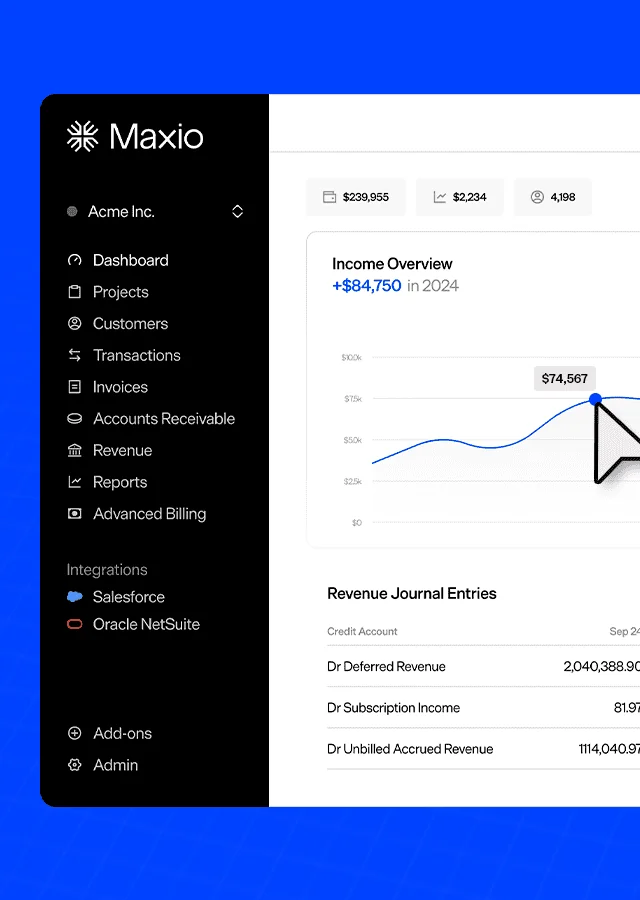
Maxio surfaces logo churn alongside revenue churn in the same dashboard, so you can immediately spot divergence between customer-level and revenue-level retention — the key analytical step this article recommends.
All SaaS investors will ask about logo churn, as there is some common knowledge in the marketplace about acceptable and unacceptable thresholds of customer churn. The astute SaaS investors, bankers, and consultants will pass right by logo churn or pass right through logo churn to Customer Lifetime Value, as the primary purpose of customer churn is as input into the CLV calculation.
How to Calculate Logo Churn
As with all SaaS metrics, there is no official definition for logo (or customer) churn. However, the market has generally accepted that the definition of logo (customer) churn is a measure of the number of customers lost during a particular time period.
Logo churn is expressed as a percentage and the formula is simple: The number of logos (customers) lost during the period divided by the number of logos (customers) at the start of the period.
Logo Churn Formula
Logo Churn (%) = Customers Lost During the Period ÷ Customers at the Start of the Period
Example
- Customers at the start of the year: 100
- Customers lost during the year: 5
Logo Churn = 5 ÷ 100 = 5%
This means the company lost 5% of its customers over the year.
Choosing the Right Time Period
Selecting the correct time period is one of the most important—and often overlooked—parts of measuring logo churn.
Common approaches include:
- Annual churn for B2B SaaS businesses with annual contracts
- Monthly churn for businesses selling month-to-month subscriptions
- Quarterly churn for companies balancing shorter contracts with longer sales cycles
Measuring churn too frequently can produce misleading results if customers only make renewal decisions at specific intervals.
How to Set Up a Billing Cycle
Setting up a billing cycle requires clear decisions around products, customers, and timing.
Most SaaS companies follow these steps:
- Identify what you are billing for (subscriptions, usage, services)
- Determine who you are billing (customer segments or contract types)
- Select invoice frequency based on cash flow needs and customer expectations
Depending on your company’s billing model, some products or services can be billed on an automatic or recurring basis. A shorter billing cycle is typically a better option for growing companies because it keeps their cash flow positive and allows them to keep up with company expenses like payroll, software, etc.
Defining a “Lost” Customer Correctly
To make logo churn actionable, companies must clearly define what qualifies as a lost customer and apply that definition consistently.
Key considerations include:
- Whether a customer is considered churned immediately at renewal expiration
- How to handle customers in renewal “limbo” who haven’t formally canceled
- Whether temporary pauses or billing disputes count as churn
Moving goalposts on churn definitions can obscure real trends and undermine trust in reporting.
Why Logo Churn Alone Isn’t Enough
While logo churn is easy to calculate, it should never be analyzed in isolation—especially in B2B SaaS.
Losing five small customers has a very different financial impact than losing five enterprise customers. In businesses with heterogeneous customer bases, logo churn and revenue churn can tell very different stories.
For this reason, most SaaS operators evaluate logo churn in parallel with revenue churn and customer lifetime value (CLV) to avoid drawing incorrect conclusions from surface-level metrics.
Using Logo Churn for Operational Insight
Logo churn becomes most valuable when it’s used as a diagnostic tool rather than a headline metric.
Now that you know the calculation, you can see the math for logo (customer) churn is simple, but it is not enough by itself. In any B2B SaaS/subscription business, you should always measure churn at least two ways: logo churn and revenue churn. B2B SaaS/subscription businesses tend to have lots of sales negotiation in their contracts, and the loss of one customer can have a very different financial impact from the loss of another.
Teams often analyze logo churn by:
- Customer segment or contract size
- Industry, use case, or acquisition channel
- Customer tenure or lifecycle stage
In B2B SaaS/subscription businesses, the lack of homogeny in the customer base means customers very likely churn for different reasons at different stages of their evolutions. Measuring both revenue and logo (customer) churn in concert with determining your churn profiles can help keep you from drawing the wrong conclusions.
Tracking logo churn accurately requires a clear record of when each customer’s subscription ended — Maxio’s subscription management captures cancellations, non-renewals, and contract terminations in real time, so your logo churn figure reflects the actual state of your customer base.