
How Maxio Is Investing to Help Customers Adapt to a More Complex Revenue Environment



Modern SaaS companies are being asked to do several things at once: support more dynamic pricing, improve financial accuracy, operate more efficiently, and make better decisions with clearer visibility into performance.
That creates real pressure across billing, finance, and revenue operations. Systems that were good enough for simpler subscription models often struggle to keep up as businesses grow, pricing evolves, and teams need faster, more reliable answers. The challenge is not just managing more data. It is managing more complexity across the full revenue lifecycle without introducing more manual work, more reconciliation, or more operational risk. For many teams, that complexity shows up in very practical ways: slower reporting cycles, disconnected workflows, and more time spent validating information instead of acting on it.
At Maxio, we’re investing in the areas that can help customers meet that complexity with more confidence, flexibility, and control. Throughout the year, customers will see progress across four areas that reflect where modern recurring revenue businesses need the most support.
Analytics and Insights for Better Revenue Visibility
As recurring revenue models become more sophisticated, visibility becomes both more important and harder to maintain. Finance and revenue teams need trusted reporting, clearer retention and growth metrics, and stronger forecasting to plan with confidence. They also need faster access to answers without spending unnecessary time stitching together reports across systems.
In this area, the focus is on helping customers:
- gain a clearer view of revenue, retention, and customer performance
- reduce manual analysis and reporting effort
- improve confidence in metrics used for planning and decision-making
- better understand future outcomes through stronger forecasting and trend visibility
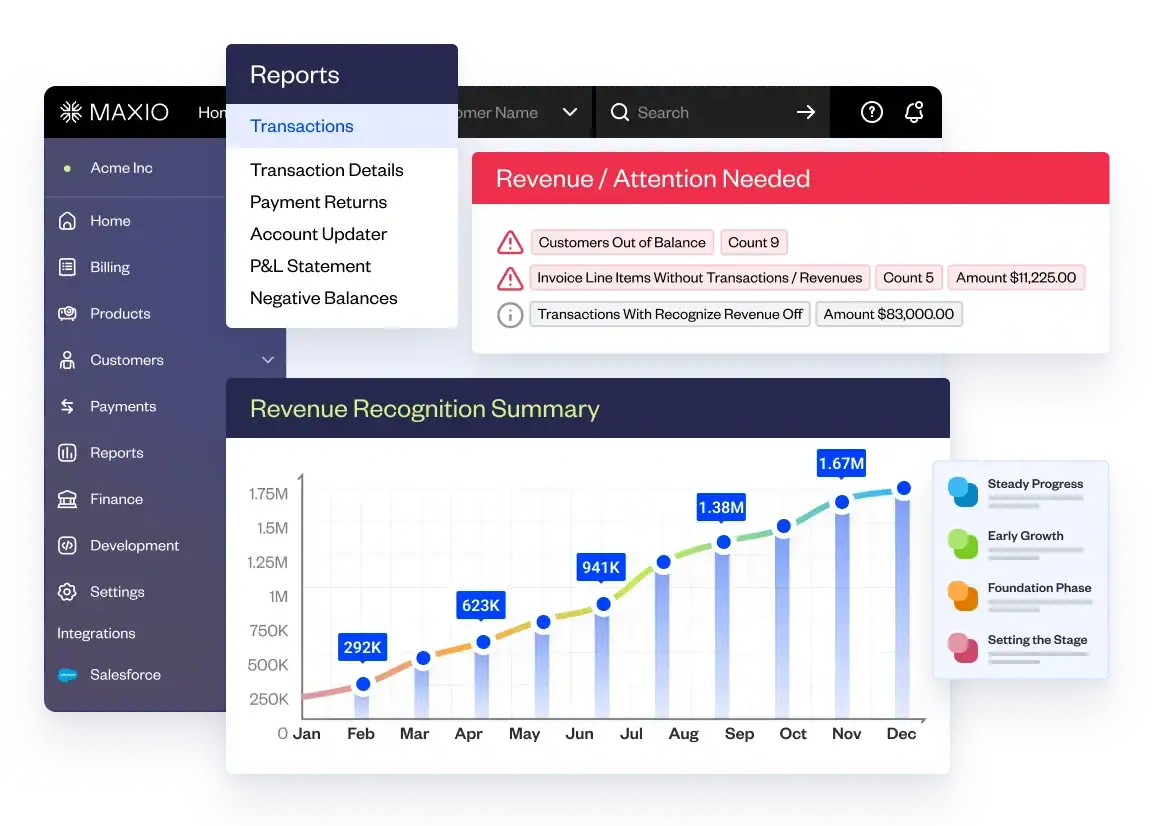
This includes continued investment in reporting enhancements, dashboard improvements, cohort and retention analysis, multi-entity reporting, advanced SaaS metrics, and forecasting capabilities. The goal is straightforward: less time spent piecing together answers and more confidence in the metrics used to run the business.
Third-party Integrations for a More Connected Revenue Stack
As businesses scale, revenue data needs to move reliably across the systems that support finance, sales, tax, support, and customer success. When those systems are disconnected, teams spend more time reconciling data, fixing errors, and chasing context. That slows execution and makes it harder to maintain a consistent view of both the customer and the business.
Here, the priority is helping customers:
- reduce manual handoffs and reconciliation work
- improve consistency across the revenue stack
- connect Maxio more effectively to the systems teams already rely on
- support a more efficient, end-to-end operational workflow
That work includes ERP and accounting integrations, CRM connectivity, tax support, document management, customer success integrations, and improved tools for building and managing integrations. In practice, that means fewer manual processes, fewer disconnected workflows, and better alignment across finance and revenue teams.
Flexible SaaS Pricing and Monetization Strategies
SaaS pricing is evolving well beyond simple subscriptions. More companies are introducing usage-based models, prepaid structures, hybrid pricing, and contract terms that better align to how their products are sold and consumed. As pricing becomes more sophisticated, billing infrastructure has to keep up so teams can support new models without relying on workarounds that create friction later.
This area is centered on helping customers:
- bring new pricing and packaging models to market more easily
- align billing operations more closely to commercial strategy
- support growth without relying on manual workarounds
- improve flexibility for both finance teams and end customers
Areas of investment here include prepaid models, usage-based billing, hybrid pricing, tokenized approaches, flexible commitments, and more adaptable rating and billing structures. The result is greater freedom to evolve pricing strategy without creating unnecessary downstream billing complexity.
Developer Experience for Easier Integrations and Automation
As Maxio becomes more embedded in the broader revenue stack, technical teams need a platform that is easier to integrate, automate, and extend. That means reducing friction for developers and creating a more consistent experience across systems and workflows. It also means giving teams a stronger foundation for implementation, testing, and long-term management.
For technical teams, that means helping customers:
- integrate Maxio more efficiently into their existing environment
- accelerate implementation and testing
- improve automation across workflows
- scale with a platform foundation that is easier to manage over time
Priority areas here include authentication, API consistency, documentation, webhooks, sandbox environments, and broader platform unification. For teams building Maxio into their workflows, that translates to faster implementation and less friction over time.
What Customers Should Expect from Maxio
These areas reflect a shared goal: helping customers manage recurring revenue with the accuracy, adaptability, and operational control that modern SaaS businesses need.
As we share updates throughout the year, we’ll continue to connect product progress back to the outcomes that matter most: greater confidence in revenue data, more flexibility in monetization, stronger system connectivity, and a platform that scales with the business.Across each area, the focus remains the same. We want to help customers adapt to a more complex revenue environment with tools and capabilities designed to support how modern SaaS companies operate today and how they need to grow over time. That means investing in the parts of the platform that can help reduce friction, improve visibility, and give teams a stronger foundation as their business models and operations continue to evolve.