
What Are Business Metrics? Top 18 to Track For Better Performance




Business metrics show what’s really happening inside a business. They reveal whether growth is sustainable, where revenue is coming from, and which efforts are paying off, all using data instead of assumptions. Without the right metrics in place, teams risk making decisions based on incomplete or misleading information.
This guide walks through the most important metrics to track for growth, broken down by department and explained in clear, practical terms. You’ll see how each metric works, how it’s calculated, and why it matters, so you can focus on the numbers that support informed decision-making as your business scales.
Key takeaways
- Business metrics turn activity into measurable insight, helping teams understand how the business is actually performing.
- Tracking the right metrics reduces guesswork and supports better decisions across teams.
- Not all metrics are KPIs, but KPIs help connect data directly to business goals.
- Different departments rely on different metrics based on their role in growth.
- Accurate, consistent data is essential for metrics to be useful and reliable.
What are business metrics?
Business metrics are numbers that show how a business is performing. They can track revenue, customers, operations, or marketing results based on business priorities.
Instead of relying on gut feelings, business metrics give clear proof of what’s working and what’s not. They turn daily activity into useful insights, making it easier to catch issues early and measure progress over time.
When used well, business metrics guide better decisions at every level. Leaders can set goals with confidence, teams can stay focused on the right priorities, and everyone has a shared way to measure success as the business grows.
Business metrics vs. key performance indicators(KPIs)
Business metrics give a broad view of what’s happening across the business, helping teams spot patterns and understand company performance, while key performance indicators (KPIs) are a smaller set of those metrics chosen because they tie directly to goals and results.
Metrics provide context and insight, but KPIs are used to measure progress against benchmarks and signal whether the business is moving in the right direction.
Why tracking business metrics matters
Tracking key business metrics matters because growth adds complexity and makes assumptions risky. Metrics give teams a clear view of what’s happening, so business decisions are based on facts, not instinct.
When metrics are tracked with intention, they help connect daily work to the overall business strategy.
- Performance clarity: Metrics show how the business is performing across key areas, making gaps and wins easier to spot.
- Smarter decisions: Reliable data helps leaders choose actions based on trends and results rather than opinions.
- Team alignment: Shared metrics keep teams focused on the same priorities and reduce confusion around goals.
- Measurable progress: Tracking the same metrics over time makes it easier to see improvement or decline.
- Early issue detection: Metrics can reveal problems early, before they affect revenue or customers.
With a clear understanding of why metrics matter, the next step is deciding which ones are worth tracking in the first place.
How to choose the right business metrics
Choosing the right business metrics starts with focus. Tracking too many numbers can be just as unhelpful as tracking none at all. The goal is to pick metrics that clearly reflect how the business is performing and support the decisions you need to make as it grows.
A simple framework can help narrow your options and keep your metrics meaningful.
- Start with your goals: Choose metrics that connect directly to what the business is trying to achieve, not just what is easy to measure.
- Prioritize impact: Focus on metrics that influence decisions or signal meaningful change, rather than surface-level activity.
- Keep them actionable: Select metrics that point to clear next steps so teams can optimize performance when they move up or down.
- Limit the list: A small, focused set of metrics is easier to track, review, and use consistently in a dashboard.
- Review and adjust: As the business evolves, revisit your metrics to make sure they still reflect current priorities.
The metrics you choose should reflect how each team contributes to growth, which looks different from one department to the next.
Most important business metricsby department
Different teams track different performance metrics because each department plays a unique role in business growth. Organizing metrics by department makes it easier to focus on the numbers that matter most to each function while keeping the broader goals aligned across the business.
Sales metrics
Sales and revenue metrics focus on revenue performance and account-level results. They help sales teams understand how well efforts are converting into income and where growth is coming from over time.
1. Net sales revenue
Net sales revenue measures the income a business earns from sales after accounting for returns, refunds, and discounts.
How to calculate: Take total sales and subtract returns, allowances, and discounts.
Example: If a company earns $100,000 in total sales and issues $10,000 in refunds and discounts, its net sales revenue is $90,000.
2. Sales growth rate
Sales growth rate shows how sales change over time, indicating whether revenue is increasing or declining during a specific period.
How to calculate: Subtract sales from the earlier period from sales in the current period, divide the result by the earlier period’s sales, then multiply by 100.
Example: If sales were $80,000 last quarter and $100,000 this quarter, the sales growth rate is 25%.
3. Average revenue per account (ARPA)
Average revenue per account (ARPA) looks at how much revenue each customer account brings in on average over a given timeframe.
How to calculate: Divide total revenue by the number of active customer accounts during that period.
Example: If a business generates $50,000 in monthly revenue from 100 active accounts, the average revenue per account is $500.
Marketing metrics
Marketing metrics help marketing teams track how efficiently a business attracts, engages, and converts potential customers. These numbers show how well marketing efforts support sales and growth without overspending.
4. Customer acquisition cost(CAC)
Customer acquisition cost (CAC) reflects how much a business spends to gain a new customer through marketing and sales efforts.
How to calculate: Add total marketing and sales costs for a period and divide by the number of new customers acquired.
Example: If a company spends $20,000 on marketing and sales and acquires 100 new customers, its customer acquisition cost is $200.
5. Customer lifetime value(CLV)
Customer lifetime value (CLV) estimates the total revenue a business can expect from a customer over the length of their relationship.
How to calculate: Simple CLV estimate: Multiply average revenue per customer by average customer lifespan. More advanced versions may also factor in gross margin, churn, or profitability.
Example: If a customer generates $1,000 per year and stays with the company for five years, the customer’s lifetime value is $5,000.
6. Cost per lead (CPL)
Cost per lead (CPL) shows how much a business spends to generate a single qualified lead through a marketing campaign.
How to calculate: Divide total marketing spend by the number of leads generated.
Example: If a company spends $5,000 on a campaign and generates 250 leads, the cost per lead is $20.
7. Conversion rate
Conversion rate indicates the percentage of users who take a desired action, such as signing up, making a purchase, or filling out a form.
How to calculate: Divide the number of conversions by the total number of users or visitors, then multiply by 100.
Example: If 1,000 visitors result in 50 signups, the conversion rate is 5%.
Customer success metrics
Customer success metrics highlight how customers experience and stay with a business. They help teams measure satisfaction, loyalty, and long-term relationship health.
8. Customer retention rate
Customer retention rate shows the percentage of customers a business keeps over a specific period of time.
How to calculate: Divide the number of customers at the end of the period, excluding new customers acquired during that period, by the number of customers at the start of the period, then multiply by 100.
Example: If a company starts the month with 200 customers and ends with 180, the customer retention rate is 90%.
9. Net promoter score (NPS)
Net promoter score (NPS) reflects customer loyalty by measuring how likely customers are to recommend a business to others.
How to calculate: Subtract the percentage of detractors from the percentage of promoters based on survey responses.
Example: If 60% of respondents are promoters and 20% are detractors, the net promoter score is 40.
10. Customer satisfaction (CSAT)
Customer satisfaction (CSAT) captures customer experience by measuring how satisfied customers feel after an interaction, product use, or service experience.
How to calculate: Divide the number of positive responses by the total number of responses, then multiply by 100.
Example: If 80 out of 100 survey responses indicate satisfaction, the CSAT score is 80%.
11. Customer churn rate
Customer churn rate shows the percentage of customers who stop doing business with a company during a given period.
How to calculate: Divide the number of customers lost during the period by the number of customers at the start, then multiply by 100.
Example: If a company starts with 200 customers and loses 20, the customer churn rate is 10%.
Financial metrics
Financial metrics provide insight into profitability, cash flow, and overall financial health. They are used to evaluate stability and the business’s ability to grow responsibly.
12. Net income
Net income represents the amount of profit a business has left after all expenses, taxes, and costs have been deducted from total revenue.
How to calculate: Subtract total expenses from total revenue.
Example: If a company earns $150,000 in revenue and has $120,000 in total expenses, its net income is $30,000.
13. Gross profit margin
Gross profit margin shows how much revenue remains after covering the direct costs associated with producing goods or delivering services.
How to calculate: Subtract the cost of goods sold from total revenue, divide by total revenue, then multiply by 100.
Example: If a company earns $100,000 in revenue and has $60,000 in production costs, the gross profit margin is 40%.
14. Net profit margin
Net profit margin indicates how much profit a business keeps from each dollar of revenue after all expenses are accounted for.
How to calculate: Divide net income by total revenue, then multiply by 100.
Example: If a company earns $100,000 in revenue and has $15,000 in net income, the net profit margin is 15%.
15. Current ratio
Current ratio assesses a company’s ability to pay short-term obligations using its short-term assets.
How to calculate: Divide current assets by current liabilities.
Example: If a company has $50,000 in current assets and $25,000 in current liabilities, the current ratio is 2.
Human resources metrics
Human resources metrics focus on workforce stability, employee satisfaction, and productivity. These metrics help connect people-related trends to overall business performance.
16. Employee turnover rate
Employee turnover rate shows how often employees leave a company during a specific period.
How to calculate: Divide the number of employees who left during the period by the average number of employees, then multiply by 100.
Example: If 15 employees leave during the year and the company averages 150 employees, the employee turnover rate is 10%.
17. Employee net promoter score (eNPS)
Employee net promoter score (eNPS) reflects how likely employees are to recommend the company as a place to work.
How to calculate: Subtract the percentage of detractors from the percentage of promoters based on employee survey responses.
Example: If 50% of employees are promoters and 10% are detractors, the eNPS score is 40.
18. Revenue per employee
Revenue per employee shows how much revenue a business generates for each employee on average.
How to calculate: Divide total revenue by the total number of employees.
Example: If a company earns $2,000,000 in revenue and has 100 employees, revenue per employee is $20,000.
Track your business metrics accurately with Maxio
Tracking business metrics only works when the data behind them is accurate and reliable. Without clean, consistent data, even the right metrics can lead to the wrong conclusions and poor decisions.
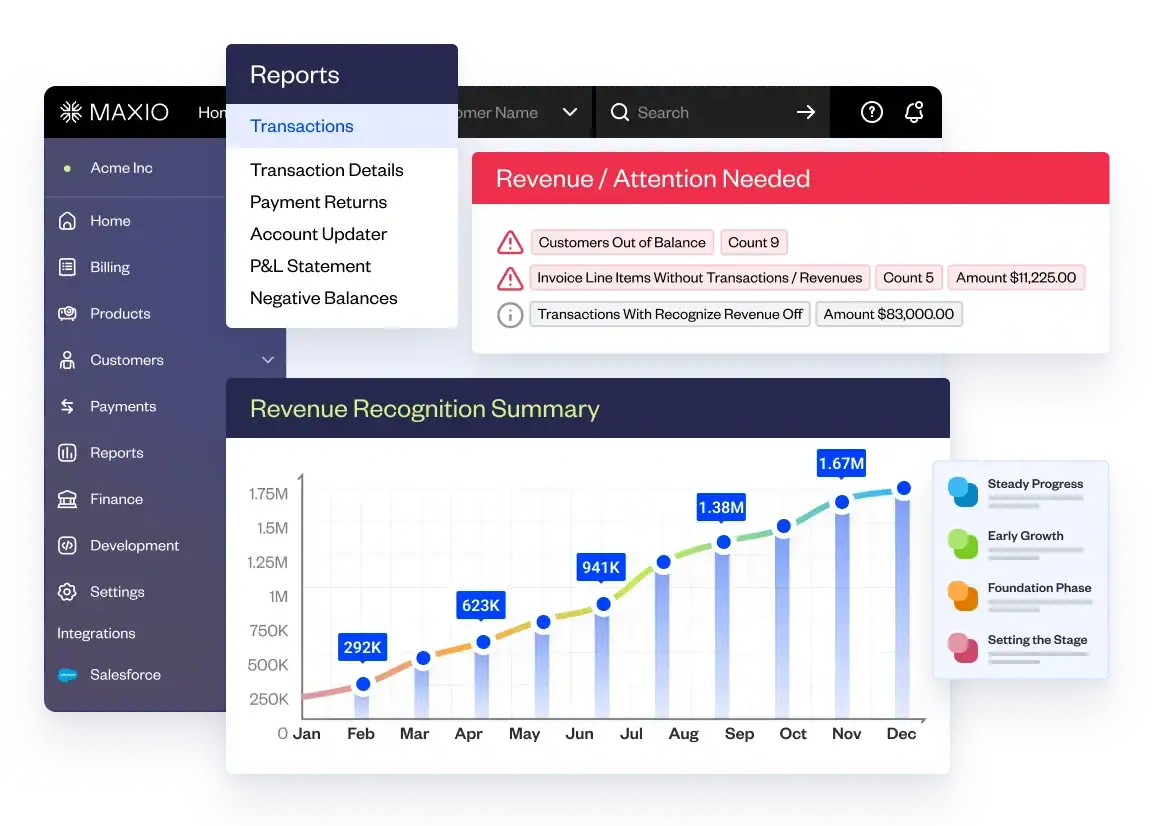
That’s where the right systems make a real difference. Maxio is a billing and revenue management platform designed for subscription and usage-based businesses that need dependable data as they scale. By bringing billing, payments, revenue recognition, and reporting into one place, Maxio removes guesswork and gives teams a clear view of revenue and customer activity.
Get a demo to see how Maxio helps teams track business metrics with confidence and make decisions based on numbers they can trust.