Invoice Consolidation: Benefits, Examples, & How to Set It Up


Invoice consolidation groups multiple charges into one billing document instead of issuing separate invoices for each transaction. This billing method changes how finance teams prepare statements and how customers receive and pay their bills.
The approach affects operational efficiency, customer relationships, invoice management, and payment processing across your business. Understanding when and how to implement consolidated invoicing helps you decide whether this billing structure fits your company’s needs and your customers’ preferences.
In this article, we’ll cover when consolidated invoicing makes sense for your business, the operational advantages it creates, real-world applications across different industries, implementation steps, and best practices for running consolidated billing over time.
Key takeaways
- Consolidated invoices group multiple charges from the same time period into one document with a single payment deadline
- This billing method reduces administrative work for finance teams while simplifying payments for customers
- Businesses that bill the same customers multiple times per month see the most benefit from consolidation
- Implementation requires connecting billing systems, setting grouping rules, and creating unified invoice templates
- Automated consolidation platforms handle billing timing, payment coordination, subscription grouping, and mid-cycle adjustments without manual intervention
What is a consolidated invoice?
A consolidated invoice combines several charges from a set time period into one document. Instead of issuing separate invoices for each service or transaction, related charges are grouped.
The system pulls billing data and organizes it based on the criteria you choose, such as customer, project, billing period, or department. The final invoice lists all line items in one place with a single total amount due and one payment date. This works well for monthly billing cycles where charges happen at different points in the month but are easier for customers to handle when combined.
This method cuts down on the work involved in managing invoices and simplifies subscription and account oversight. Tracking one statement instead of many usually leads to faster payments. For businesses that provide recurring services or sell across different product lines, it also creates a clearer record of invoiced activity and makes account-level reconciliation easier from one accounting period to the next.
When consolidated invoicing makes sense
Consolidated invoicing works well in situations where separate invoices create extra steps, confusion, or unnecessary processing. It tends to be the better option when any of the following are true:
- A single customer receives multiple invoices each month for different services, products, or locations, and a combined statement would reduce clutter.
- Recurring billing cycles generate regular charges that can be grouped by month or quarter instead of being handled one at a time.
- Clients maintain multiple accounts or subscriptions that share the same billing contact and payment terms.
- Administrative teams spend significant time creating, sending, tracking, and reconciling invoices that could be processed together.
- Customers have asked for simpler statements or expressed confusion about receiving separate invoices for related work.
- Accounting teams struggle to match payments to the correct invoices when several charges are paid at once or spread across different statements.
Benefits of consolidated billing that support growth
Consolidated billing creates operational advantages that extend well beyond simply reducing paperwork. When you group related charges into single statements, you establish a more organized billing structure that benefits your internal teams and your customers.
Benefits of consolidated billing that support growth
Consolidated billing creates operational advantages that extend well beyond simply reducing paperwork. When you group related charges into single statements, you establish a more organized billing structure that benefits your internal teams and your customers.
Increased operational efficiency
Consolidated billing brings related charges into one place so teams spend less time preparing and managing invoices. Automating the grouping process cuts down on manual data entry and helps streamline the invoicing steps your team manages each cycle. Finance teams can process one statement instead of several individual invoices.
Clearer customer experience
A single invoice gives customers a complete view of their charges and when payment is due. They can use their preferred payment methods without sorting through multiple documents or tracking different due dates. Fewer statements also means fewer notifications, making it easier for customers to review and approve payments on their end.
Improved cash flow management
Combining charges into one invoice creates more consistent billing patterns and predictable cash flow. One payment due date is easier for customers to track, lowering the chance of missed payments. This consistency simplifies cash forecasting and helps finance teams identify late payments before they become problems.
Lower error rates
Keeping all charges in one document reduces the likelihood of discrepancies between statements. Line items pull from the same data source and stay linked to the correct accounts or projects. This consolidation lowers the chances of duplicate charges, incorrect amounts, or mismatched information that require time-consuming corrections. It also reduces the risk of missed invoices or overlooked subscription changes by centralizing billing activity in a single statement.
Easier invoice and subscription management
Consolidated billing helps accounting and finance teams manage invoices and related subscriptions more efficiently. Instead of tracking multiple open invoices across different services or billing dates, teams can oversee activity at the customer level. This simplifies invoice tracking, reduces follow-up work, and provides a clearer view of outstanding balances and active subscriptions.
Real-world invoice consolidation examples by industry
Billing can become complicated when charges come from different sources. Some businesses manage mid-cycle changes, others bill for project work, and many split charges across departments.
The examples below show how invoice consolidation brings these items into one clear statement.
SaaS and subscription businesses
A project management software company charges for subscription tiers, user seats, and storage. In one month, a 50-user account adds five additional users and extra storage, which leads to three separate invoices for the same billing period.
How it works: The billing system gathers every charge tied to the customer’s billing period and places them on one invoice. It lists the base subscription first, then the prorated cost for the five added users, followed by the storage upgrade as its own line item. All items share a single payment deadline.
The result: The customer receives one monthly invoice showing their complete account activity. They review their base plan, adjustments, and add-ons in a single document. The finance team only receives one payment and can easily track the customer’s active subscriptions and invoice status in one place.
Agencies and professional services
A digital marketing agency tracks 40 hours of strategy work, 25 hours of content production, $5,000 in ad spend, and $300 in stock photos for one client in one month. Each category typically generates its own invoice, creating four separate bills.
How it works: The billing system collects time entries and groups them by service type. Ad spend and expenses are added as separate line items. Everything appears on one invoice, organized by category.
The result: The client sees the full scope of work and costs in one document. The agency reduces the time spent generating multiple invoices. The client’s accounting team processes one payment instead of four and can more easily track invoice status.
Multi-product or multi-department companies
A business services company provides payroll processing, HR consulting, and benefits administration. Each department sends its own invoice, so clients with all three services receive three separate bills from the same vendor.
How it works: The billing system aggregates charges from all departments. Payroll shows per-employee fees, HR lists consulting hours, and benefits display management fees. All charges appear in clear sections on one invoice.
The result: Clients receive one statement showing total costs across all services. Internal departments follow the same billing process. The client’s accounting team processes one payment and reconciles one document more efficiently.
How to consolidate invoices
Moving to consolidated billing requires a structured approach that touches multiple parts of your finance operations.
Decide what should be consolidated
Identify which charges make sense to group. A consolidated invoice works best when charges share the same customer, billing period, or project. Consolidated billing typically groups charges by customer account, subscription, or time period to simplify oversight for your team and your customers.
Gather your billing data
Collect all charges within your chosen timeframe for each customer. Pull data from time tracking tools, subscription platforms, and sales records. Your billing process should capture complete information for each line item before consolidation begins.
Choose your consolidation method
Select an invoice solution that handles your consolidation needs. Some accounting software tools include built-in consolidation functionality, while others require integrations with third-party tools. Your choice depends on transaction volume and the level of automation you need.
Set clear billing and grouping rules
Establish consistent rules for how charges get grouped and when invoices are generated. Define criteria such as billing frequency, subscription alignment, or customer account numbers. Set standard due dates that align with your consolidation schedule so customers know when payment is required.
Create a unified invoice format
Design a comprehensive invoice template that accommodates all the charge types you need to include. The format should clearly separate different categories while maintaining a consistent structure that’s easy for customers to read and understand.
Sync and validate data across systems
Connect your billing systems to ensure data flows correctly into consolidated invoices. If you use an ERP system, configure it to pull information from relevant modules. Set up automated checks that flag missing data or duplicate entries before invoices are finalized.
Review for accuracy before sending
Check each consolidated invoice for completeness before it goes to the customer. Verify that all expected charges appear and amounts match source records. Review the line items to confirm accuracy and catch any issues before sending.
Best practices for better consolidated billing
Running consolidated billing effectively over time requires attention to system design and customer communication.
Support flexible billing rules
Your automated billing system should accommodate different customer needs without creating extra manual work. Some customers may need charges grouped by project, while others prefer grouping by department or service type. Build flexibility into your payment processing so you can adjust billing cycles, apply custom discounts, or align multiple subscriptions under one invoice without generating separate statements.
Use strong data integrations
Connect all systems that generate billable charges so data flows automatically into your consolidated invoices. Strong integrations between your CRM, project management tools, subscription platform, and accounting system eliminate manual data entry and reduce errors.
Build clear, consistent invoice templates
Design invoice templates that present charges and applicable taxes in a clean, easy-to-read format. Group charges by category and include enough detail so customers understand what they’re paying for without overwhelming them.
Provide customer self-serve tools
Give customers access to billing portals where they can view current and past invoices, download statements, and track payment history. Include features that let customers update payment methods or review subscription details tied to each consolidated invoice.
Maintain audit-ready billing records
Store complete records of every consolidated invoice, including all supporting documentation. Keep backup data that shows how charges were calculated, which source systems contributed to each line item, and any adjustments made before sending. Organized records make audits easier and help resolve customer disputes quickly by providing clear documentation of invoiced activity.
What to consider before implementing consolidated billing
Consolidated billing changes how your finance team operates and how customers interact with your invoices.
Consider the following factors:
- System compatibility: Check whether your existing accounting software, ERP, or billing platform supports invoice consolidation.
- Data quality: Consolidated invoices depend on accurate data from every system that tracks billable activities.
- Customer communication: Some customers may prefer receiving detailed separate invoices rather than consolidated statements.
- Internal workflow changes: Consolidation affects how your finance team prepares, tracks, and manages invoices and subscriptions.
- Billing complexity: Evaluate how many charge types, departments, or service lines you need to consolidate.
- Payment terms and timing: Determine whether consolidated billing will change when customers receive invoices or when payments are due.
Automate invoice consolidation with Maxio
Managing multiple subscriptions per customer shouldn’t mean juggling separate invoices, payment dates, and transaction fees every month.
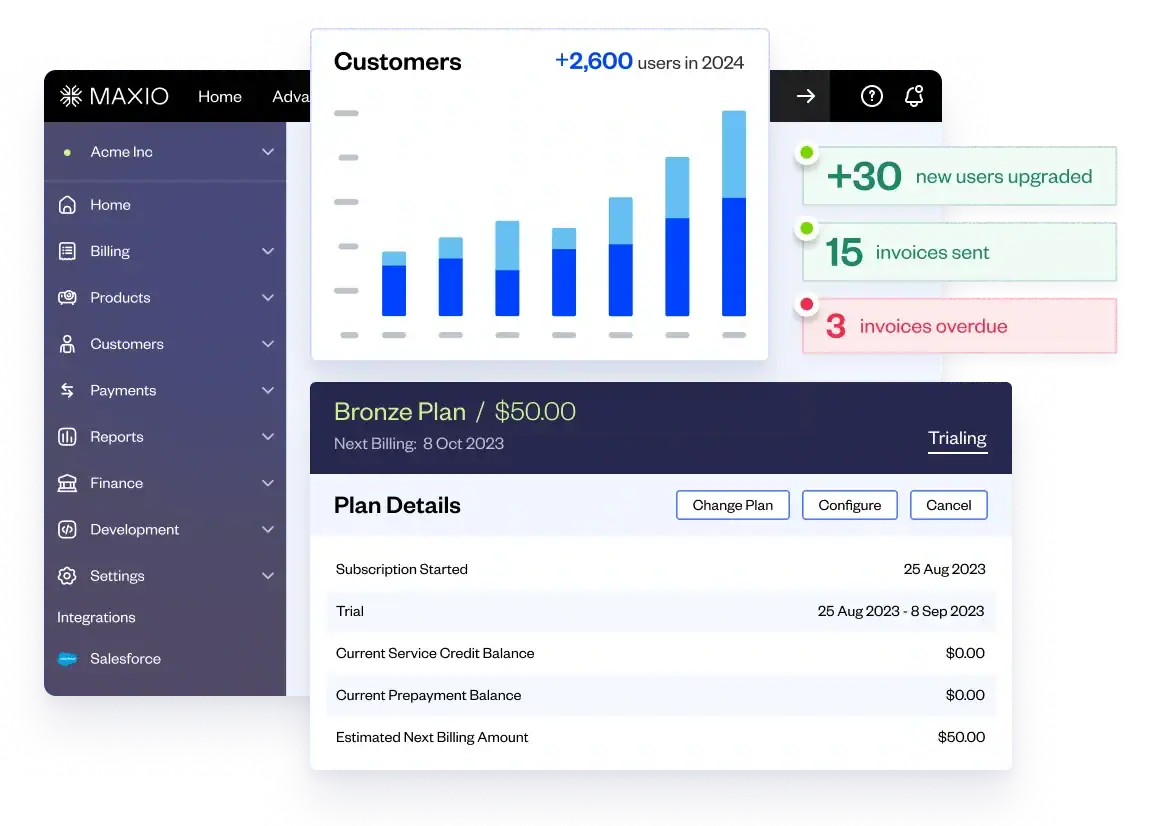
Maxio makes it simple. With our subscription billing software, you can group related subscriptions and let our platform handle billing timing, payment coordination, and collection automatically.
With our invoice consolidation features, monthly and annual subscriptions can be combined into a single statement, mid-cycle changes can be processed separately, and charges from different renewal dates can roll into a single invoice without extra effort from your team. Your customers pay once per billing cycle with one clear statement and one due date, which reduces transaction fees and cuts down on payment follow-up. Your finance team gains a clearer view of invoices and subscription activity at the customer level without altering how revenue is recognized.
Ready to see how Maxio can simplify your billing process? Book a demo with our team today.
–>Invoice consolidation groups multiple charges into one billing document instead of issuing separate invoices for each transaction. This billing method changes how finance teams prepare statements and how customers receive and pay their bills.
The approach affects operational efficiency, customer relationships, invoice management, and payment processing across your business. Understanding when and how to implement consolidated invoicing helps you decide whether this billing structure fits your company’s needs and your customers’ preferences.
In this article, we’ll cover when consolidated invoicing makes sense for your business, the operational advantages it creates, real-world applications across different industries, implementation steps, and best practices for running consolidated billing over time.
Key takeaways
- Consolidated invoices group multiple charges from the same time period into one document with a single payment deadline
- This billing method reduces administrative work for finance teams while simplifying payments for customers
- Businesses that bill the same customers multiple times per month see the most benefit from consolidation
- Implementation requires connecting billing systems, setting grouping rules, and creating unified invoice templates
- Automated consolidation platforms handle billing timing, payment coordination, subscription grouping, and mid-cycle adjustments without manual intervention
What is a consolidated invoice?
A consolidated invoice combines several charges from a set time period into one document. Instead of issuing separate invoices for each service or transaction, related charges are grouped.
The system pulls billing data and organizes it based on the criteria you choose, such as customer, project, billing period, or department. The final invoice lists all line items in one place with a single total amount due and one payment date. This works well for monthly billing cycles where charges happen at different points in the month but are easier for customers to handle when combined.
This method cuts down on the work involved in managing invoices and simplifies subscription and account oversight. Tracking one statement instead of many usually leads to faster payments. For businesses that provide recurring services or sell across different product lines, it also creates a clearer record of invoiced activity and makes account-level reconciliation easier from one accounting period to the next.
When consolidated invoicing makes sense
Consolidated invoicing works well in situations where separate invoices create extra steps, confusion, or unnecessary processing. It tends to be the better option when any of the following are true:
- A single customer receives multiple invoices each month for different services, products, or locations, and a combined statement would reduce clutter.
- Recurring billing cycles generate regular charges that can be grouped by month or quarter instead of being handled one at a time.
- Clients maintain multiple accounts or subscriptions that share the same billing contact and payment terms.
- Administrative teams spend significant time creating, sending, tracking, and reconciling invoices that could be processed together.
- Customers have asked for simpler statements or expressed confusion about receiving separate invoices for related work.
- Accounting teams struggle to match payments to the correct invoices when several charges are paid at once or spread across different statements.
Benefits of consolidated billing that support growth
Consolidated billing creates operational advantages that extend well beyond simply reducing paperwork. When you group related charges into single statements, you establish a more organized billing structure that benefits your internal teams and your customers.
Benefits of consolidated billing that support growth
Consolidated billing creates operational advantages that extend well beyond simply reducing paperwork. When you group related charges into single statements, you establish a more organized billing structure that benefits your internal teams and your customers.
Increased operational efficiency
Consolidated billing brings related charges into one place so teams spend less time preparing and managing invoices. Automating the grouping process cuts down on manual data entry and helps streamline the invoicing steps your team manages each cycle. Finance teams can process one statement instead of several individual invoices.
Clearer customer experience
A single invoice gives customers a complete view of their charges and when payment is due. They can use their preferred payment methods without sorting through multiple documents or tracking different due dates. Fewer statements also means fewer notifications, making it easier for customers to review and approve payments on their end.
Improved cash flow management
Combining charges into one invoice creates more consistent billing patterns and predictable cash flow. One payment due date is easier for customers to track, lowering the chance of missed payments. This consistency simplifies cash forecasting and helps finance teams identify late payments before they become problems.
Lower error rates
Keeping all charges in one document reduces the likelihood of discrepancies between statements. Line items pull from the same data source and stay linked to the correct accounts or projects. This consolidation lowers the chances of duplicate charges, incorrect amounts, or mismatched information that require time-consuming corrections. It also reduces the risk of missed invoices or overlooked subscription changes by centralizing billing activity in a single statement.
Easier invoice and subscription management
Consolidated billing helps accounting and finance teams manage invoices and related subscriptions more efficiently. Instead of tracking multiple open invoices across different services or billing dates, teams can oversee activity at the customer level. This simplifies invoice tracking, reduces follow-up work, and provides a clearer view of outstanding balances and active subscriptions.
Real-world invoice consolidation examples by industry
Billing can become complicated when charges come from different sources. Some businesses manage mid-cycle changes, others bill for project work, and many split charges across departments.
The examples below show how invoice consolidation brings these items into one clear statement.
SaaS and subscription businesses
A project management software company charges for subscription tiers, user seats, and storage. In one month, a 50-user account adds five additional users and extra storage, which leads to three separate invoices for the same billing period.
How it works: The billing system gathers every charge tied to the customer’s billing period and places them on one invoice. It lists the base subscription first, then the prorated cost for the five added users, followed by the storage upgrade as its own line item. All items share a single payment deadline.
The result: The customer receives one monthly invoice showing their complete account activity. They review their base plan, adjustments, and add-ons in a single document. The finance team only receives one payment and can easily track the customer’s active subscriptions and invoice status in one place.
Agencies and professional services
A digital marketing agency tracks 40 hours of strategy work, 25 hours of content production, $5,000 in ad spend, and $300 in stock photos for one client in one month. Each category typically generates its own invoice, creating four separate bills.
How it works: The billing system collects time entries and groups them by service type. Ad spend and expenses are added as separate line items. Everything appears on one invoice, organized by category.
The result: The client sees the full scope of work and costs in one document. The agency reduces the time spent generating multiple invoices. The client’s accounting team processes one payment instead of four and can more easily track invoice status.
Multi-product or multi-department companies
A business services company provides payroll processing, HR consulting, and benefits administration. Each department sends its own invoice, so clients with all three services receive three separate bills from the same vendor.
How it works: The billing system aggregates charges from all departments. Payroll shows per-employee fees, HR lists consulting hours, and benefits display management fees. All charges appear in clear sections on one invoice.
The result: Clients receive one statement showing total costs across all services. Internal departments follow the same billing process. The client’s accounting team processes one payment and reconciles one document more efficiently.
How to consolidate invoices
Moving to consolidated billing requires a structured approach that touches multiple parts of your finance operations.
Decide what should be consolidated
Identify which charges make sense to group. A consolidated invoice works best when charges share the same customer, billing period, or project. Consolidated billing typically groups charges by customer account, subscription, or time period to simplify oversight for your team and your customers.
Gather your billing data
Collect all charges within your chosen timeframe for each customer. Pull data from time tracking tools, subscription platforms, and sales records. Your billing process should capture complete information for each line item before consolidation begins.
Choose your consolidation method
Select an invoice solution that handles your consolidation needs. Some accounting software tools include built-in consolidation functionality, while others require integrations with third-party tools. Your choice depends on transaction volume and the level of automation you need.
Set clear billing and grouping rules
Establish consistent rules for how charges get grouped and when invoices are generated. Define criteria such as billing frequency, subscription alignment, or customer account numbers. Set standard due dates that align with your consolidation schedule so customers know when payment is required.
Create a unified invoice format
Design a comprehensive invoice template that accommodates all the charge types you need to include. The format should clearly separate different categories while maintaining a consistent structure that’s easy for customers to read and understand.
Sync and validate data across systems
Connect your billing systems to ensure data flows correctly into consolidated invoices. If you use an ERP system, configure it to pull information from relevant modules. Set up automated checks that flag missing data or duplicate entries before invoices are finalized.
Review for accuracy before sending
Check each consolidated invoice for completeness before it goes to the customer. Verify that all expected charges appear and amounts match source records. Review the line items to confirm accuracy and catch any issues before sending.
Best practices for better consolidated billing
Running consolidated billing effectively over time requires attention to system design and customer communication.
Support flexible billing rules
Your automated billing system should accommodate different customer needs without creating extra manual work. Some customers may need charges grouped by project, while others prefer grouping by department or service type. Build flexibility into your payment processing so you can adjust billing cycles, apply custom discounts, or align multiple subscriptions under one invoice without generating separate statements.
Use strong data integrations
Connect all systems that generate billable charges so data flows automatically into your consolidated invoices. Strong integrations between your CRM, project management tools, subscription platform, and accounting system eliminate manual data entry and reduce errors.
Build clear, consistent invoice templates
Design invoice templates that present charges and applicable taxes in a clean, easy-to-read format. Group charges by category and include enough detail so customers understand what they’re paying for without overwhelming them.
Provide customer self-serve tools
Give customers access to billing portals where they can view current and past invoices, download statements, and track payment history. Include features that let customers update payment methods or review subscription details tied to each consolidated invoice.
Maintain audit-ready billing records
Store complete records of every consolidated invoice, including all supporting documentation. Keep backup data that shows how charges were calculated, which source systems contributed to each line item, and any adjustments made before sending. Organized records make audits easier and help resolve customer disputes quickly by providing clear documentation of invoiced activity.
What to consider before implementing consolidated billing
Consolidated billing changes how your finance team operates and how customers interact with your invoices.
Consider the following factors:
- System compatibility: Check whether your existing accounting software, ERP, or billing platform supports invoice consolidation.
- Data quality: Consolidated invoices depend on accurate data from every system that tracks billable activities.
- Customer communication: Some customers may prefer receiving detailed separate invoices rather than consolidated statements.
- Internal workflow changes: Consolidation affects how your finance team prepares, tracks, and manages invoices and subscriptions.
- Billing complexity: Evaluate how many charge types, departments, or service lines you need to consolidate.
- Payment terms and timing: Determine whether consolidated billing will change when customers receive invoices or when payments are due.
Automate invoice consolidation with Maxio
Managing multiple subscriptions per customer shouldn’t mean juggling separate invoices, payment dates, and transaction fees every month.
Maxio makes it simple. With our subscription billing software, you can group related subscriptions and let our platform handle billing timing, payment coordination, and collection automatically.
With our invoice consolidation features, monthly and annual subscriptions can be combined into a single statement, mid-cycle changes can be processed separately, and charges from different renewal dates can roll into a single invoice without extra effort from your team. Your customers pay once per billing cycle with one clear statement and one due date, which reduces transaction fees and cuts down on payment follow-up. Your finance team gains a clearer view of invoices and subscription activity at the customer level without altering how revenue is recognized.
Ready to see how Maxio can simplify your billing process? Book a demo with our team today.