Where to Start With AI




Hire Claude to do accounting, not financial analysis.
Most AI use cases I hear about in SaaS finance focus on financial analysis or writing a board deck. But AI does analysis like I did when I was just out of college: “Gross margins are down 1.2 percentage points because of an increase in raw materials. It tells you nothing because AI does not know your competitive landscape, your product roadmap, your fundraising efforts… etc. It can identify places to look, but it’s a junior analyst at best.
Start using AI in a much more tangible way.
Start with reconciling cash
Using AI to reconcile cash will save you time the first or second time you do it and improve data accuracy rather than corrupt it with hallucinations.
Matching bank deposits with customer invoices is a great place to start. You can do this offline on spreadsheets and then, once comfortable, integrate it into production. No big investment, no big risk.
If you pull together your bank deposits, invoices, and customer master on three spreadsheets, AI can match the invoices to the deposits and create a confidence score. It’s actually pretty good at understanding fringe cases, such as a $1,000 deposit covering two $500 invoices, or a $450 deposit being applied to a $500 invoice along with a $50 short-pay note. This can save a lot of time.
More broadly, AI can compare all your accounting system cash transactions with your bank account transactions and generate a simple report like this:
October Cash Reconciliation: 98.7% automatically reconciled
- 1,247 transactions reviewed
- 1,231 matched automatically
- 11 require review
- 5 unmatched
- Net unexplained difference: $3,247.18
This report is fully auditable, saves time, and improves the accuracy of your numbers.
Earlier this year, I wrote about red flags I have seen in SaaS companies, and failing to reconcile cash to the bank account properly is one of the most problematic. I have seen two companies fail because the CFO/controller failed to reconcile cash and had to restate the company’s financials.
Another tangible AI use case: cash forecasting
When I lent to SaaS businesses, if a borrower was running low on cash, we required them to hire a consultant to build a 13-week cash flow. (Very few could build it on their own.) This is a tactical, granular report that estimates exactly when a company will run out of cash and why.
AI can easily build this forecast using AR, AP, and payroll data. If you give it historical payment data, it gets even better.
A detailed forecast at this level is easy to check. This is not a black box model.
In this use case, AI improves your data and visibility and adds a skill set to your team.
The bottom line
Use AI for discrete, tangible actions that will save you time, and leverage it for low-level financial analysis only to ensure you are not missing something.
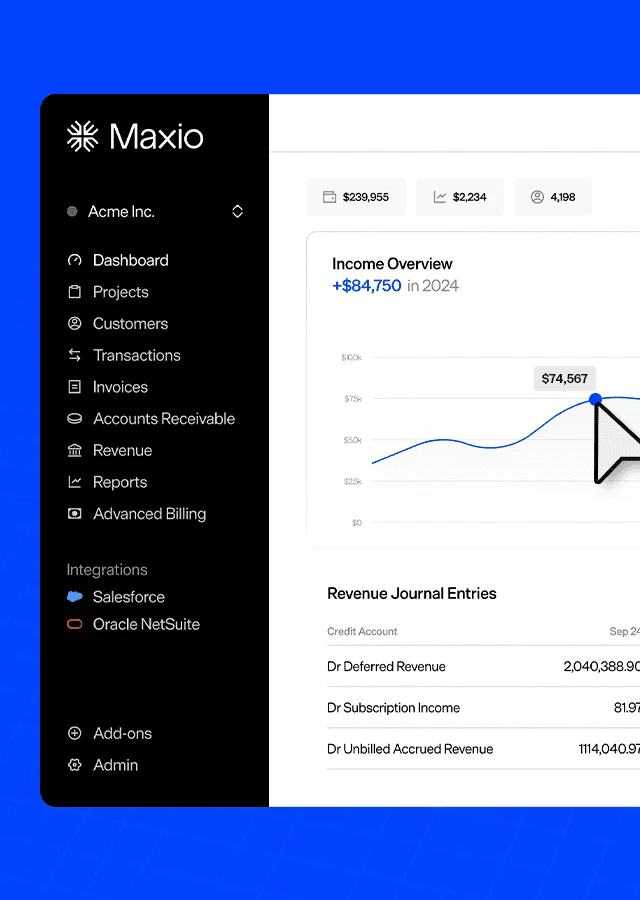
Both use cases work best when AI lives inside your system. Spreadsheets dropped into Claude are a snapshot: stale on download, limited to what you remembered to export, and rebuilt by hand every month.
AI built into your billing and revenue platform sees every contract, invoice, and payment as it happens. It knows this month’s short-pay is the customer’s third in a row, and it runs the same way every close.