
Recurly Alternatives for B2B SaaS Billing: An Architectural Comparison




You signed up for Recurly when billing meant recurring charges on a card and a monthly invoice. And it worked. Soon your sales team was closing multi-year deals with ramp schedules, usage tiers, and mid-term amendments. Your auditors started asking for ASC 606 documentation. You needed a revenue waterfall that matched the CRM.
Recurly was not designed for any of it. Recurly is a subscription billing engine built primarily for B2C and SMB use cases. It handles volume well. For most B2B SaaS and AI finance teams, volume is not the problem. Complexity is the problem, and complexity needs a different architecture.
This post is for finance ops leaders and controllers evaluating alternatives to Recurly for B2B SaaS and AI billing. The goal is a clear-eyed view of what matters at the architectural level, not a feature checklist that treats every vendor as roughly equivalent.
Why B2B Billing Is Architecturally Different
Consumer subscription billing is largely stateless. A customer pays $15/month, the card is charged, and a receipt goes out. The billing system does not need to know much about the deal structure, because there is no deal structure.
B2B SaaS billing is stateful by nature. A contract has a start date, an end date, committed quantities, optional add-ons, and a renewal schedule. Mid-term changes create prorations, and every upgrade, downgrade, and seat addition has to be calculated correctly and documented for audit. Revenue recognition is not a downstream accounting step you can handle separately. It is a constraint that shapes how the billing system models the contract from day one.
Finance teams evaluating a new platform are usually reacting to a specific failure mode. The billing system produced one number, the revenue schedule produced another, and nobody could explain the gap without pulling up a spreadsheet. The right alternative does more than fix the symptom. It eliminates the gap by treating the contract, the invoice, and the revenue schedule as a single object instead of three systems to reconcile every month-end.
What to Actually Evaluate (Beyond the Feature Table)
Most comparison posts hand you a table with checkboxes. That confirms a vendor supports usage billing or offers a Salesforce connector. It tells you nothing about whether the system holds up when your team needs to model a three-year deal with a 20% ramp in year two and a true-up clause tied to API calls.
Here are the dimensions that separate purpose-built platforms from consumer billing tools with B2B features added on.
Contract modeling depth. Can the system represent your actual deal structure, including multi-element arrangements, variable consideration, and mid-term amendments, without a workaround? Workarounds become technical debt. Technical debt becomes audit risk.
Revenue recognition architecture. Is ASC 606 compliance built into how the system models contracts from the start, or added on top of billing? A bolt-on approach lets the billing record and the revenue record diverge. A native approach makes that divergence structurally difficult.
Audit trail completeness. Every change to a contract, a price edit, a quantity adjustment, a credit memo, should produce an immutable log entry. When your auditors ask why MRR changed between two periods, you should be able to answer in minutes, not days.
Reporting that finance actually uses. Deferred revenue schedules, ARR waterfall, cohort retention, net revenue retention. Your CFO uses these outputs to run the business and your board uses them to assess it. When the billing system cannot produce them natively, you are back to spreadsheets.
Integration with your quote-to-cash stack. Billing sits between your CRM and your general ledger. The quality of those integrations, specifically whether they are bidirectional and handle amendment scenarios, decides whether your close cycle runs five days or fifteen.
How the Main Alternatives Compare
Several platforms come up consistently in these evaluations. Here is an honest read on each, based on each vendor’s publicly available documentation and product positioning as of 2026.
Maxio
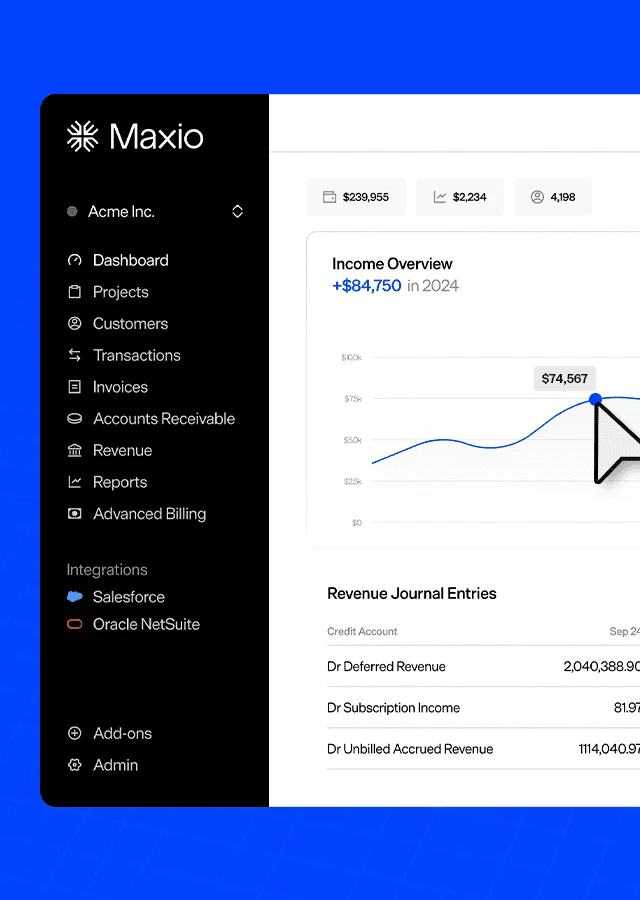
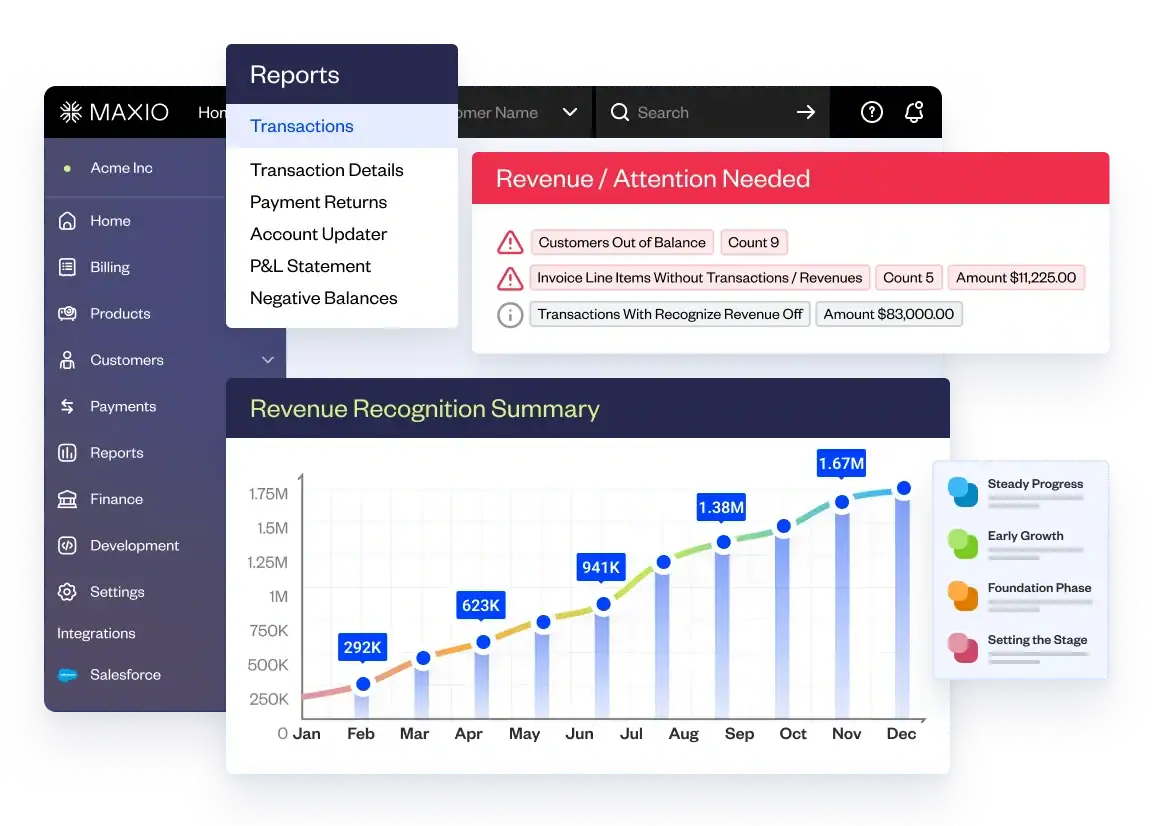
Maxio is purpose-built for B2B SaaS and AI companies. Billing, ASC 606 revenue recognition, and finance reporting share one data model, so the contract, the invoice, and the revenue schedule stay in agreement through ramps, amendments, and renewals. Usage-based and AI pricing run natively. Metered usage feeds contract-based revenue schedules, entitlements record what each customer is provisioned for, and wallets track prepaid credits as they draw down. Native integrations with Salesforce, HubSpot, QuickBooks, and Xero connect billing to the CRM and the general ledger, and deferred revenue schedules, ARR waterfalls, and retention reporting come straight from the system of record.
Maxio performs best in B2B environments with complex contracts, so if your business runs on high-volume, low-complexity consumer subscriptions, a lighter billing tool is usually the better fit.
Chargebee
Chargebee is strong on billing and dunning, with a broad integration ecosystem and a fast initial setup. Revenue recognition is sold as a separate module that sits alongside the billing product, so finance teams with multi-element arrangements or variable consideration should test it against their ASC 606 requirements before committing. It suits companies with moderate billing complexity that want to get running quickly.
Stripe Billing
Stripe offers a strong developer experience and payment infrastructure. However, it is not a finance system in the traditional sense. Revenue recognition, audit trails, and contract modeling require significant custom development or third-party tools on top of it. Finance teams who choose Stripe Billing are, in effect, choosing to build a billing system rather than buying one.
Zuora
Zuora is enterprise-grade and capable of handling complex billing scenarios. Deployments at mid-market companies can be lengthy and often require dedicated implementation partners. For companies earlier in their growth trajectory, that implementation scope is a meaningful factor to weigh against the capability gains.
Salesforce Revenue Cloud
It is tightly integrated with Salesforce CPQ, a real advantage if your sales process is already deeply embedded in Salesforce. Licenses, implementation, and ongoing administration add up, so total cost of ownership tends to run higher than purpose-built alternatives. Billing and revenue recognition have improved in recent releases, though growth-stage companies should weigh whether the cost lines up with the capability they actually need.
Start With the Problem You Need to Solve
If involuntary churn from weak payment retries is the issue, Chargebee or a better-configured Recurly setup may cover it.
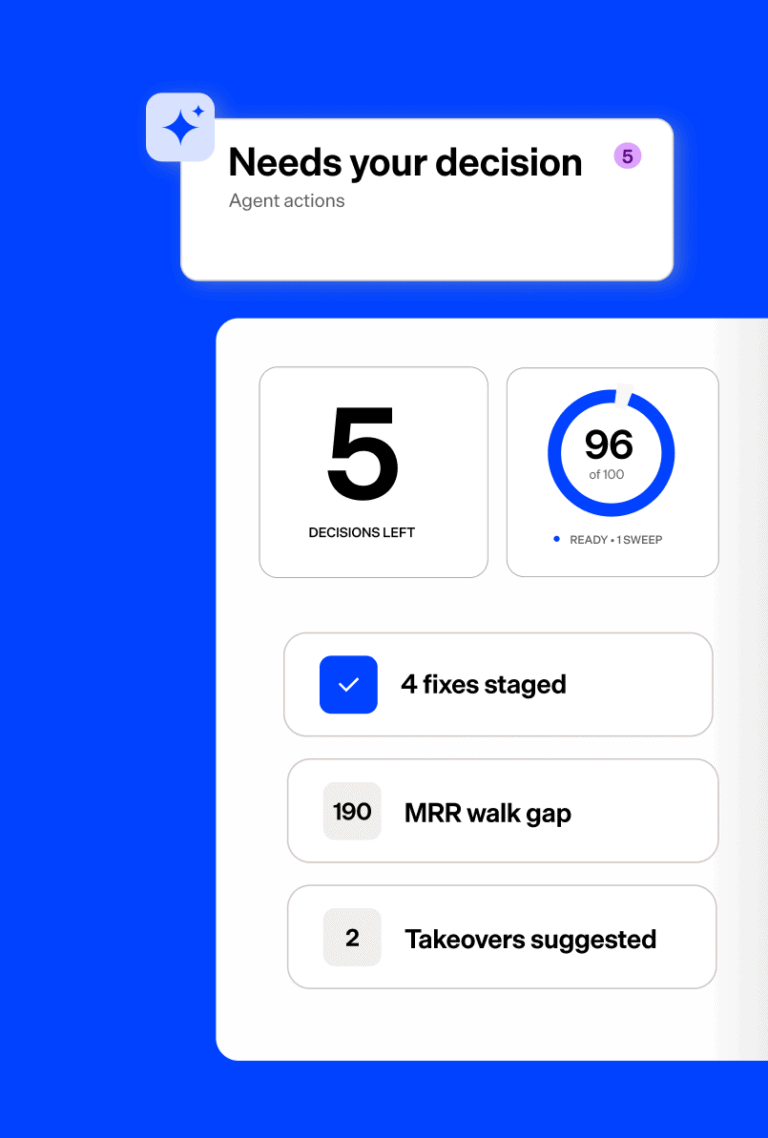
If your billing and revenue schedules disagree, your close runs long, and the board’s ARR waterfall takes a spreadsheet to build, you need a platform where billing, revenue recognition, and reporting share one data model. A billing tool with a reporting add-on keeps that gap in place, because every amendment, ramp, and usage true-up still has to be reconciled across two systems at month-end.
Finance ops professionals who have been through this evaluation cite the same regret. They chose a system based on ease of initial implementation rather than fit for the complexity the business was heading toward. A system that takes four weeks to implement but needs a spreadsheet layer to produce accurate revenue schedules is only simpler to start.
What Changes When the Data Model Is Unified
When the billing system, revenue recognition engine, and reporting layer share a single data model, several things shift. Companies that unify these functions typically report a shorter monthly close, because there is no reconciliation step between billing and revenue. Audits get less painful, because every contract change carries an immutable trail. The CFO’s board package comes together faster, because the ARR waterfall and deferred revenue schedule come straight from the system of record.
If you are evaluating subscription billing models and trying to understand which pricing structures your platform needs to support, that is a useful starting point for scoping your requirements.
If you are further along and wondering whether your current stack, including QuickBooks or a legacy ERP, is holding your finance team back, the Outgrowing QuickBooks guide covers the signals that indicate it is time to move and some tips for staying on QuickBooks longer.
Results vary with how well the platform fits your contract structure, and a canned demo scenario will not tell you much about that. Book a Maxio demo, bring two or three of your most complex deals, and see how each one runs through billing, revenue recognition, and reporting. That’s the clearest way to know whether it fits before you commit.