

A guide to forecasting SaaS growth with accuracy
Revenue Projections
Subscription businesses need a clear view of future earnings to make smart decisions about hiring, product investment, and growth strategy. Without reliable forecasts, companies can struggle with resource allocation or with setting realistic expectations with investors and stakeholders.
This guide covers how to build reliable revenue forecasts for your SaaS company, including which metrics drive accuracy and calculation methods for different business models.

Key takeaways
- Revenue projections estimate how much your SaaS will earn over a set period, so you can plan spending, hiring, and growth with fewer surprises.
- Projections and forecasts are close, but not identical: projections look further out and use bigger assumptions, while forecasts focus on near-term results and current data.
- Reliable projections depend on clean inputs: MRR/ARR, churn, CAC, CLV, and expansion revenue give the clearest picture of growth and risk.
- Strong projections account for unit economics and costs, not just sales, so you can protect cash flow and profitability before pressure hits.
- Your best method depends on your model, like PLG conversion and upgrades, enterprise pipeline and renewals, or pricing changes, and it works best when updated regularly.
What are revenue projections?
Revenue projections estimate your company’s revenue over a specific period of time. These projections use historical data and market trends to predict future income.
Businesses use revenue projections to support financial planning and make informed decisions about growth. Accurate projections help companies identify potential cash flow issues early and protect overall financial health.
Revenue projections vs. revenue forecasts: What’s the difference?
Revenue projections and revenue forecasts are often used interchangeably, but they serve slightly different purposes.
- Projections usually look farther ahead and are based on bigger assumptions about growth and the market.
- Forecasts cover a shorter time frame and lean more on recent results and current data.
The distinction matters most for planning. Use forecasts when you need detailed predictions for the next quarter or year, and use projections when you’re making long-term strategic decisions or presenting growth potential to investors.
Why revenue projections matter for SaaS businesses
Accurate revenue projections help your company prepare for what’s coming and drive informed decision-making that maximizes stability and growth.
Revenue projections are used by SaaS businesses to:
- Improve cash flow forecasting: Know whether you’ll have capital for new initiatives or need to adjust spending.
- Decide on sales team quotas: Use a sales forecast to set realistic targets that align with company goals and keep your team motivated.
- Drive marketing strategies: Determine which marketing campaigns and retention programs will have the biggest impact on revenue growth.
- Formulate a better-performing business plan: Identify strategy weaknesses and adjust before problems affect your bottom line.
- Scale your business: Plan expansion at the right pace with confidence that you have the revenue to support it.
Accurate revenue projections set your SaaS company up to allocate resources properly, understand revenue potential, and reach your goals.
Key metrics for accurate SaaS revenue projections
Revenue projections are only as good as the data behind them, so protecting data quality is key to forecasting accuracy. Tracking the right metrics and using SaaS benchmarks gives you the foundation to create reliable forecasts.
- Monthly Recurring Revenue (MRR): Shows your predictable revenue stream each month and helps you spot growth trends or warning signs early.
- Annual Recurring Revenue (ARR): Gives you a big-picture view of subscription revenue for annual budgets and long-term strategy.
- Customer Acquisition Cost (CAC): Reveals how much you’re spending to gain each customer so you can assess whether your growth is sustainable.
- Customer Lifetime Value (CLV): Shows the total revenue you can expect from a customer relationship and helps determine how much you can spend on acquisition.
- Churn Rate: Measures how many customers you’re losing and directly impacts whether your projected growth will materialize.
- Expansion Revenue: Tracks additional revenue from existing customers through upgrades and add-ons.
These SaaS metrics paint a complete picture of your revenue health. Once you understand what each reveals, you can use them to calculate accurate revenue projections.
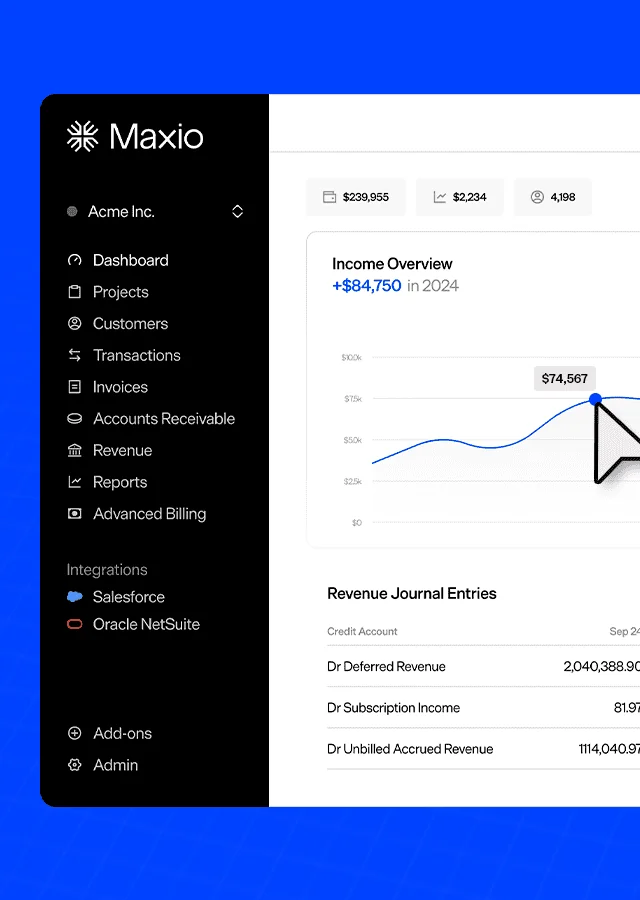
Accurate revenue projections require clean inputs — Maxio’s metrics dashboard provides live ARR, MRR, churn, and expansion revenue data that feeds directly into the projection models this article describes.
How to calculate revenue projections
To generate accurate revenue projections, take the difference between your company’s projected income and projected expenses. Use this formula:
Projected revenue = Projected income – Projected expenses
Here’s how to calculate each component:
1. Estimate projected income
Start by establishing a baseline for how much product or service your company will sell during a specific time period. This requires understanding your company’s performance history and your insight into industry and market conditions.
For subscription businesses, identify which tiers perform best and look at seasonal patterns to determine peak revenue months. Use this data to create realistic income estimates.
2. Estimate projected expenses
Income tells an important part of the story, but you need to account for what it costs to generate that revenue. Determine the technology and labor cost per subscription, then multiply by your projected subscription count.
Add fixed costs like salaries, office expenses, and software maintenance. Don’t forget variable costs that scale with growth, such as customer support and server capacity.
3. Apply the projected revenue formula
Subtract your projected expenses from your projected income. The result is your projected revenue for the time period you’re analyzing.
How to calculate revenue projections
To generate accurate revenue projections, take the difference between your company’s projected income and projected expenses. Use this formula:
Projected revenue = Projected income – Projected expenses
Here’s how to calculate each component:
1. Estimate projected income
Start by establishing a baseline for how much product or service your company will sell during a specific time period. This requires understanding your company’s performance history and your insight into industry and market conditions.
For subscription businesses, identify which tiers perform best and look at seasonal patterns to determine peak revenue months. Use this data to create realistic income estimates.
2. Estimate projected expenses
Income tells an important part of the story, but you need to account for what it costs to generate that revenue. Determine the technology and labor cost per subscription, then multiply by your projected subscription count.
Add fixed costs like salaries, office expenses, and software maintenance. Don’t forget variable costs that scale with growth, such as customer support and server capacity.
3. Apply the projected revenue formula
Subtract your projected expenses from your projected income. The result is your projected revenue for the time period you’re analyzing.
The complete guide to SaaS revenue modeling
It’s difficult to build a SaaS revenue model that accurately reflects your future cash position. In this guide, we’ll show you exactly how to collect, measure, and use these metrics to build a long-lasting revenue model that will grow with your business over time.
What you’ll learn
- Two methods for forecasting ARR
- How to model cash flow associated with revenue
- How to build an ARR momentum table
Types of revenue projections
Most companies have more than one revenue stream and need multiple ways to predict how each of them will perform. Let’s review some of the data you can use in revenue forecasting.Most companies have more than one revenue stream and need multiple ways to predict how each of them will perform. Let’s review some of the data you can use in revenue forecasting.
SaaS revenue from existing contracts
Each existing contract will have a revenue schedule, which typically runs through the end of the present term, but there are plenty of exceptions. This schedule includes fees for subscription services and other items accountants determine must be recognized over time. In addition to the scheduled revenues, you need to include any variable, transaction, or usage fees. Typically, these are calculated, recognized, and often billed in arrears.
Revenue from renewal contracts
To generate accurate revenue projections, you must also project renewals.
These projections are typically created using a simple renewal rate or churn number. A more sophisticated approach is to use different renewal rates for different segments. The most accurate approach, if your business supports it, is to project individual contracts. This is only possible if you have either a limited number of contracts and sufficient customer interaction to gauge customer health, or you have an algorithmic-based approach based on actual usage information pulled from your application.
Revenue from new contracts
Projections using revenues brought in from new sales can include a contract’s value during the period, one-time charges like set-up fees, and subscriptions.
You can lay the groundwork for this projection by pulling sales pipeline data from your CRM). This information will show you how much new business is percolating in your sales funnel. You can combine this number with other metrics like last year’s new contract revenue and forecasted growth rate to create a revenue schedule.
Projecting revenue offers insight that companies can use to manage products, plan strategies, and protect against unfriendly market trends. They can run their businesses more confidently and make decisions with greater clarity.
Savvy leaders use every metric and tool at their disposal to ensure they maximize their revenue and grow their businesses. Tools like Maxio that can help you proactively project your future revenues and manage your recurring subscriptions to keep your company competitive.
Learn more about Maxio’s advanced revenue management features today.
Revenue projection calculation examples
Revenue projections look different based on how your SaaS business grows. Below are three different scenarios with structured calculations for each.
Product-led growth company
A PLG SaaS company has 10,000 free users. Each quarter, 5% convert to a paid plan that costs $50 per month.
- New paid users: 10,000 × 0.05 = 500
- New monthly revenue from those users: 500 × $50 = $25,000
- New quarterly revenue (3 months): $25,000 × 3 = $75,000
The company also has 2,000 paid users already on the platform. In a quarter, 20% of them upgrade and pay $30 more per month.
- Upgraded users: 2,000 × 0.20 = 400
- Extra monthly revenue from upgrades: 400 × $30 = $12,000
- Extra quarterly revenue (3 months): $12,000 × 3 = $36,000
Based on conversions and upgrades alone, the company would add $111,000($75,000 from new conversions + $36,000 from upgrades) in revenue this quarter before factoring in customer churn or cancellations.
Enterprise sales model
An enterprise SaaS company has 20 deals in its sales pipeline with a total value of $2 million in annual contract value. Based on historical data, deals at this stage close at a 40% rate.
- Expected closed deals: 20 × 0.40 = 8 deals
- Expected annual contract value: $2,000,000 × 0.40 = $800,000
- Monthly recognized revenue: $800,000 ÷ 12 = $66,667
The company also has $5 million worth of existing contracts up for renewal this quarter. Its historical renewal rate is 85%.
- Renewal contract value: $5,000,000 × 0.85 = $4,250,000
- Monthly recognized renewal revenue: $4,250,000 ÷ 12 = $354,167
Between new deals and renewals, the company projects $420,834 ($66,667 from new contracts + $354,167 from renewals) in monthly recurring revenue before accounting for any upsells or contract expansions.
Pricing change impact
A SaaS company plans to increase its subscription price by 20%, from $100 to $120 per month. The company currently has 1,000 customers and acquires 50 new customers each month.
- New customer monthly revenue (at new price): 50 × $120 = $6,000
- Previous new customer monthly revenue: 50 × $100 = $5,000
- Monthly revenue increase from new customers: $6,000 – $5,000 = $1,000
Existing customers renew throughout the year at a steady rate of about 83 customers per month.
- Monthly renewals at new price: 83 × $120 = $9,960
- Previous monthly renewal revenue: 83 × $100 = $8,300
- Monthly revenue increase from renewals: $9,960 – $8,300 = $1,660
The company expects the price increase to cause an additional 10% churn among renewing customers.
- Additional monthly churn: 83 × 0.10 = 8 customers
- Lost monthly revenue from price-related churn: 8 × $100 = $800
After accounting for new customer pricing, renewal increases, and additional churn, the company projects a net monthly revenue increase of $1,860 ($1,000 from new customers + $1,660 from renewals – $800 from additional churn).
Common revenue projection models
Inaccurate revenue projections can lead to decisions that harm your business. A data-driven approach can prevent this problem.
You can forecast revenue in multiple ways, using different forecasting methods based on different data sets. Here are four popular revenue forecasting models companies use to arrive at accurate projections.
- Historical financial forecasting: One of the best predictors of the future is the past. By taking historical data and applying an assumed growth rate, your company can predict future revenue. Keep in mind that significant market changes and other external factors can reduce this method’s accuracy.
- Length of sales cycle forecasting: This method works well for companies with established sales cycles. It shows how much time you’ll have to prepare your product or service before customers are ready to buy.
- Test market analysis: This approach benefits startups and companies launching new products or entering a new market. Instead of a full launch, you test on a small scale and measure results to determine if a broader rollout makes financial sense.
- Multivariable analysis: This model factors in multiple data points, including marketing efforts, seasonality, inflation, interest rates, and expected supply and demand.
Types of SaaS revenue projections
Most companies have multiple revenue streams and need different ways to predict how each will perform. Here’s how to forecast the main sources of SaaS revenue.
Revenue from existing contracts
Each existing contract has a revenue schedule that typically runs through the end of the current term. This schedule includes subscription service fees and other items recognized over time. You also need to include variable, transaction, or usage-based pricing fees, which are usually calculated and billed in arrears.
Revenue from renewal contracts
These projections typically use a simple SaaS renewal rate or churn number. A more sophisticated approach applies different renewal rates for different customer segments.
The most accurate method projects individual contracts based on customer health indicators or usage data pulled from your application. This works best when you have either a limited contract count with strong customer relationships or an algorithm-based usage-based billing software.
Revenue from new contracts
New sales projections include the contract’s value during the period, one-time charges like setup fees, and subscription revenue.
Pull sales pipeline data from your CRM to see how much new business is in your funnel. Combine this with revenue metrics like last year’s new contract revenue and your forecasted growth rate to create a revenue schedule.
How Maxio helps with revenue projections
Revenue projections give companies the insight needed to manage products, plan strategies, and protect against unfavorable market trends. They enable more confident decision-making with greater clarity.
Building accurate projections requires pulling data from multiple sources, tracking complex metrics, and updating forecasts as your business evolves. Maxio automates this process by centralizing your subscription data, revenue recognition, and key metrics in one platform. Instead of manually calculating metrics across Excel spreadsheets, you get real-time visibility into the numbers that drive your projections.
Savvy leaders use every metric and tool at their disposal to ensure they maximize their revenue and grow their businesses. Maxio’s revenue management software can help you proactively project your future revenues and manage your recurring subscriptions to keep your company competitive.
If you’re ready to simplify your revenue projections and gain better control over your SaaS metrics, get a demo of Maxio today.