

Credit Card Fees Don’t Have to Be a Cost of Doing Business



Credit card processing fees are one of the heaviest line items on your P&L, and one of the only ones nobody questions. Most finance teams have filed them under fixed cost of doing business, the same drawer as rent and payroll taxes, things you pay and don’t relitigate. But credit card fees don’t belong in that drawer. They’re a business decision most companies have never made on purpose.
The tool to change that has existed the whole time, and almost nobody in subscription software has picked it up. It’s called surcharging, and the reason it’s stayed on the shelf isn’t cost or appetite. Until recently, no billing system could handle it the way a subscription business needs. This post is about how that changed, what it takes to do it right, and how to tell whether it’s worth your attention.
What Is Credit Card Surcharging?
Surcharging is deciding who absorbs the processing fee. Instead of eating the 2 to 4% yourself, it shows up on the customer’s bill. You disclose it at payment and give them a way around it: pay by card and cover the fee, or pay by ACH or bank transfer for free. Surcharging is legal in 47 U.S. states, and you’ve almost certainly paid one yourself. Your gym or cafe probably has a small notice about a fee for card payments. That’s surcharging.
How Much Are Credit Card Processing Fees Actually Costing Your Business?
Card networks are well built, they move money quickly and reliably, and you pay for the privilege on every transaction. For a business running $5 million a year through cards, that 2 to 4% is hundreds of thousands of dollars annually. Subscription businesses feel it more sharply than anyone, because recurring revenue means recurring transactions, and the same fee lands on the same customers month after month, compounding quietly in the background.
Somewhere around $100,000 a month in card volume, the number stops being background noise and starts drawing the eye. That’s usually the moment a finance leader asks the obvious question: is this something we have to accept, or something we’ve simply never treated as ours to change?
Why Haven’t Subscription Businesses Adopted Credit Card Surcharging?
It comes down to how the two businesses actually operate.
A physical store surcharges easily. One terminal, one state, one rulebook. The checkout is standing in front of you and the rules that apply are the rules of the place you’re standing in.
A subscription business has none of that clarity. Your buyers are spread across the country, paying with different card brands, moving through a checkout that runs on a billing cycle with no cashier in the loop to catch anything. The surcharge rules shift by state and by card network, and getting them wrong creates real compliance exposure.
What Does Credit Card Surcharging Actually Require?
Doing it right comes down to four requirements, each one harder to pull off in a subscription business than it looks:
- Disclose the surcharge in two places, at checkout and again on the invoice. Miss either one and the networks consider you non-compliant, regardless of how clean everything else is.
- Detect the payment method on the back end. You can surcharge a credit card, but not a debit card, a prepaid card, or an ACH payment. The moment someone keys a debit number into the card field, the surcharge has to come off on its own.
- Configure by state and by card brand. Visa and Mastercard cap your surcharge at your actual cost of acceptance, generally 3 to 4%, no matter where you are, and individual states layer their own rules on top, California’s price-transparency requirements among them.
- Give customers a way out. Anyone who doesn’t want the fee needs a frictionless path to pay by ACH instead.
All of that is doable. It just can’t be done by hand at any real volume, which is why surcharging stayed theoretical for subscription businesses for so long. The logic had to live inside the billing system before it could move from something retail does to something a subscription company can actually run.
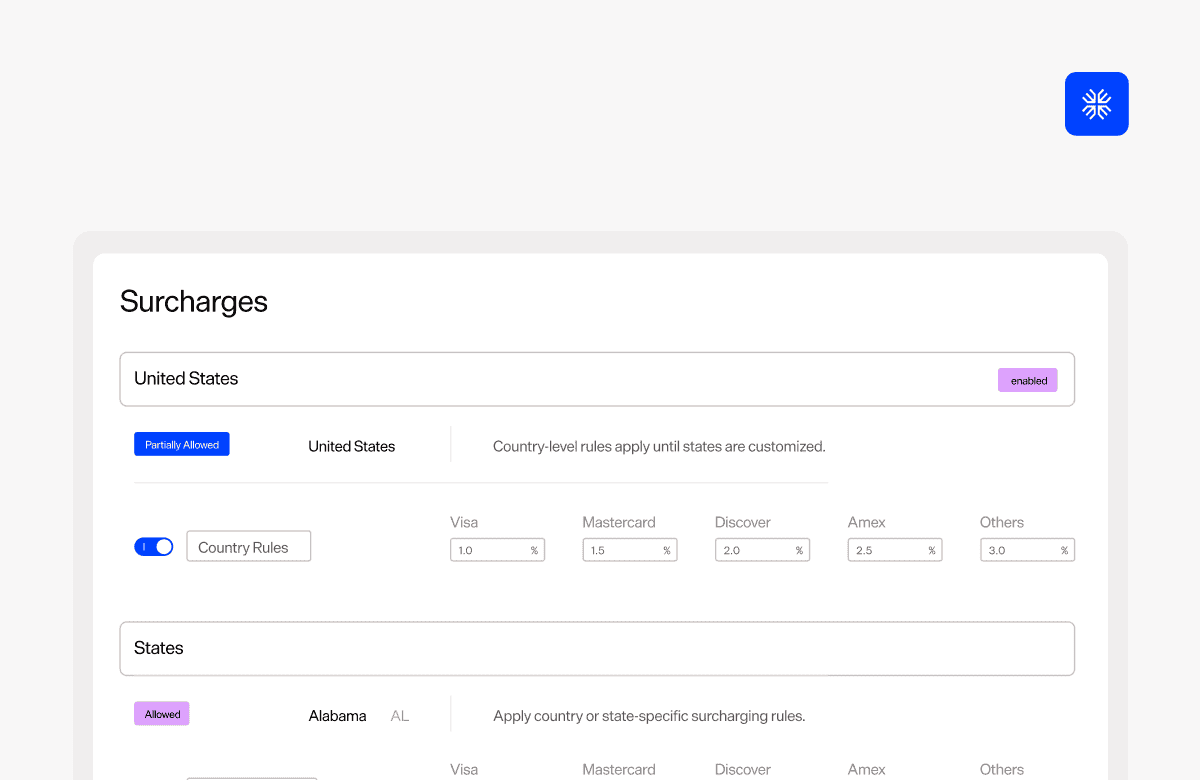
We built that logic into Maxio Payments, the first surcharging engine designed specifically for B2B subscription businesses, native to the platform rather than a switch bolted on after an acquisition. It handles each of those requirements directly:
- Rates by state and card brand, set from a finance-friendly interface with no code required.
- Cost of acceptance calculated for you in every jurisdiction, so you’re configuring against a real number instead of guessing at the cap.
- State-specific handling flagged automatically, with the checkout disclosure language generated for you.
- Payment-method detection on the back end, so a debit card entered in the credit card field drops the surcharge on its own.
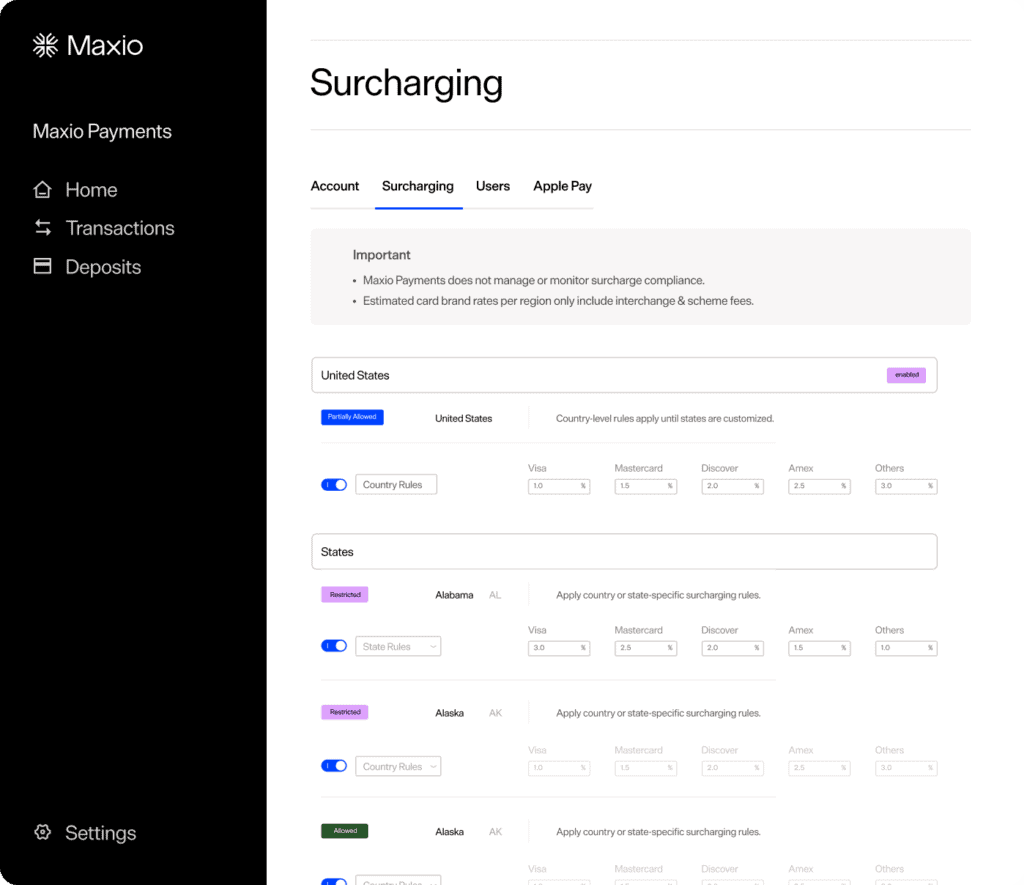
One important note: Maxio Payments surcharging is a configuration tool, not a legal or compliance service. We recommend consulting legal counsel to confirm your approach meets the requirements that apply to your business.
The Subscription Billing Accounting Problem Most Surcharging Tools Miss
Reconciling cash at scale is its own discipline. You’re handling thousands of transactions, many of them for small amounts, and the books only stay clean if the system is doing the tie-out for you. This is the part of surcharging that never makes the sales deck, and it’s the part most tools quietly ignore.
Surcharging adds a wrinkle that sounds trivial and isn’t. You issue an invoice in March. You close March. The customer pays in April, and the payment now carries a surcharge that was never on the March invoice. The cash coming in doesn’t match the invoice that went out, and it’s landing in a period you’ve already closed. Reconcile that wrong across a few thousand accounts and you’ve traded a fee problem for a month-end problem.
A system built for this detects whether the invoice sits in an open period or a closed one. When the period is still open, the surcharge posts as a separate line item on the original invoice. When it’s already closed, Maxio creates a separate invoice for the delta between the original amount and the surcharge, ties it back at reconciliation, and clears the whole thing when the deposit hits the bank. Everything syncs down to your GL, whether you close in QuickBooks, Xero, NetSuite, or Intacct, so the tie-out is the system’s job and not your team’s.
This is the difference between surcharging that recovers margin and surcharging that just relocates the headache, and it’s the reason we built ours into the invoicing engine rather than onto the edge of it.
Is Credit Card Surcharging the Right Move for Your Subscription Business?
Surcharging isn’t the right move for every business. Here’s where it fits and where it doesn’t.
It’s worth a serious look if you’re running $100,000 or more a month in card volume, if processing fees are large enough to show up as their own line on the P&L, or if you need margin back and you’ve already pushed pricing and headcount as far as they’ll reasonably go. It’s probably not your problem if most of your customers already pay by ACH or check, or if your card volume is low enough that the fees haven’t started to sting.
The companies we’ve seen turn it on are recovering 80% or more of their credit card processing costs, which is real margin at exactly the moment margin is hardest to find, when the easy cuts are already gone. The point was never to save on fees so you could turn around and spend more on them. It’s to take a cost most of our industry agreed to stop looking at and put it back under your control.
Getting started is quicker than most people expect. Surcharging runs through Maxio’s invoicing suite, so if you’re already on Maxio Payments, we turn it on for your account, help you add the disclosure, and you can be live in about 30 days. If you want to see what the recovery math looks like against your own numbers first, our team has been running that analysis for a long time. Reach out to your account manager, or contact us at sales@maxio.com.
See How it Works
If those numbers are worth chasing, see how surcharging works with Maxio Payments. If you’d rather see the mechanics live, our CFO Jon Cochrane recently walked through the whole thing, configuring by state and card brand, showing the checkout disclosure, and following an invoice all the way to the GL to show how it handles the open-and-closed-period problem. Check out the recording.
FAQs
Q: What is credit card surcharging?
A: Credit card surcharging is the practice of passing some or all of the credit card processing fee, typically 2 to 4% per transaction, on to the customer at the time of payment. It is legal in 47 U.S. states and is already common in retail and service businesses. For B2B subscription businesses, surcharging allows finance teams to treat credit card processing fees as a business decision rather than a fixed cost of doing business.
Q: Is credit card surcharging legal for subscription businesses?
A: Yes. Credit card surcharging is permitted in 47 U.S. states. Businesses must provide upfront disclosure at checkout and again on the invoice itself, ensure the surcharge only applies to credit cards (not debit cards, prepaid cards, or ACH payments), and comply with card network rules and any state-specific requirements. A purpose-built surcharging solution handles this compliance logic automatically, which is especially important for subscription businesses with buyers across multiple states and card brands.
Q: Can you surcharge debit cards or ACH payments?
A: No. Surcharging only applies to credit cards. Debit cards, prepaid cards, and ACH or bank payments cannot be surcharged. This distinction has to be detected on the back end. If a customer enters a debit card number in the credit card field, a compliant subscription billing platform will automatically remove the surcharge. Managing this manually at scale is not practical, which is why back-end payment method detection is a core requirement of any legitimate surcharging solution.
Q: When does credit card surcharging make sense for a B2B SaaS company?
A: Surcharging becomes meaningful for B2B SaaS and subscription businesses when credit card processing volume reaches approximately $100,000 or more per month. At that scale, processing fees of 2 to 4% represent a significant P&L line item, potentially hundreds of thousands of dollars annually for a business processing millions in card volume. Companies adopting surcharging through Maxio Payments have recovered more than 80% of their credit card processing costs, making it a high-impact lever for protecting margin without changing pricing or headcount.