
What is churn?
Customer Churn: Causes, Benchmarks, and How to Reduce It

Customer churn is one of the most closely monitored SaaS metrics because it touches nearly every part of the business. From growth planning to forecasting and investor conversations, churn shapes how SaaS companies understand performance and risk over time.
This guide breaks down how churn is measured, analyzed, and applied across SaaS teams. You’ll find clear explanations, practical examples, and common benchmarks to help you interpret churn data and use it more effectively as your business scales.
Key takeaways
- Customer churn impacts revenue, growth, and valuation, making it a core metric for SaaS businesses.
- There is no universal “good” churn rate, since benchmarks vary by SaaS model, customer type, and pricing structure.
- Tracking multiple churn metrics provides better insight than relying on a single churn rate.
- Early churn signals offer more value than cancellation data alone and allow teams to act sooner.
- Reducing churn depends on product fit, clear onboarding, fair pricing, and reliable customer support.
What is customer churn?
Customer churn, also called customer attrition, measures the frequency at which customers stop using a product or service within a specified time frame. It includes cancellations, non-renewals, and inactive accounts. Churn is typically shown as a percentage and is used to track customer retention over time.
This financial metric gives teams a consistent way to monitor changes in the customer base and compare performance across different periods.
Why customer churn matters for SaaS businesses
Customer churn directly affects revenue stability and growth in SaaS. Since most revenue comes from subscriptions, losing customers reduces predictable income and lowers the long-term return on new customer acquisition. Even small increases in churn can compound over time and affect your bottom line.
Churn also helps surface areas that need attention and highlights where customer loyalty may be weakening over time. Patterns in churn can point to issues with onboarding, pricing model, product fit, or support, helping teams focus retention efforts where they matter most.
How churn is used in SaaS businesses
Churn is used in SaaS finance to support customer lifetime value models and revenue, bookings, and cash flow forecasts. A single churn rate is often used for external reporting and high-level discussions.
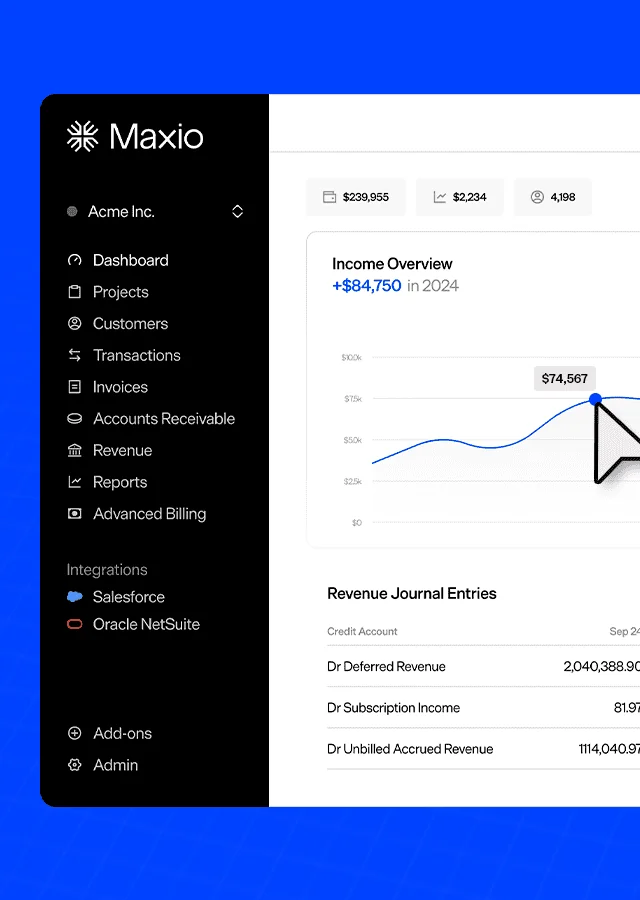
Maxio tracks customer churn, MRR churn, ARR churn, and net churn in a single metrics dashboard — so teams can monitor all churn types simultaneously without managing separate spreadsheets or reports.
For internal decision-making, teams rely on more detailed churn metrics. These revenue metrics are defined clearly, measured consistently over monthly or quarterly periods, and analyzed across cohorts such as:
- Marketing campaigns or promotions
- Specific products or features
- Length of the sales cycle
- How customers use the product
- Licensed modules
- Sales channels or sales teams
- Industry or market segment
- Customer size
- Total contract value or revenue per customer
Breaking churn down this way helps teams understand what is driving customer loss and make decisions based on actual customer behavior rather than averages.
Subscription management software like Maxio tracks every cancellation, non-renewal, and inactive account in real time — so churn is captured the moment it happens, not discovered at month-end.
How to calculate customer churn
To calculate customer churn, compare the number of customers at the beginning of a period to the number at the end.
Customer churn rate = (Customers at the beginning of the period – Customers at the end of the period) ÷ Customers at the beginning of the period
This formula is most often used to calculate monthly churn, but it can also be applied to quarterly or annual churn by changing the time period.
Types of customer churn to monitor
Not all churn tells the same story. Different types of customer churn highlight different risks and behaviors, which is why SaaS teams track more than one churn metric. Looking at churn from multiple angles helps teams understand what is driving customer loss and where to focus retention efforts.
- Customer churn: The percentage of customers who cancel or do not renew during a given period. This shows how many customers are leaving.
- MRR churn: The percentage of monthly recurring revenue lost from existing customers in a period, excluding any new sales. This shows how churn affects recurring revenue.
- ARR churn: The percentage of annual recurring revenue lost from existing customers over a set period, showing how much long-term revenue is being lost due to churn.
- Revenue churn: The total amount of recurring revenue lost from churned customers over a period. This highlights the financial impact of customer loss.
- Gross churn: Churn measured without factoring in expansions or upgrades. This reflects total customer or revenue loss before any offsets.
- Net churn: Churn measured after accounting for expansions, upgrades, or downgrades. This shows whether growth from existing customers offsets losses.
- Voluntary churn: Customers who actively cancel their subscriptions. This often points to issues with product fit or customer experience.
- Involuntary churn: Customers lost due to failed payments or billing issues rather than an intentional cancellation.
Monitoring these churn types together gives a more complete picture of retention. Instead of relying on a single number, teams can better understand why customers leave and take more targeted action to reduce churn over time.
When is a customer considered churned?
When measuring customer churn for operational performance, there is no single standard for when a customer should be counted as churned. Each business can define the timing based on how subscriptions and customer activity are tracked. These approaches often align with how new customers are counted, such as using the order date or the subscription start date.
For customer churn, the most common approaches are:
- On the date a customer gives notice of cancellation, even if the subscription remains active until a later end date
- On the official subscription end date, regardless of when notice was given
- On the date there is clear evidence that the customer will not continue, such as a contract breach, failed payment, or expired credit card on file
When churn is used for customer lifetime value calculations, the timing is more straightforward. A customer is considered churned when their recurring revenue contribution reaches zero. This method treats the customer as active until revenue fully ends, even if a cancellation notice was provided earlier.
Customer churn benchmarks by SaaS model
When assessing your company’s churn rate, context matters. Comparing your churn against the average churn rate for similar SaaS businesses is more useful than looking at the number on its own. What counts as acceptable churn varies by SaaS model, company size, and market.
Below are churn benchmarks across different software markets.
SMB SaaS
SMB-focused SaaS companies typically target 5%-7% annual recurring revenue churn. Businesses with lower-priced, high-volume subscriptions often accept slightly higher churn, as long as it stays within this range and supports sustainable growth.
Enterprise SaaS
Enterprise SaaS companies generally aim for 2%-3% annual ARR churn. Long-term contracts, complex implementations, and high switching costs often result in 90%+ year-over-year revenue retention, making lower churn a reasonable expectation in this segment.
Freemium SaaS
Freemium SaaS products usually experience higher churn among paying users. Because fewer than 5% of free users convert to paid plans and downgrades are easy, 5%-10% monthly churn for paid subscribers is common. These companies often offset a high churn rate through large user bases and ongoing access to new conversion opportunities.
Top causes of customer churn
Understanding why customers cancel their subscriptions is key to improving customer satisfaction and reducing churn. By reviewing customer feedback and analyzing product usage over time, SaaS companies can identify the most common reasons customers leave, including:
Poor product-market fit
When a product does not meet customer needs or solve their core problems, customers are more likely to leave for a better alternative. If a customer is not a strong fit, retention efforts have limited impact. This type of churn can be reduced by clearly defining who the product is built for, using customer interviews and cohort-level churn analysis to validate and refine that focus.
Example: A small business signs up for an enterprise-focused reporting tool and churns after realizing the setup and feature set are far more complex than they need.
Lack of value realization
Customers may churn when they do not see meaningful results from the product. If time to value is slow, such as when a tool has a steep learning curve, customers are more likely to cancel and look for an easier option. Reducing this type of churn often depends on strong SaaS customer success efforts, including clearer onboarding, better in-product guidance, and accessible training resources.
Example: A customer cancels a design tool after a month because they never finish setup and cannot produce usable assets quickly.
Pricing and packaging misfits
Customers may churn when subscription pricing or packaging no longer matches how they use the product. This can happen if they are on the wrong plan for their usage or if costs rise as their needs grow. Flexible pricing structures, tiered plans, and add-on options can help better align offerings with different customer segments and reduce this type of churn.
Example: A growing team exceeds usage limits on a lower-tier plan and churns instead of upgrading due to a sharp price jump.
User experience issues
Customers may churn when a product is difficult to use or navigate. Confusing workflows, complex admin interfaces, and steep learning curves can create friction that pushes users toward simpler alternatives. As SaaS markets become more crowded, a clear and intuitive user experience plays a major role in retaining customers.
Example: A user abandons a project management tool after struggling to complete basic tasks without extensive training.
Lack of support and service
Customers are more likely to churn when support issues go unresolved or response times are slow, which can weaken customer relationships over time. Ongoing bugs, limited access to support, or unclear communication can quickly erode trust. Clear service level agreements, priority support for higher-tier customers, and well-maintained help documentation can improve the support experience and reduce churn.
Example: A customer cancels after repeated billing issues go unresolved for weeks with no clear response from support.
How to identify customers at risk of churn
The most effective way to reduce churn is to catch it early. That means using SaaS churn prediction to identify at-risk customers who show signs of disengagement before they cancel. Instead of relying on late signals like failed payments or cancellation requests, SaaS teams should watch for early indicators that suggest a customer may be at risk.
Common signs of churn risk include:
- Declining product usage: Logins drop, key features go unused, or activity slows over time compared to earlier behavior.
- Low feature adoption: Customers never adopt core features or fail to expand usage beyond basic functionality.
- Missed onboarding milestones: Customers do not complete setup steps or early success markers tied to long-term retention.
- Increased support volume or unresolved tickets: Repeated issues, long resolution times, or unresolved bugs can signal frustration.
- Changes in account engagement: Fewer responses to emails or disengaged account owners may indicate reduced interest.
- Billing or contract changes: Downgrades or questions about contract terms can point to uncertainty or budget pressure.
By monitoring these signals consistently, teams can intervene earlier with targeted support, education, or plan adjustments. Catching churn risk before it turns into a cancellation gives SaaS businesses more opportunities to retain customers and protect recurring revenue.
How to reduce customer churn
Reducing churn means making it easier for customers to succeed, prevent cancellations, and win back customers who leave for fixable reasons. The actions below focus on changes teams can make within the product and customer experience.
Improve onboarding and time to value
Customers are more likely to stay when they understand how the product fits their workflow early on. Onboarding should focus on the features that matter most to each customer and help them reach a clear first win. Removing unnecessary steps and confusion early can reduce churn later.
Monitor product usage and engagement
Product usage data, often used in predictive churn models, shows where customers spend time and where they drop off. Reviewing this information regularly helps teams identify gaps in adoption and areas where customers may need additional guidance or support.
Align pricing with customer needs
Churn can increase when customers feel their plan no longer matches how they use the product. Pricing structures should support changes in usage over time and allow customers to move between plans without friction.
Strengthen customer support and communication
Consistent support builds confidence in the product. Customers are more likely to stay when issues are resolved clearly, and communication sets realistic expectations around response and resolution.
How customer churn impacts valuation and funding
Customer churn affects long-term revenue, customer lifetime value, and company valuation. Because SaaS revenue is recurring, higher churn reduces the amount of revenue a business can expect to earn from each customer over a specific period of time.
For example, a SaaS company with a strong customer retention strategy may generate several years of revenue from each customer, supporting a higher valuation. If churn increases, those revenue streams shorten, lifetime value drops, and projected future revenue declines. As a result, investors view the business as higher risk and often apply lower valuations or stricter funding terms.
Track customer churn with Maxio
Accurate churn tracking depends on clean subscription data. Maxio calculates churn in real-time directly from subscription financial records, which allows teams to measure both logo churn and recurring revenue churn with confidence. Because this approach is based on validated financial data, it avoids the inconsistencies that often come from manually tagged records in CRMs or spreadsheets.
If you’re looking for a more reliable way to track key SaaS metrics and better understand customer churn, SaaS reporting tools like Maxio can help. Schedule a demo to see how it works in practice.